
 Membership
 Network
 Regional Sites & Affiliates


 Events
 Participate
 Resources

 Training
 Credentials
 Government


 Content Channels
 Tools
Tools


 Business Overview





Access Control
Tracking mileage for intelligent FM

Historically, access control has been confined to a binary function of unlocking doors. However, in the today’s data-driven era and the development of large-scale facilities, this siloed approach creates operational friction that is no longer sustainable for modern organizations. Imagine a multitenant high-rise building where various tenants experience a peak of hirings and new accessing credentials must be issued.
The transition toward digital access management breaks through fragmented logs across organizations and departments, transforming a routine administrative register into a source of real-time intelligence. In this new ecosystem, access control evolves from a simple gatekeeping procedure into a real-time platform where facility managers orchestrate operators and digital workflows, enabling optimal operations, agile response to new events and predictive maintenance based on accurate facility usage.
The "odometer" problem: Why stationary assets are managed blindly
The mantra of modern management states that "what cannot be measured, cannot be maintained." In the automotive world, the odometer is the absolute parameter for maintenance. It dictates service routines, justifies budgets and prevents catastrophic failures by providing a data-driven trigger for action.
There is a stark contrast between the management of mobile and stationary assets. While a mid-range vehicle provides a dashboard with precise usage metrics, multi-million-dollar real estate assets often lack a centralized odometer. FMs operate based on static estimations or calendar dates rather than real wear and tear. This creates a blind spot where resources are either wasted on premature maintenance or lost to reactive repairs following an unexpected failure.
 The critical metric for any modern administrator is knowing precisely how many people use a property on a daily, weekly or monthly basis.
Deconstructing operational friction: The cost of the status quo
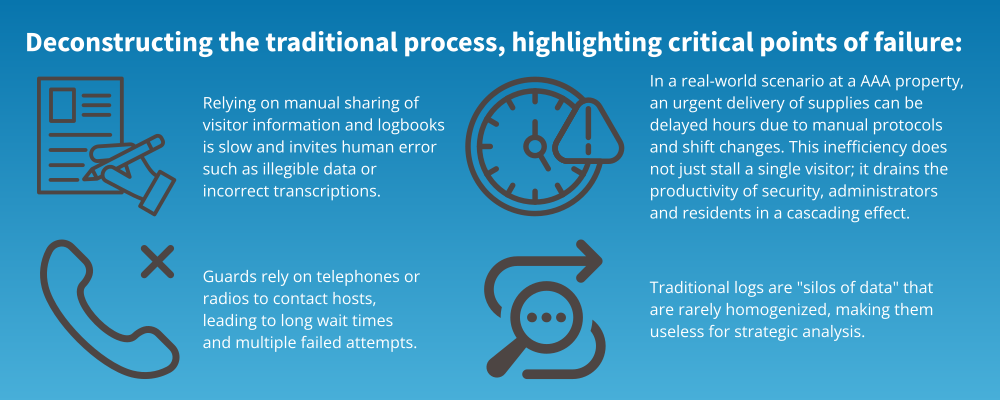
The traditional gatekeeping model forces lobby staff to operate in a state of low situational awareness. These front-line personnel function without anticipatory data; they often only learn of a visitor’s identity or the purpose of a delivery at the moment the individual arrives at the checkpoint. This reactive state forces security staff to spend a significant portion of their time on manual data capture — checking physical IDs, transcribing details into logbooks and making confirmation calls with each host, rather than focusing on their primary mission of security and verification.
When front-line staff lack a digital connection to the property's hosts or residents, they are effectively data islands. This lack of visibility leads to bottlenecks where security personnel must pause operations to make multiple phone calls or radio transmissions to verify an entry, often resulting in long queues and frustrated visitors. By operating without a synchronized data flow, the personnel responsible for the first point of contact cannot distinguish between a high-priority service provider and a routine visitor until the friction of manual registration has already been introduced.
To transition toward intelligence, organizations must first address the friction inherent in current systems. Traditional access control is often a singular purpose tool, such as cards, fingerprints, or tags, designed only for those already registered in the visitor management system. It ignores the critical pre-registration phase and the scenario where massive volume of temporary visitors occurs.
The back-office labyrinth in multi-tenant properties
The complexity of access management is significantly exacerbated in multi-tenant properties, such as corporate towers, mixed-use plazas and industrial parks. In these environments, FMs must coordinate an intricate back-office labyrinth involving multiple independent organizations, each with its own internal policies and stakeholders.
The current state of fragmented management involves a chain of disconnected actors: the building administrator, various tenant companies, independent security firms and third-party facility service providers. In a manual environment, information regarding an authorized visitor must pass through several hands — often via email chains or physical lists — before reaching the guard at the gate. If a tenant changes a meeting time or a provider sends a different driver, the manual log immediately becomes obsolete, leading to the hidden costs of delays.
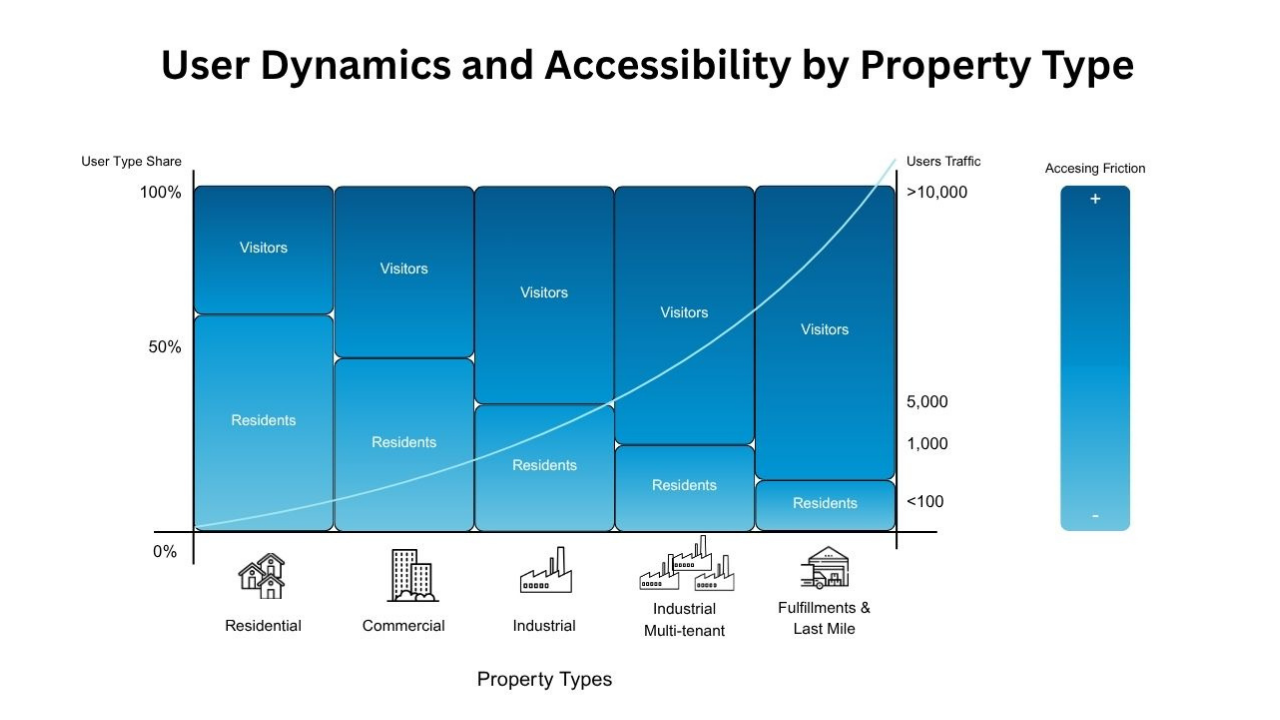
In multi-tenant industrial parks, the ratio of visitors to residents could be particularly high, this creates a high-pressure environment where the lack of a centralized digital self-registry results in redundant checks; a visitor might be registered at the main perimeter gate, only to be forced to repeat the entire process at a specific tenant's warehouse or the central lobby desk. This labyrinthine process not only drains the productivity of the administrative staff but also compromises the security of the property by increasing the likelihood of human error during manual data entry.
 The business & strategic shift: From CapEx to OpEx
A significant transformation should occur in where organizations allocate the value of access control, in the hardware or in the data. Traditionally, access control was viewed as a capital expenditure (CapEx) investment, requiring heavy upfront costs for specialized hardware, servers and complicated on-site installations. These systems used to become rigid and obsolete as the property's needs evolve, leading to high maintenance costs and actionable data debt.
Modern FM should approach access control as an information service shifting toward an operational expenditure (OpEx) model, primarily through subscription-based services. This transition allows FMs to access top-tier technology with lower entry barriers and flexibility to scale according to actual property usage. This financial shift parallels a necessary change in frameworks for original equipment manufacturers (OEMs) of gates, cards and readers. Hardware manufacturers must evolve from seeing their products as standalone security silos and instead design them as integral components of a broader digital ecosystem. In this new reality, the value lies not just in the physical lock, but in the software that orchestrates the flow.
Access as a digital concierge
As systems evolve, the access point is no longer a simple barrier; it becomes a digital concierge that simultaneously serves all stakeholders. This platform-based approach acts as a service facilitator that connects end users, FMs, operators, visitors and security in a unified digital thread. For a visitor, the concierge provides a fluid, self-guided pre-registration experience. For the security team, it provides the situational awareness needed to perform validations instantly. For the FM, it organizes all operational data by property or tenant in real-time, providing a transparent view of the building's daily performance.
Dynamic resource management
A major gain in operational efficiency occurs when access data is used to orchestrate physical resources, such as parking availability. In the modern corporate landscape, many organizations have implemented hybrid work " policies, leading to fluctuating daily occupancy levels.
In a traditional setup, visitor parking is often a static allocation, which can lead to phantom occupancy — where parking spots reserved for usual tenants remain empty while visitors are turned away or forced to wait. By leveraging a digital concierge that tracks real-time usage and captures pre-registration data, FMs gain a precise understanding of daily occupancy. This intelligence allows for the dynamic reallocation of resident parking spots for visitor use in real-time, transforming parking from a rigid asset into a flexible, data-driven service that responds to actual behavioral patterns.
Shifting the focus: From registration to user experience
The implementation of self-check-in and automated pre-registration allows properties to bypass the need for manual logs at every checkpoint. When a visitor can complete their own registration — submitting documents and photos before arrival — they arrive at the property with a validated digital identity.
This automation has a profound effect on FM role personnel. Instead of acting as administrative capturists who spend hours hunched over logbooks, security guards and receptionists are empowered to become experience hosts focusing on high-value activities such as providing personalized experiences for residents or performing strategic safety verifications for service providers, rather than just performing data entry.
Leadership, upskilling & change management: The true frontier of implementation
AI-powered software represents a substantial leap of capabilities of traditional software, from large information repositories to an operational assistant and a source of intelligence. This evolution challenges the traditional soft and hard cost parameters to assess the cost/benefit ratio of digital access systems these days.
While the technological tools for digital access are now mature and accessible, the cornerstone for successful adoption is no longer the technology itself, but leadership and change management. Technology is rarely the primary failure point; rather, it is the rigid, silo-based frameworks of different organizations and departments that prevent transformation.
Successful implementation requires leaders who can bridge these silos. A strategic roadmap involves the alignment of incentives, ensuring that digital transformation objectives are integrated into performance evaluations so that the human factor supports rather than hinders the new system. Leadership must also establish a two-velocity strategy, allowing a dedicated team to focus on rapid adoption and innovation while the daily operational team maintains stability.
The power of data intelligence: Understanding user behavior
The potential of data intelligence lies in understanding real usage patterns within a property. Every digital access event serves as a data point in the building’s odometer, providing a factual basis for management decisions. Analyzing the dynamics of flow allows for:
-
Predictive maintenance: Knowing exact mileage of assets like elevators to prevent failure.
-
Space optimization: Redesigning flows based on high-traffic peaking data.
-
Behavioral trends: Optimizing utilities like HVAC and cleaning schedules based on real-time demand.
Human-centered access experience
The era of access control as hardware with a mere gatekeeping function or a static checklist is over. In the modern landscape, the ability to orchestrate flows and capture high-fidelity data is the primary differentiator for operational excellence.
The back-office labyrinth of disconnected actors is a structural problem that technology can reveal, but only leadership can solve. Successful implementation requires a cultural shift that aligns every department toward a shared digital goal. By moving from fragmented paper logs to a centralized, real-time dashboard and fostering a leadership culture that breaks down departmental barriers, FMs can finally orchestrate their assets with the precision of a high-performance machine while creating a seamless and personalized accessing experience for their clients, colleagues and end-users.

Eduardo Cabrera is an engineer and serial entrepreneur who leveraged his experience on the construction teams of iconic Mexico City projects to found KIN Services. Cabrera's interdisciplinary approach led him to develop technologies for intelligent checkpoint management, including a method patented at the USPTO in the United States. His ability to combine engineering, data, user experience, operations and business strategy earned him a place in Techstars, one of the world’s leading startup accelerators, where he solidified a vision for innovation with global impact. Today, he empowers organizations to move toward models that are smarter, more human-centric, and resilient.

Lucia Cabrera is a digital designer focused on creating clear, intuitive and functional visual experiences. She helps organizations communicate more effectively through platforms, applications, websites and visual materials that guide users seamlessly. With a background in graphic, web and interface design, she combines aesthetics and functionality to transform ideas into digital products that communicate for themselves. She drives communication and design initiatives at KIN Services, contributing to innovation and digital transformation projects.
References
Top image via Getty Images.
Read more on Risk Management and Facility Operations or related topics Occupant Safety , Risk Management and Operational Technology
Explore All FMJ TopicsRelated articles
-

A New Approach
Improving business continuity with alarm managementBy Brad Freeman09.09.2024 -

Beware of Growing Cyberthreats
Why it’s time for stronger facility cybersecurityBy Andrew Harris & Eric Headington10.30.2024 -

Going Up?
Keeping elevators safe & compliantBy Dave Myers & Doug Taylor11.06.2024
