
 Membership
 Network
 Regional Sites & Affiliates


 Events
 Participate
 Resources

 Training
 Credentials
 Government


 Content Channels
 Tools
Tools


 Business Overview





An FM’s Moisture-event Documentation Protocol
From first complaint to remediation closeout

Small leaks, condensation events and occupant reports rarely arrive as complete facility management problems.
They begin as scattered observations: a ceiling stain, a musty odor, a humidity complaint, a failed condensate line or a tenant report after heavy rain.
When those observations are not recorded consistently, facility teams can lose the timeline needed to prioritize work, scope vendors, communicate with occupants and defend capital decisions.
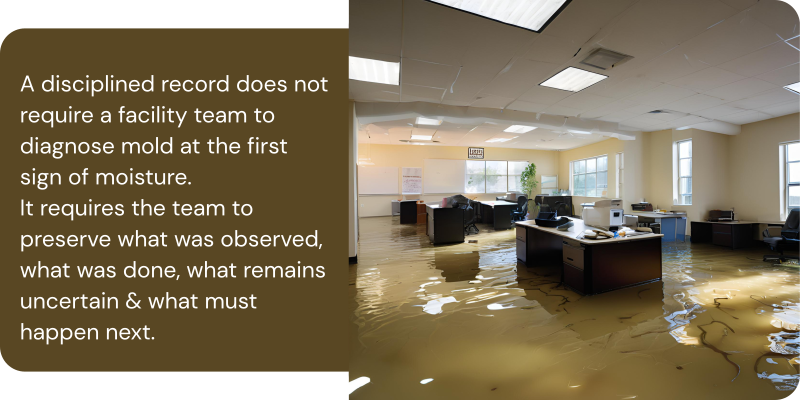
That distinction matters because moisture management, indoor air quality (IAQ) and remediation decisions involve different kinds of evidence and different responsibilities.
Start with an event record, not a conclusion
The first entry should describe the event without trying to explain it. A useful record captures the date and time, the person reporting the issue, the exact location, the reported condition and how the report was received. It should identify whether the observation followed rain, a plumbing failure, an HVAC problem, a cleaning event, a construction activity or an unknown cause.
The record should also note immediate actions. These might include isolating a wet area, protecting electrical equipment, stopping a leak, moving contents, placing warning signs or contacting an emergency vendor. The purpose is to show the sequence of decisions, not to create a dramatic narrative.
The same framework can be adapted to offices, schools, health care facilities, retail sites, industrial buildings and residential properties managed by an organization. Terminology, reporting duties and regulatory thresholds differ by jurisdiction, so FM teams should apply the protocol alongside local building, occupational-safety, public-health and environmental requirements.
FM teams should separate three statements:
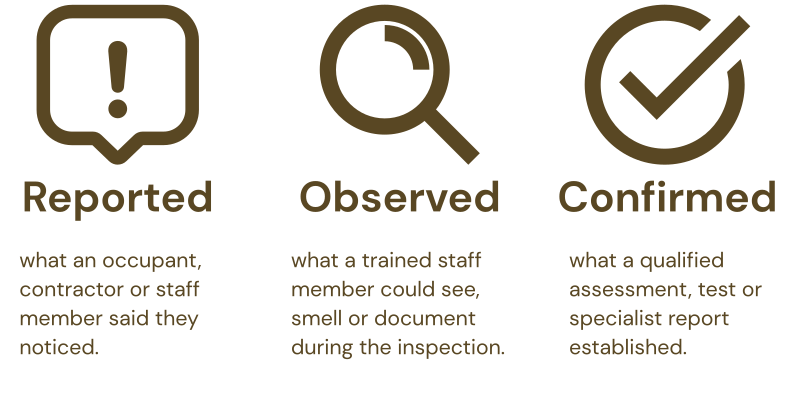
Keeping those categories separate reduces the risk of turning an odor report into an unsupported health or mold conclusion. The U.S. Environmental Protection Agency's (EPA) guidance on mold remediation in schools and commercial buildings emphasizes investigating moisture sources and correcting water problems as part of a broader remediation process.
 Build a location-specific inspection record
The first inspection should be repeatable by someone who was not present. A general statement such as “water damage found near the east offices” is less useful than a location-specific entry identifying the room, floor, wall or ceiling section, nearby mechanical equipment and the apparent boundary of affected materials.
Photographs can preserve conditions that change after drying or temporary repairs. Each image should have a date, location and direction of view. A simple sketch or floor-plan mark-up can show where photographs, readings and affected materials were located. If the building uses a computerized maintenance management system, the event record should connect those materials to the work order rather than leaving them in a separate email chain.
Moisture readings can be useful when they are recorded with the instrument type, units, date, location and comparison area. A number without context is difficult to interpret. Readings can vary with material, temperature, surface condition and instrument limitations. A record should therefore identify whether the reading is a screening observation, a comparison to a nearby dry area or part of a formal assessment. It should not imply that a meter alone identifies a mold condition.
The same principle applies to indoor humidity. A single reading may be a useful clue, but a series of readings across time and locations can be more informative for understanding building operation. EPA moisture-control guidance identifies design, construction and maintenance practices as important parts of controlling moisture in buildings.
Record temporary controls & limits
Temporary controls should be recorded as carefully as permanent repairs. The file should identify what was done, when it was done, who performed it, and what the action was intended to accomplish. Examples include stopping a water source, removing standing water, increasing controlled drying, relocating occupants, isolating materials or covering equipment.
The record should also state what the temporary action did not establish. Covering a stain does not prove that a cavity is dry. Removing visible material does not, by itself, establish that the moisture source has been corrected. Increasing ventilation does not automatically resolve a building-wide IAQ concern. Documenting those limits helps the next decision-maker understand why follow-up remains necessary.
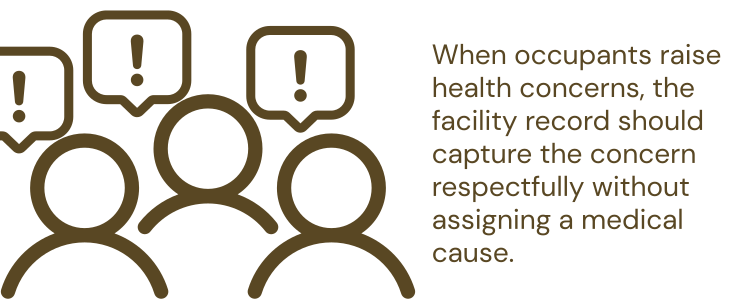
CDC and NIOSH materials describe potential health effects associated with damp or moldy environments, but individual health decisions belong with qualified health care professionals. A facility team's role is to document conditions, respond to building problems and communicate the steps being taken.
Use an escalation matrix
Not every moisture event requires the same response. A small, promptly dried area with a known source may be managed through routine maintenance if the organization’s procedures and applicable requirements allow. Escalation may be appropriate when the affected area is extensive, the source is recurring or concealed, porous materials remain wet, occupants are displaced, building systems are involved, sewage or contaminated water is present, or the cause cannot be identified.
An escalation matrix should name the decision-maker, the trigger and the next action. It can distinguish between maintenance review, building science or indoor environment assessment, industrial hygiene support, remediation planning, engineering review and specialized restoration. The matrix should not substitute for professional judgment or local requirements. Its value is that it makes the handoff visible and reduces delays caused by uncertainty about ownership.
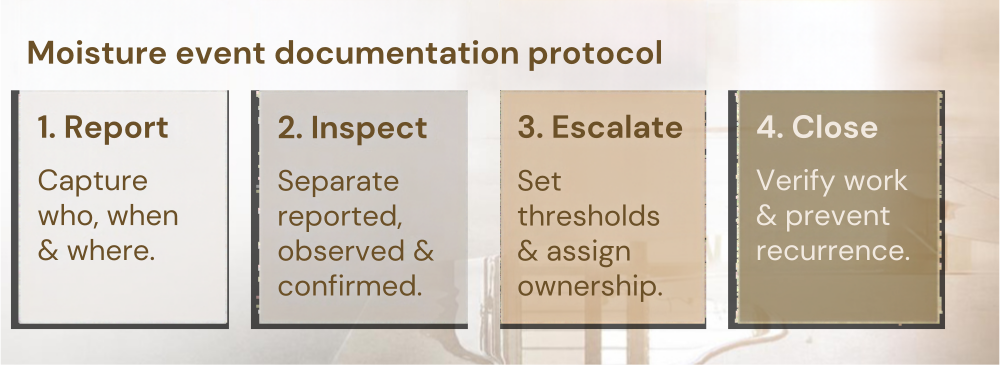 The file should preserve vendor qualifications, scope documents, assumptions, exclusions and change orders. A proposal that says “remove mold” without identifying the suspected source, affected materials, containment approach, drying objectives and verification steps may leave important questions unresolved. FMs can ask vendors to explain how the proposed work addresses the source and how completion will be documented.
Close the event with evidence, not just an invoice
An event is not necessarily closed when a contractor leaves or a work order is marked complete. The closeout record should identify the source correction, materials removed or retained, drying or cleaning work performed, areas that could not be accessed, remaining observations, and any recommended monitoring or repairs.
Post-work photographs can show the final condition. A completion record can link the final scope, invoices, readings, reports and communications in one location. If a qualified professional recommends clearance, verification or additional evaluation, that recommendation should be recorded with the responsible party and due date. The goal is not to create paperwork for its own sake. The goal is to leave the facility with a defensible account of what was known and what was done.
The closeout should also ask why the event happened. Did a roof drain overflow? Did a condensate line lack an alarm? Did a tenant improvement change airflow? Did a preventive maintenance task lapse? Did a previous repair address the visible damage but not the source? The answer may belong in a capital plan, a preventive maintenance schedule, a design review or a vendor management process.
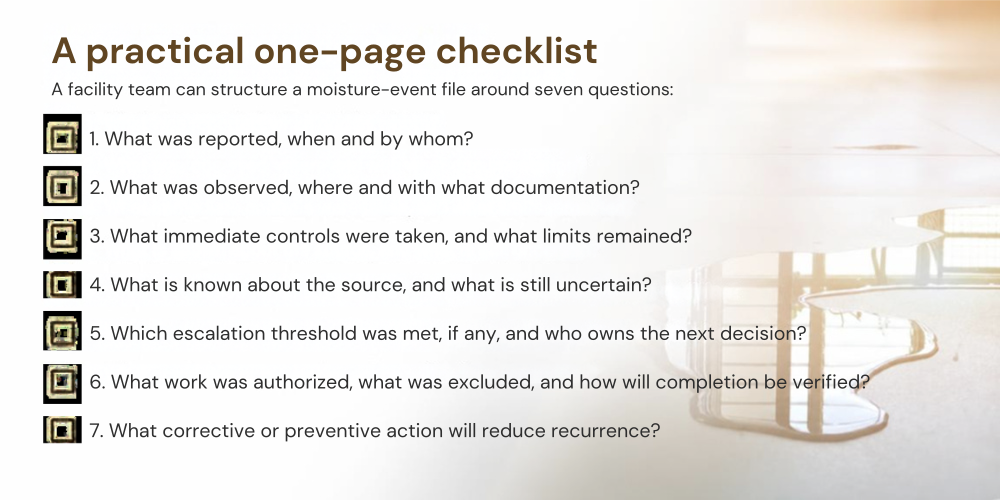 This structure can be used in a work-order system, a paper form or a shared facility record. It is intentionally evidence-based: observations are preserved, conclusions are attributed, uncertainty is visible, and decisions can be revisited.
Conclusion
Moisture events become expensive when the building problem and the documentation problem grow together. A consistent record helps facility managers coordinate maintenance, vendors, occupants, owners and risk teams before a small event becomes a larger capital or operational problem. It also supports a more careful conversation about mold and IAQ by keeping building observations, professional findings and health concerns in their proper places.

Meyer Stein writes about mold, moisture management and indoor air quality in buildings. His work with Northeast Mold Experts focuses on translating public-health and building-science guidance into practical, source-based resources for property and facility teams. He writes for audiences responsible for documenting moisture events, coordinating remediation and reducing recurrence.
References
EPA, Mold Remediation in Schools and Commercial Buildings: https://www.epa.gov/mold/mold-remediation-schools-and-commercial-buildings-guide-chapter-1
EPA, Moisture Control Guidance for Building Design, Construction and Maintenance: https://www.epa.gov/indoor-air-quality-iaq/moisture-control-guidance-building-design-construction-and-maintenance-0
CDC/NIOSH, Mold: https://www.cdc.gov/niosh/mold/health-problems/index.html
OSHA, Indoor Air Quality: https://www.osha.gov/indoor-air-quality
Top image via Getty Images.
Read more on Risk Management and Facility Operations or related topics Operations and Maintenance Planning , Facility Resilience and Emergency preparedness, response and recovery
Explore All FMJ TopicsRelated articles
-

A New Approach
Improving business continuity with alarm managementBy Brad Freeman09.09.2024 -

Beware of Growing Cyberthreats
Why it’s time for stronger facility cybersecurityBy Andrew Harris & Eric Headington10.30.2024 -

Going Up?
Keeping elevators safe & compliantBy Dave Myers & Doug Taylor11.06.2024