
 Membership
 Network
 Regional Sites & Affiliates


 Events
 Participate
 Resources

 Training
 Credentials
 Government


 Content Channels
 Tools
Tools


 Business Overview





Better Gatekeeping
Strengthening security amid rising threats

Facility managers in the industrial, entertainment and manufacturing industries are facing a convergence of security requirements. With organizations increasingly having more dispersed workforces across greater numbers of locations, traditional visitor management and access control approaches are proving inadequate to counter growing threats targeting intellectual property and business continuity.
The growing security threat
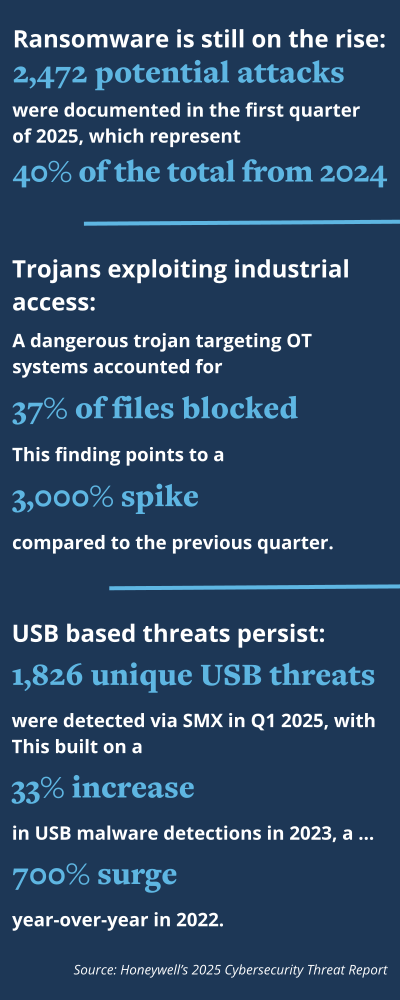
New data reveals the scope of the problem facing building managers. Honeywell’s 2025 Cybersecurity Threat Report found that ransomware attacks grew 46 percent in energy, manufacturing and other industrial sectors, while more than 75 percent of multilocation organizations now treat digital visitor management and centralized access control systems as a top budgetary priority.
The threat extends from cybersecurity to physical security weaknesses, and companies with geographically dispersed facilities have difficulty applying homogeneous security policies, particularly with revolving and contract workforces. In contrast, repeated compliance audits demand accurate, easily accessible records that are impossible with traditional pen-and-paper applications.
 Key security vulnerabilities
Major security vulnerabilities are some major areas that pose significant risks to organizational safety and compliance. Unreliable access controls across numerous locations provide opportunities for misuse by hostile individuals to gain unauthorized access. The risk is compounded by inadequate visibility of visitor movement and behavior between locations, and it becomes difficult to track and investigate potential security breaches in real time.
The organization is vulnerable to high intellectual property risk when unauthorized visitors pass through areas containing confidential data or trade secrets. In addition, compliance loopholes are created due to incomplete or biased record-keeping processes, which can cause regulatory violations and legal ramifications. Such security flaws are further augmented by operational inefficiencies caused by time-consuming, paper-based processes susceptible to human mistakes, creating additional vulnerabilities in the total security system.
Impact on the real world: Lessons from global deployment
The promise of innovation of new visitor management is revealed through real-world applications. Technicolor, a global creative network of 30 offices and 15,000 employees, was faced with traditional problems with their previous pen-and-paper visitor system: inconsistent procedures at locations, no easy notification process for guests and suboptimal security for production areas handling precious intellectual property. By adopting an electronic visitor management system (VMS), Technicolor experienced measurable gains:
-
40 percent decrease in administrative work time
-
NDA signing and visitor monitoring integrated for comprehensive intellectual property protection
-
improved audit preparedness through electronic documentation and analytics
-
seamless operations at all 30 global locations
-
improved visitor experience with streamlined, automated check-in procedures
Lauren Rios, IT project manager at Technicolor, saw the transformation: “Security is an important priority for our manufacturing plants. We needed a way to sign NDAs and enhanced visitor tracking for visitors to our plants.”
The electronic system now allows their security team to access easily and at a moment’s notice who comes into the building and if they have complied with required compliance protocols.
The strategic shift to smart workplace platforms
Modern VMS are not incremental advances over paper-based logs. They are a strategic shift toward smart workplace platforms that reconcile physical security with operational efficiency.
Key features of modern systems:
-
Role-based access management: Role-based access control (RBAC) enables high-fidelity permission assignment based on roles, reducing risks from over-provisioned and idle accounts geographically.
-
AI-based verification: Biometric and facial recognition technology enhances security and enables the possibility of self-healing access permissions. Mobile credentials can enable seamless entry to safe workplaces from smartphones.
-
Deep visitor screening: Advanced systems can screen visitors against internal blocklists, third-party watchlists and security databases to assess the likelihood of risks prior to building entry.
-
Automated compliance: Audit trails in electronic format and auto-reporting ensure that organizations are compliant with strict regulations like SOC2, ITAR and FSMA standards.
-
Real-time analytics: Visitor flow analytics provide facility managers with insights for optimizing security and facility capacity planning, which allows them to identify patterns and gaps.
Implementation framework
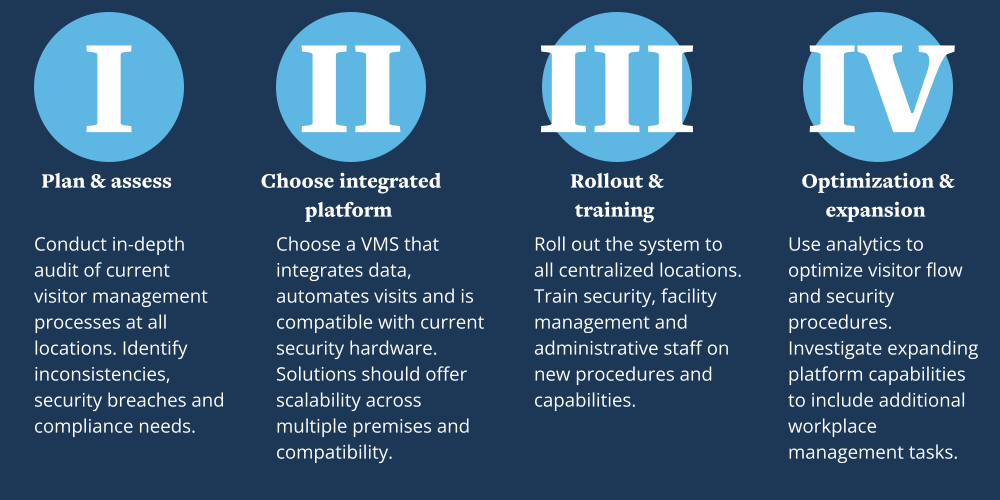
Organizations interested in enhancing facility security should implement a four-phased approach:
 Measuring success & ROI
Organizations using new visitor management software tend to see improvements in several areas, with measurable returns normally manifesting themselves within the first 12 months of implementation:
-
Security enhancements: Offers real-time threat detection and prevention through screening across multiple databases at once. Security policies have been standardized to all sites, essentially eradicating geographic vulnerabilities once in place. Real-time occupancy and facility access awareness functions facilitate immediate incident response in the event of security issues. These enhancements have yielded decreased security incidents as well as compliance audit results improvement throughout the organization.
-
Operational efficiency: Significantly enhances operational efficiency by reducing the administrative burden on reception and security staff, allowing them to apply their time to more value-added activities. Automated reporting functions have improved compliance and audit preparation work, reducing preparation time. The visitor experience has been significantly enhanced with spectacular streamlining and average check-in times conveniently reduced. In addition, elimination of paper-based processes has reduced space requirements for storage and administrative cost within the organization.
-
Cost optimization: Delivers significant cost optimization value across several channels, with most organizations benefiting from significant administrative cost savings through automation. Compliance improvements prevent organizations from potentially disastrous financial loss through lower penalties and audit failure. Visitor analytics enable improved resource deployment choices, with the potential to make more intelligence-informed staffing and space allocation decisions that maximize efficiency.
-
Quantifiable business impact: Deployments of revealed provide measurable ROI through different measurements. With its 40 percent reduction in administrative activities, cost savings are significant to their 30 global sites at Technicolor. Payback periods, as reported by most organizations, range from 12-18 months, factoring in labor savings, compliance improvements and protection from risks.
Industry-specific considerations
Certain industries possess specific challenges that affect VMS requirements: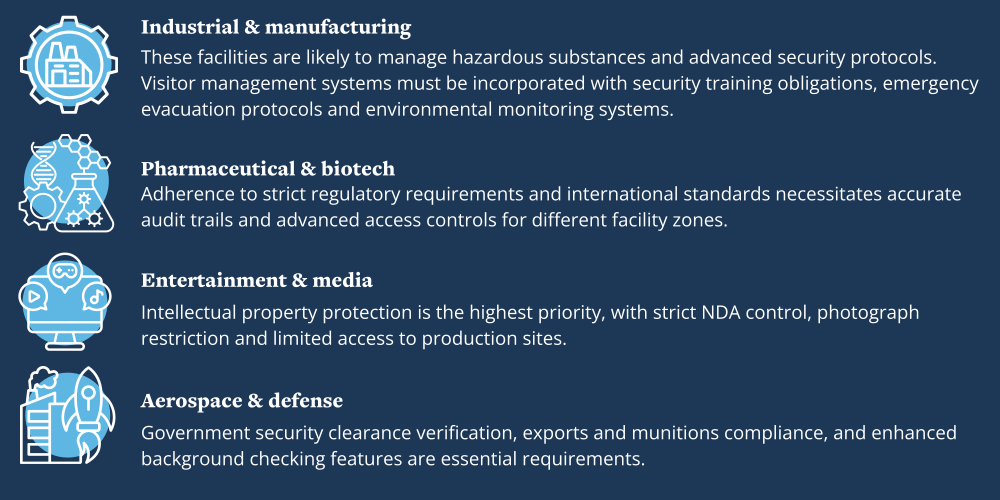
Looking forward: The evolution of facility security
Combining visitor management with more advanced smart workplace platforms is merely the beginning of facility security innovation. With businesses shifting toward hybrid work models and increasing security threats, physical access management systems will need to become more integrated and sophisticated.
Coming technologies will incorporate more integration with security platforms for cybersecurity, advanced AI-based threat detection, and between cyber and physical security systems. Emerging technologies such as behavior analytics, predictive threat modeling and response automation systems will enhance security functions without affecting the effectiveness of operations.
 Hybrid work model development also adds new VMS challenges. Companies manage more visitors with fewer employees on site having the same security credentials. Virtual front desk capability and touchless check-in become essential components rather than nice-to-have features.
Additionally, sustainability considerations are driving companies to become paperless and have effective power arrangements. Sophisticated visitor management software encourages business sustainability goals together with security and business benefits.
The inclusion of visitor management in broader smart workplace suites represents merely the tip of the facility security revolution iceberg. With continuing business migration toward hybrid work patterns and growing security needs, physical access systems will be forced to adapt and converge further.
Future development will entail increased integration with cyber defense infrastructures, more robust AI-powered threat detection, and easier communication between physical and virtual defense. Companies that initiate upgrading their VMS infrastructure today will be more likely to address these future requirements.
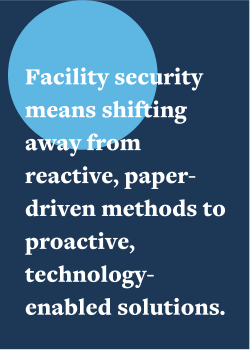
Facility security means shifting away from reactive, paper-driven methods to proactive, technology-enabled solutions. Organizations that install robust VMS are not only making their facilities safer – they are positioning themselves for improved, compliant and safer operations throughout their entire portfolio of facilities. The question is not if, but how rapidly can they implement security enhancements.

Rene Matawaran is a Senior Product Marketing Manager at Envoy, where he helps shape go-to-market strategy and bring new workplace solutions to market. With a background in digital infrastructure and cloud partnerships, Matawaran specializes in turning complex technology into clear, impactful stories that resonate with customers. He’s passionate about building strategies that empower organizations to stay connected, compliant and ready for the future of work.
Read more on Risk Management , Facility Technology & Data Management and Leadership & Strategy or related topics Cybersecurity , Physical Security and Occupant Security
Explore All FMJ TopicsRelated articles
-

A New Approach
Improving business continuity with alarm managementBy Brad Freeman09.09.2024 -

Beware of Growing Cyberthreats
Why it’s time for stronger facility cybersecurityBy Andrew Harris & Eric Headington10.30.2024 -

Going Up?
Keeping elevators safe & compliantBy Dave Myers & Doug Taylor11.06.2024