 Membership
 Network
 Regional Sites & Affiliates


 Events
 Participate
 Resources

 Training
 Credentials
 Government


 Content Channels
 Tools
Tools


 Business Overview




Beyond Comfort
FM’s role in workplace ergonomics & injury prevention

Facility managers carry the unique responsibility of ensuring safe, productive workplaces. Beyond managing the physical environment, they often play a pivotal role in supporting injury prevention by coordinating ergonomics initiatives. These efforts include space planning, furniture and equipment procurement, and overseeing ergonomic assessments and employee training.
According to the National Institute for Occupational Safety and Health (NIOSH), a complete ergonomics program typically includes six core elements. FMs support these elements through coordination, oversight and collaboration with vendors and internal teams:
1. Identifying ergonomic risk factors
Workplace ergonomic risks include awkward postures, repetition, forceful exertions (lift, push/pull, carry, grip), contact stress, vibration and cold exposure. Once ergonomic risk is identified and quantified, solutions to reduce or eliminate the risk are the next focus. From an ergonomics perspective, driving down both the frequency and costs associated with workplace musculoskeletal disorders (MSD) is often a top organizational priority.
FMs typically coordinate with internal safety team champions and external vendor ergonomics professionals to conduct assessments using validated tools such as the rapid entire body assessment (REBA), the NIOSH Lifting Equation or the Quick Exposure Checklist, to name a few.
Advanced tools, including AI-driven video capture ergonomics software, may be employed by specialists to analyze risk and recommend solutions. FMs play a vital role in understanding the jobs and tasks of greatest importance as well as in collaborating with vendor partners in the analysis and solutions trial process.
2. Engaging & training management & employees
Employee and management training is essential so that ergonomic risk factors and general principles of injury prevention can be provided. This is also an opportunity for employees to learn why proper workstation set up, equipment and body mechanics techniques are important for ongoing health and career longevity.
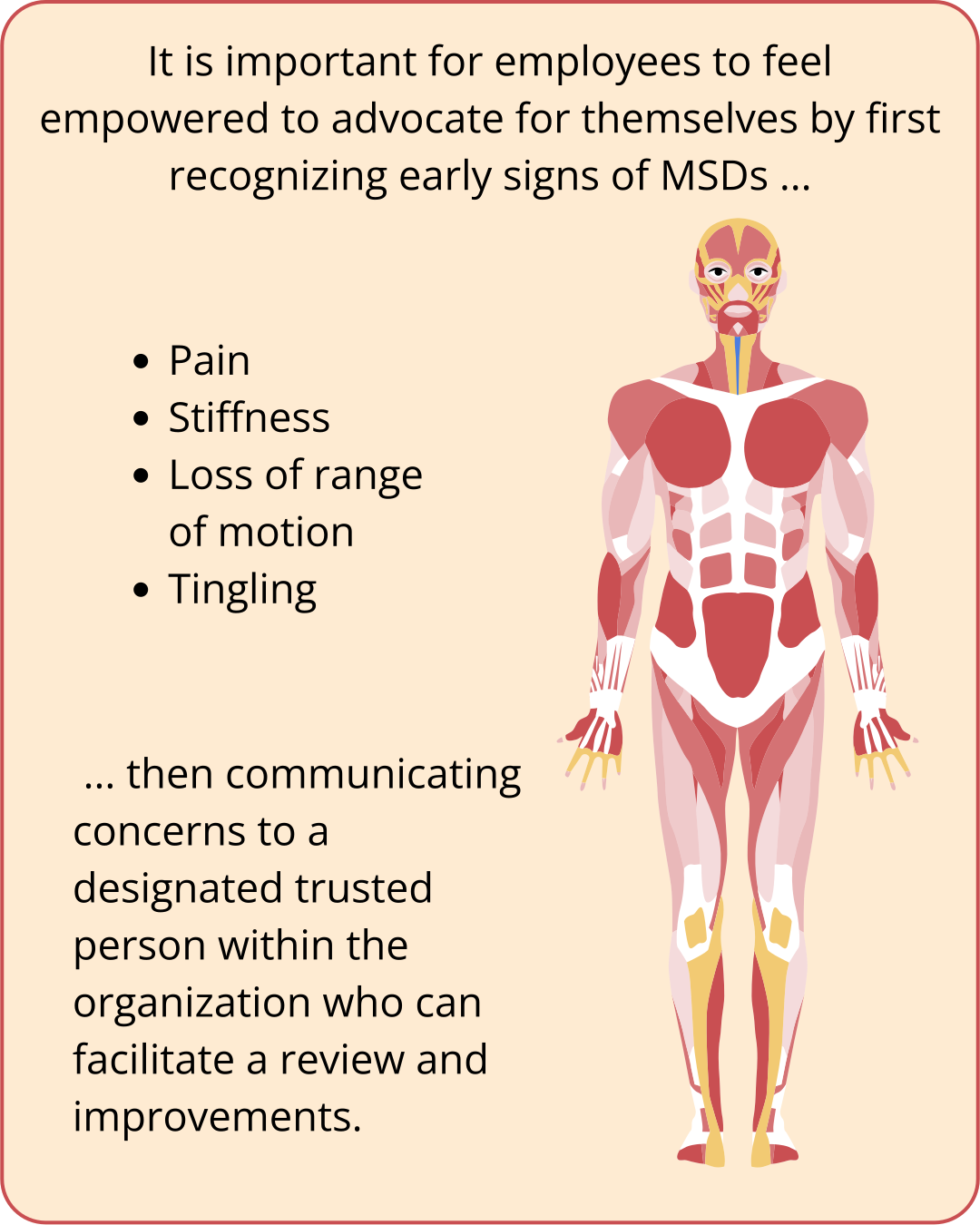
FMs support these efforts by coordinating with trusted occupational health teams, ergonomics vendors and internal safety champions. They ensure that training programs, onboarding modules and communication channels are implemented and accessible.
Providing a clearly documented and communicated process for reporting discomfort or workstation issues helps employees to be active participants in the injury prevention process.
3. Using data to drive decisions
Collecting and analyzing workplace injury data such as OSHA logs, workers compensation claims data, medical claims and space utilization records can help organizations identify high-risk jobs and environments. It is not unusual for sprain/strain and lifting injuries to be among the most common and costly forms of non-fatal workplace injuries. According to the most recent Liberty Mutual report, manual material handling accounts for almost US$14 billion in annual spending by industry. Pairing injury data with employee survey feedback, high-risk job tasks can be pinpointed for focused interventions.
FMs are uniquely able to provide input regarding building layouts, equipment usage and workflow patterns to help prioritize interventions based on the data.
4. Implementing & evaluating solutions
Solutions may include reconfiguring workspaces, procuring ergonomic furniture, integrating process improvements and implementing behavioral strategies such as stretch breaks or task rotation.
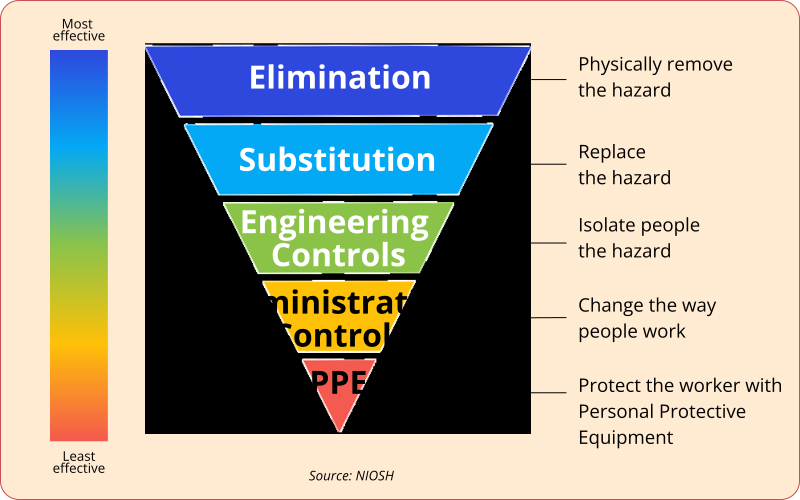
The OSHA Hierarchy of Controls provides a framework for prioritizing solutions from most to least effective, from engineering solutions like height-adjustable tables and ergonomic chairs, to administrative controls like job rotation and scheduling adjustments.
Providing ergonomic equipment such as high-quality workstations and state-of-the-art seating solutions is a critical engineering control that can significantly reduce the risk of workplace injuries. These investments in ergonomics support long-term employee health, comfort and productivity. FMs often play a key role in selecting and sourcing this equipment, working closely with vendors to ensure the implementation of solutions that meet both operational needs and ergonomic standards.
Sit-to-stand workstations are a prime example of effective ergonomic design. These adjustable work surfaces allow employees to alternate between sitting and standing throughout the day, which promotes blood circulation and helps keep body tissues properly oxygenated. This reduces the risk of discomfort and fatigue, particularly during prolonged periods of computer use. It is generally recommended that individuals change positions every one to two hours to maintain physical well-being and prevent musculoskeletal strain.
A critical component of an ergonomic workspace is a high-performance ergonomic chair.
5. Supporting recovery & well-being
Supporting employee recovery includes ensuring accommodations for returning workers, such as temporary workstation adjustments, alternative seating options or task modifications that allow for a safe and gradual return to work.
This approach fosters a culture of care and aligns with NIOSH’s Total Worker Health model.
 6. Ensuring ongoing management commitment
Ongoing leadership commitment is essential for sustaining ergonomic and injury prevention programs. Management support ensures ongoing versus sporadic funding, regular written policy updates and long-term success, including return on investment.
Research underscores the importance of this commitment: The American Psychological Association’s 2016 Work and Well-Being Survey found that employees who feel valued are 60 percent more likely to report being engaged and 69 percent less likely to report wanting to leave their jobs.
Conclusion: FMs as champions of ergonomics
An effective ergonomics and injury prevention program is not just about compliance — it is about creating healthier, safer and more engaged employees. FMs are central to this mission. By coordinating assessments, training and workplace improvements, safety principles are translated into real-world improvements. They further ensure management and staff are aligned and that employees are supported at every stage.
By working in collaboration with health and safety teams and vendor partners, FMs champion proactive strategies that reduce risk, improve morale and strengthen organizational performance. The result is a workplace where employees thrive, risks are reduced and organizations realize lasting value.

Dr. Julie Landis, DPT, CEAS, CEES, serves as the vice president of business development at Briotix Health. With nearly 30 years of experience, she has dedicated her career to partnering with employer clients to identify and achieve their musculoskeletal health and injury prevention goals. Landis has conducted thousands of ergonomic assessments and delivered training across diverse environments, including office, industrial, healthcare, research, and field-based settings in both the federal and private sectors.
References
Read more on Occupancy & Human Factors and Risk Management or related topics Occupant Health and Risk Management
Explore All FMJ Topics