
 Membership
 Network
 Regional Sites & Affiliates


 Events
 Participate
 Resources

 Training
 Credentials
 Government


 Content Channels
 Tools
Tools


 Business Overview





Beyond the Smoking Hole Scenario
Why mid-range risks pose a bigger threat than rare catastrophes

A subcontractor’s technician finishes a routine roof repair in March.
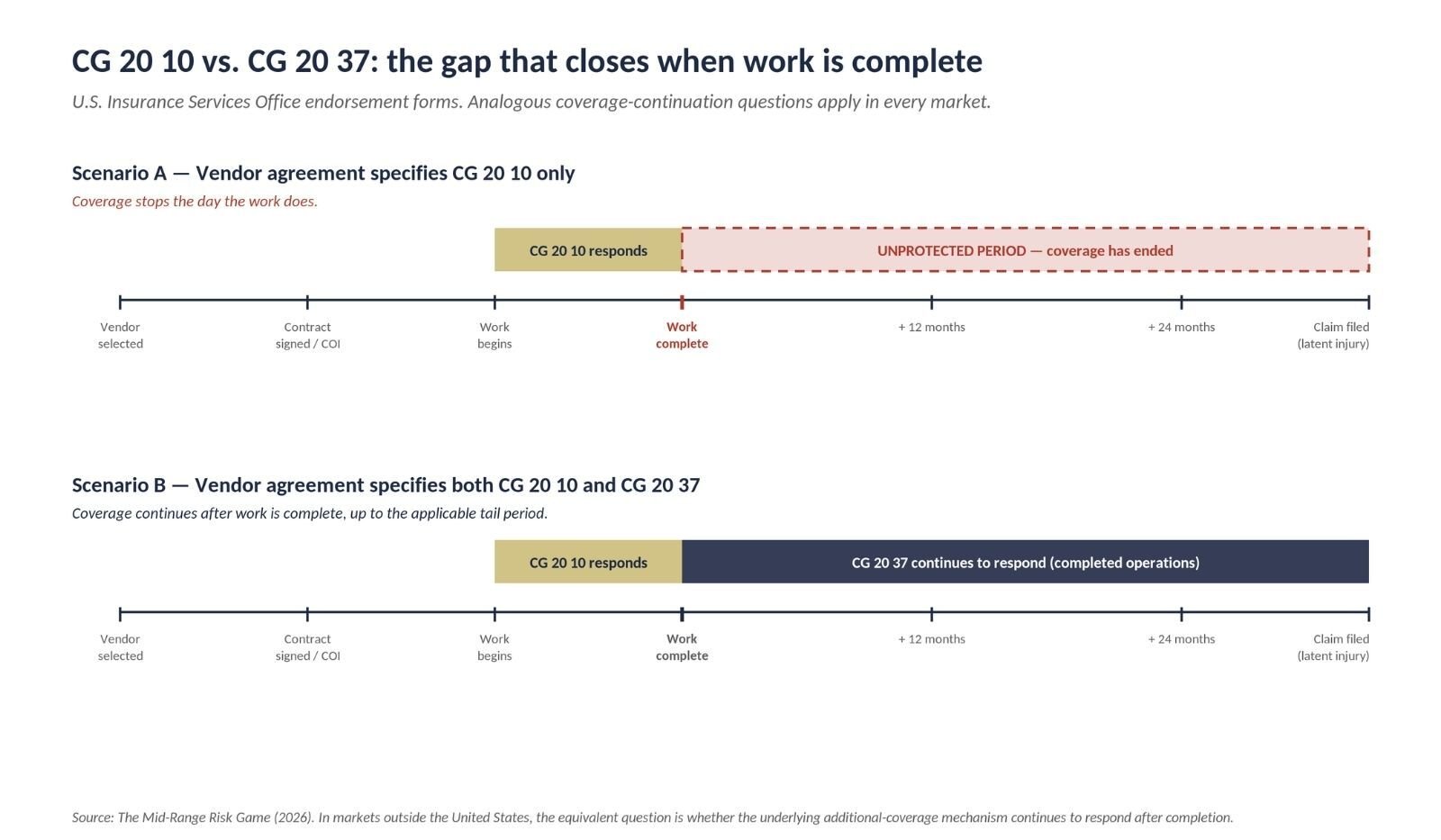
Eighteen months later, a stairwell leak causes a slip injury. General counsel pulls the file. The certificate of insurance is current. The contract requires “additional insured” status. The lawsuit names the building owner and the facility manager’s employer. The defense team checks the underlying policy and finds that the contractor’s additional insured endorsement covered ongoing operations only. Completed operations coverage was never added. Coverage for that job ended the same day the technician finished the project.
This is the mid-range risk profile that quietly drives a substantial portion of facility management loss portfolios. No fire, no flood, no act of nature. Just ordinary contracted work that matures into a claim because someone overlooked the documentation needed to transfer the risk.
The gap between what gets planned for & what gets paid for
FM programs allocate considerable attention to catastrophic scenarios. Business continuity exercises model utility loss, severe weather, civil disruption and what some practitioners call the “smoking hole” total site destruction to mitigate the risk of asset, financial and human life losses. These scenarios may be few and far between, but planning for them is essential.
The mid-range incident, however, is where financial loss is most consistent. The U.S. Bureau of Labor Statistics reported 2.5 million nonfatal workplace injuries and illnesses in private industry in 2024, alongside 5,070 fatal work injuries. Construction and extraction workers, those most often performing contracted work in commercial buildings, accounted for 1,032 of those deaths. Globally, the International Labour Organization estimates that construction work alone produces approximately 60,000 fatalities per year. In the European Union, slips, stumbles and falls represented 18 percent of all fatal and nonfatal work accidents in 2022.
Slip-and-fall incidents, the workhorse mid-range exposure, generate consistent claim activity in commercial settings. The U.S. National Council on Compensation Insurance reports an average workers’ compensation claim of approximately US$54,000 for fall injuries; and the U.S. National Institute for Occupational Safety and Health puts annual workplace slip-and-fall costs at roughly US$70 billion. These figures describe contained incidents, not catastrophic ones.
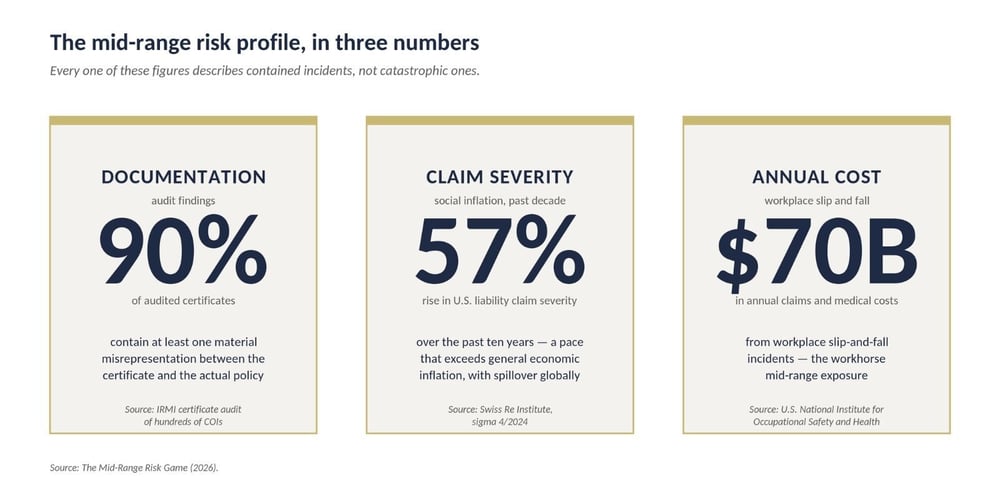 The financial picture has shifted in the past five years. Social inflation, or the phenomenon in which insurance claims costs rise due to changing societal attitudes, has affected the cost of claims. Swiss Re reports that liability claim severity in the U.S. has risen 57 percent over the past decade, with social inflation reaching 7 percent annually in 2023, a rate that exceeds general economic inflation. The trend is most pronounced in U.S. courts, which produced 135 verdicts of US$10 million or more in 2024, an increase of 52 percent year over year, with median “nuclear verdict” awards rising to US$51 million. Spillover effects appear in other markets. Swiss Re estimates that social inflation contributed more than 10 percent of liability claims in the United Kingdom in 2023, and broker reports cite parallel pressure in Australian and Canadian markets. A standard commercial general liability policy in any major market can be exhausted by a single mid-tier verdict in this environment.
Three implications follow for FM: Contained incidents now produce uncontained claims; contracts drafted prior to the shift in the litigation environment should be reviewed and updated; and the value of well-executed risk transfer has risen accordingly.
Three FM service configurations, three risk pictures
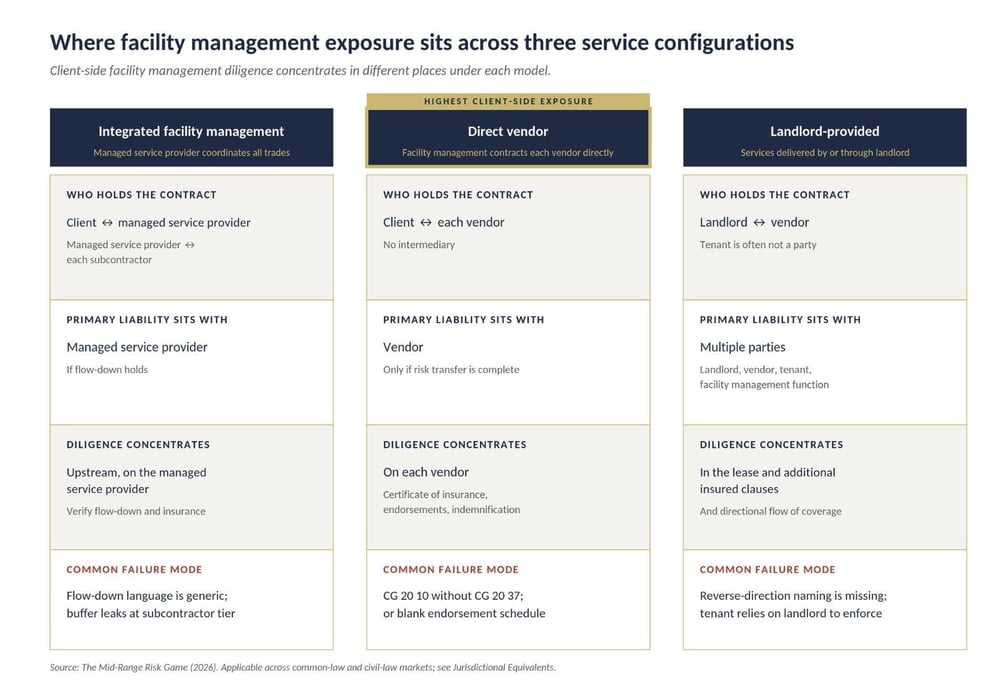
Liability does not flow uniformly. Three common service configurations distribute exposure differently, and each requires a different contracting discipline.
1. Integrated FM & MSP arrangements
In an integrated FM or managed service provider (MSP) arrangement, a single contractor coordinates multiple service lines under one master agreement. The MSP becomes a contractual buffer between the client and the underlying trades. When the model functions correctly, the MSP carries primary liability for the work it coordinates, holds appropriate insurance and flows down its obligations to subcontractors.
Function does not always follow form. The buffer is strong only if the MSP’s contract with each subcontractor mirrors the protections in the client’s contract with the MSP. Where flow-down language is generic or indemnification is capped below the master agreement, the buffer leaks. Even where the contractual position is protected, client-side FM still carries reputational and operational consequences when an incident occurs on a managed site.
The audit posture for this model is upstream. Diligence is primarily on the MSP itself: confirming that subcontractor agreements meet the same standard the client imposes on the MSP, that the MSP’s insurance program is current, and that flow-down is verified rather than assumed.
2. Direct vendor relationships
Where FM in an organization retains direct contracts with multiple vendors, a common model in mid-sized portfolios and certain hard-services categories, the client-side FM function carries the highest documentation exposure. There is no MSP buffer. Each vendor’s certificate of insurance (COI), additional insured status and contractual indemnification flow directly to the facility owner or operator.
Two specific exposures require attention. The first is coverage continuation. The mechanism that names a client as a covered party on the vendor’s policy varies by market, but the underlying question is the same: does coverage continue after the work is complete? In the U.S., Insurance Services Office (ISO) Form CG 20 10 provides additional insured status during ongoing operations only; Form CG 20 37 extends it to completed operations. Many vendor agreements specify the first without the second, leaving the period after completion unprotected. A leak that causes injury 18 months after the work was finished is a CG 20 37 problem in U.S. markets, and an analogous coverage-continuation problem in every other market.
The second is endorsement completion. A risk management firm’s audit of hundreds of certificates and underlying policies found that more than 90 percent contained at least one material misrepresentation between the certificate and the actual policy. A common defect: the additional insured endorsement is attached to the policy, but the schedule listing the named additional insureds is left blank. The endorsement does not function until the schedule is completed.
3. Landlord-provided services
The most complex liability picture occurs when services are delivered by or through the landlord rather than the tenant. A cleaning vendor, HVAC contractor or security firm engaged by property management may create claims that name multiple parties: the landlord, the property manager, the service vendor, the tenant and the tenant’s FM function.
Lease language determines starting positions. A standard “additional insured, managers or lessors of premises” endorsement (ISO Form CG 20 11) names the landlord as an additional insured on the tenant’s CGL policy for liability arising from the leased space. Where the landlord provides services, the directional flow may also be reversed: the tenant or the tenant’s FM function should be named on policies held by landlord-engaged vendors. Many leases only partially address this requirement, and tenant-side FM cannot always rely on the landlord to enforce vendor compliance.
Statutory and judicial limits on risk transfer complicate the picture further. In the U.S., anti-indemnity statutes in most states limit the extent to which one party can transfer liability for its own sole negligence to another. Other jurisdictions reach similar results through different machinery: U.K. and Commonwealth markets through doctrines on construction of exclusion clauses and statutes such as the Unfair Contract Terms Act; civil-law jurisdictions through code provisions on mandatory liability and limits on contractual exclusion of negligence. Lease and vendor language drafted in one jurisdiction may not function as written in another. Multinational portfolios face the same issue at scale.
Quick reference — Jurisdictional equivalents
Practice tracks legal tradition more than geography. Common-law markets generally follow London-market wordings (additional insured, indemnity to principals); civil-law markets generally rely on direct-action rights against the vendor’s insurer under national civil code. Hybrid markets — most notably the Gulf — combine both. The terminology varies; the underlying question is universal: is the client a named beneficiary of the vendor’s policy, both during the work and after?
|
Market |
How the client is named as a covered party on the vendor’s policy |
|
United States |
ISO endorsement forms CG 20 10 (ongoing operations) and CG 20 37 (completed operations); CG 20 11 for managers or lessors of premises. |
|
Canada |
Insurance Bureau of Canada (IBC) standard endorsements; broadly similar to U.S. ISO forms in structure. |
|
United Kingdom and Commonwealth |
“Indemnity to principals” extensions on the contractor’s public liability policy; joint-names insurance on construction works. |
|
Australia |
Principal’s indemnity extension on public and products liability policies. |
|
Continental Europe (civil law) |
Direct-action rights against the vendor’s insurer under national civil code; reduces reliance on an “additional insured” mechanism in the U.S. sense. |
|
South America (civil law) |
Direct-action rights under national civil code; “co-insured” (asegurado adicional/beneficiário adicional) endorsements available in regional markets; contractual indemnification subject to civil-code limits on transferring liability for one’s own negligence. |
|
Middle East (GCC and broader) |
Mixed. The Dubai International Financial Centre and Abu Dhabi Global Market operate under English-style common law and use London-market mechanisms. The broader UAE, Saudi Arabia, Qatar and Kuwait apply civil-code rules, but commercial insurance practice follows London-market wordings. Egypt, Jordan and Lebanon resemble continental Europe. |
|
Asia Pacific |
Sharply split. Common-law markets (Singapore, Hong Kong, India, Malaysia) follow U.K. and Commonwealth mechanisms. Civil-law markets (Japan, South Korea, China, Indonesia, Vietnam, Thailand) rely on direct-action rights against the insurer; “additional insured” status is less standardized, and contractual indemnification carries more of the load. |
 The four documentation areas that decide outcomes
Across all three configurations, four documentation areas tend to determine whether an incident becomes a manageable matter or a contested claim. The exhibits below show what good language looks like and what to ask for, in plain English.
Risk transfer language
Indemnification provisions allocate financial responsibility between contracting parties. In plain terms, an indemnification clause says: if a claim arises out of the vendor’s work, the vendor — not the client — pays the legal defense, the damages and the settlement. The strength of the clause depends on the trigger language, the duties it includes and how the relevant jurisdiction allows risk to be transferred.
|
Exhibit A — Sample contract language: indemnification What good language looks like: “To the fullest extent permitted by applicable law, [Vendor] shall defend, indemnify and hold harmless [Client], its affiliates and their respective officers, directors, employees and agents from and against all claims, losses and expenses (including reasonable attorneys’ fees) arising out of or related to the work, except to the extent caused by [Client]’s sole negligence or willful misconduct.” What to ask for:
|
Additional insured status
Additional insured status converts the vendor’s commercial general liability insurance into a coverage source for the client. The vendor still carries the policy, but the client is added as a covered party for claims arising from the vendor’s work. Three details determine whether the additional insured status actually functions when a claim arrives.
|
Exhibit B — Sample contract language: additional insured What good language looks like: “[Vendor] shall name [Client], its affiliates and their officers, directors, employees and agents as additional insureds on [Vendor]’s commercial general liability policy on a primary and non-contributory basis, using ISO endorsement forms CG 20 10 (or equivalent) for ongoing operations and CG 20 37 (or equivalent) for completed operations, with completed-operations coverage continuing for the longer of the applicable statute of repose or six (6) years after completion.” What to ask for:
|
COI currency
Certificates document insurance status at a moment in time. They do not amend the underlying policy, and they do not, on their own, confer rights. Certificates lapse. A current certificate at contract execution may be more than a year out of date when an incident occurs. Renewal tracking is the operational discipline that keeps the documentation current.
|
Exhibit C — Sample contract language: certificate currency What good language looks like: “[Vendor] shall provide a current certificate of insurance evidencing all required coverages prior to commencement of work and upon each policy renewal. Certificates shall be accompanied by copies of the actual additional insured endorsements. [Client] may suspend [Vendor]’s access to the premises if a current certificate is not on file.” What to ask for:
|
On-site documentation when work happens
The contract and the certificate establish the framework. The on-site record establishes what actually occurred when work was completed. A contained incident that produces a claim two years later relies on records that were either kept or not kept at the time of the work. This is the documentation area most directly within FM’s daily control.
|
Exhibit D — On-site documentation: a working checklist What to maintain at the site:
Sample contract language to support the practice: “[Vendor] shall maintain records of on-site personnel, daily safety briefings and work performed; retain such records for at least seven (7) years; and provide copies upon written request.” |
 Reframing the preparedness budget
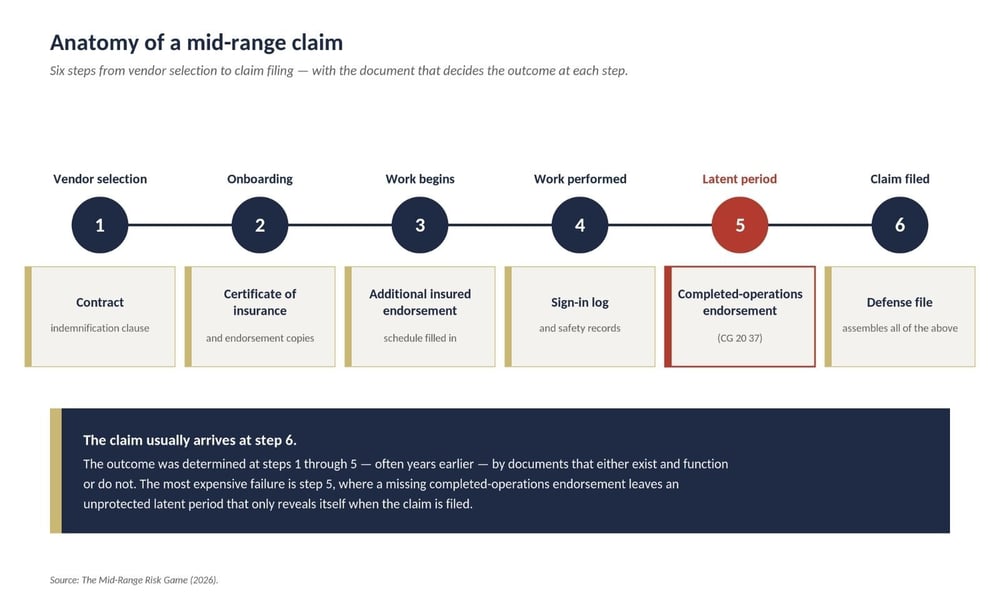
The conventional FM risk framework separates day-to-day operational discipline from continuity planning. The contractual and documentation layer falls between them. It is neither the high-frequency, low-severity work of routine compliance nor the low-frequency, high-severity work of disaster planning. It is the high-frequency, mid-severity work that produces most of the claim portfolio.
The mid-range risk game is won in advance, in plain documents that are difficult to dramatize. A correctly named additional-coverage arrangement on the vendor’s policy, an endorsement schedule that is not left blank, completed-operations coverage that does not end the day the work does, an indemnification clause that survives local statutory review, and a certificate tracking system that does not lapse: these are the sources that determine whether an incident becomes a manageable matter or an organizational crisis.
Disclaimer
This article is provided for general educational purposes and does not constitute legal, insurance or risk management advice. Specific contracts, endorsements and statutory requirements vary by jurisdiction and circumstance. FM professionals should consult qualified legal counsel and licensed insurance or risk management professionals when reviewing or negotiating specific agreements.

Amanda Muzzarelli is a global real estate and facility management executive whose career spans both enterprise leadership and independent consulting. In consulting roles, she has advised multinational enterprises on supplier transition strategy, integrated FM procurement, and operating model modernization. Her perspective on FM supplier relationships draws from both sides of the table: as a senior leader managing complex outsourced ecosystems, and as an advisor helping organizations design the governance structures that determine whether those ecosystems perform. Muzzarelli serves as President of the Central Illinois Chapter of IFMA and is a member of IFMA's Workplace Evolutionaries community.
References
U.S. Bureau of Labor Statistics, “Survey of Occupational Injuries and Illnesses, 2024” (released January 22, 2026), and “Census of Fatal Occupational Injuries, 2024” (released February 19, 2026).
International Labour Organization, statistics on occupational fatalities in the construction sector, www.ilo.org/.
Eurostat, “Accidents at work statistics,” 2022 reference period, ec.europa.eu/eurostat/.
U.S. National Council on Compensation Insurance (NCCI), workers’ compensation claim severity data on fall-related injuries, as published in National Safety Council, injury Facts, injuryfacts.nsc.org/work/costs/workers-compensation-costs/
U.S. Centers for Disease Control and Prevention, National Institute for Occupational Safety and Health (NIOSH), workplace slip, trip and fall research summaries, cdc.gov/niosh/falls/about/index.html
“Social inflation” refers to the rise in liability claim severity beyond what can be explained by general economic inflation, attributed to factors such as larger jury awards, broader theories of liability, plaintiff-friendly procedural changes and litigation funding. Source: Swiss Re Institute, sigma 4/2024, “Social inflation: litigation costs drive claims inflation.”
Swiss Re Institute, sigma 4/2024, swissre.com/institute/research/sigma-research/sigma-2024-04-social-inflation.html
U.S. Chamber of Commerce Institute for Legal Reform, “Nuclear Verdicts: Trends, Causes and Solutions,” 2024 update, instituteforlegalreform.com/
Marsh, Global Insurance Market Index, research on contractual risk transfer effectiveness. marsh.com/en/services/international-placement-services/insights/global_insurance_index.html
In this article, “ISO” refers to the U.S. Insurance Services Office, a private rating organization that publishes standard commercial insurance policy forms — not the International Organization for Standardization, which uses the same acronym for standards such as ISO 41001 (facility management).
On endorsement forms CG 20 10 and CG 20 37, see International Risk Management Institute (IRMI) commentary at irmi.com/
International Risk Management Institute, “Avoiding Common Insurance Certificate Errors in Contracting Services,” IRMI Expert Commentary (July 17, 2015), citing a multiyear audit of vendor certificates and underlying policies. irmi.com/articles/expert-commentary/avoiding-common-insurance-certificate-errors.
ISO endorsement form CG 20 11, “Additional Insured — Managers or Lessors of Premises.”
Top image via Getty Images. Article images courtesy of the author.
Read more on Risk Management , Facility Operations and Leadership & Strategy or related topics Risk Management , Regulations , Occupant Safety , Best Practices , Contract Administration , Incident Management , Policy and Supplier or Vendor Management
Explore All FMJ TopicsRelated articles
-

A New Approach
Improving business continuity with alarm managementBy Brad Freeman09.09.2024 -

Beware of Growing Cyberthreats
Why it’s time for stronger facility cybersecurityBy Andrew Harris & Eric Headington10.30.2024 -

Going Up?
Keeping elevators safe & compliantBy Dave Myers & Doug Taylor11.06.2024