
 Membership
 Network
 Regional Sites & Affiliates


 Events
 Participate
 Resources

 Training
 Credentials
 Government


 Content Channels
 Tools
Tools


 Business Overview





Breathing With Confidence
The shift from assumed safety to proven IAQ

For decades, indoor air quality (IAQ) was treated as an implicit promise. If a building met code, occupants were expected to trust that the air was safe. That assumption of occupant acceptance is fading. Across regions and building types, stakeholders evaluate indoor environments not only on compliance, but on whether air quality can be demonstrated clearly and credibly.
Expectations are evolving in the wake of changing attitudes about health and increased climate disruption. Longer periods spent indoors during colder seasons, coupled with air pollution events and public health crises, have made air quality a more visible concern. Occupants want more proof that the air they breathe is being monitored and managed, rather than relying on assurances or technical standards they cannot see.
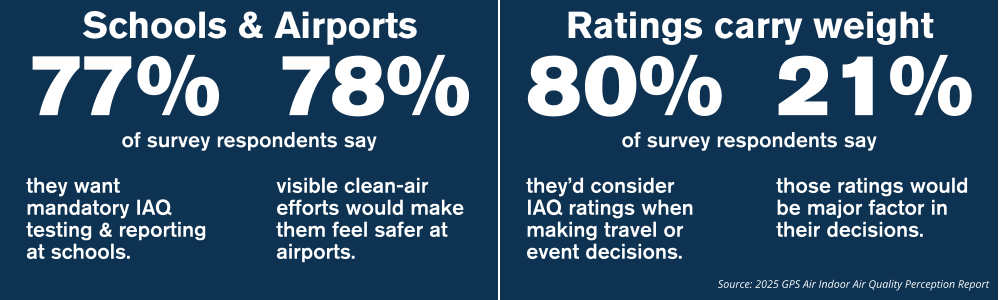
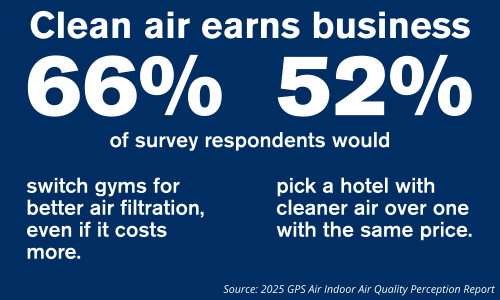
 Recent perception data highlights this shift. The 2025 Indoor Air Quality Perception Survey of adults across multiple demographics found that trust in indoor environments depends heavily on visibility and reassurance. The findings suggest IAQ is becoming a baseline expectation, similar to clean water or reliable power, rather than a behind-the-scenes technical function.
For facility managers, this shift introduces a different kind of challenge and opportunity. Buildings may technically meet ventilation and filtration requirements yet still face skepticism if occupants cannot see that air quality is being managed consistently and efficiently. Updated guidance and smart air quality technology and sensing provide a path to satisfy efficiency and occupant expectations.
What occupants expect
IAQ perception data reveals consistent trends that FMs must account for when planning operations and investments.
First, there is growing demand for transparency. Nearly two-thirds of survey respondents indicated support for publicly displayed air quality scores, similar to food safety ratings. More than 60 percent reported higher trust in spaces where indoor air quality is actively monitored and communicated.
Second, sensory cues strongly influence behavior. Unpleasant odors and stale air rank among the most common reasons people avoid returning to workplaces, retail locations and fitness facilities. In the survey, 41 percent of respondents said unpleasant odors would deter them from returning to a space, exceeding concern about known virus exposure.
Third, perception often outweighs technical performance. Many occupants rely on instinct rather than ventilation metrics or documentation when forming opinions about air quality. This matters operationally because facilities can lose trust even when systems meet applicable standards.
Transparency functions as a trust mechanism rather than a manual communications exercise. When indoor air quality remains invisible, occupants tend to assume the worst. When it is made understandable, confidence increases.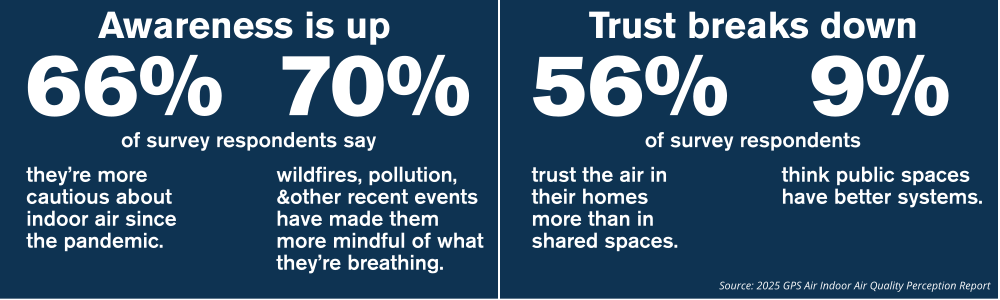
Why visibility has become a global challenge
Heightened scrutiny of IAQ is a global concern across facilities and stakeholders. Organizations face similar pressures driven by urban density and climate-related disruptions. Cold weather increases time spent indoors in many regions, while extreme heat, pollution and humidity affect others.
Regulatory frameworks differ across countries, yet occupant expectations are converging. People have higher expectations that indoor environments demonstrate care for health and comfort regardless of local code maturity. This creates a trust gap in organizations that are compliant but silent.
The perception gap is particularly evident in shared environments. Survey data shows that more than half of respondents trust the air in their homes more than in public or commercial spaces. Only a small percentage believe public buildings provide superior IAQ systems.
For FMs overseeing global portfolios, this means consistency matters.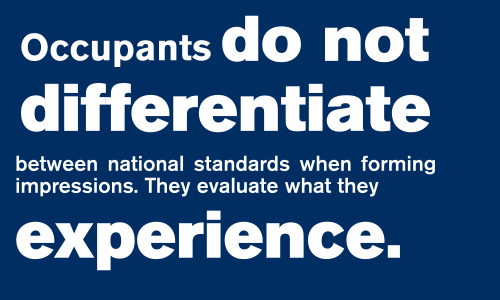
From compliance to confidence
Meeting minimum regulatory requirements remains essential. Ventilation standards, filtration levels and maintenance protocols provide IAQ’s foundation. Yet compliance alone no longer guarantees confidence.
A broader approach is emerging that includes three layers of IAQ strategy:
-
Minimum compliance, which ensures adherence to codes and standards.
-
Performance-based management, which focuses on outcomes such as contaminant reduction and comfort.
-
Occupant-facing transparency, which communicates what is being measured and why it matters.
Organizations that address all three layers are better positioned to maintain trust. In practice, this often comes down to product choice. Solutions that combine monitoring, automation and system integration allow organizations and their facilities to meet expectations without adding time, cost or energy burden to operations. Those that focus solely on compliance risk falling short of occupant expectations, even when systems operate correctly.
IAQ plays a larger role in facility experience, influencing people’s perceptions of the care and safety of that space.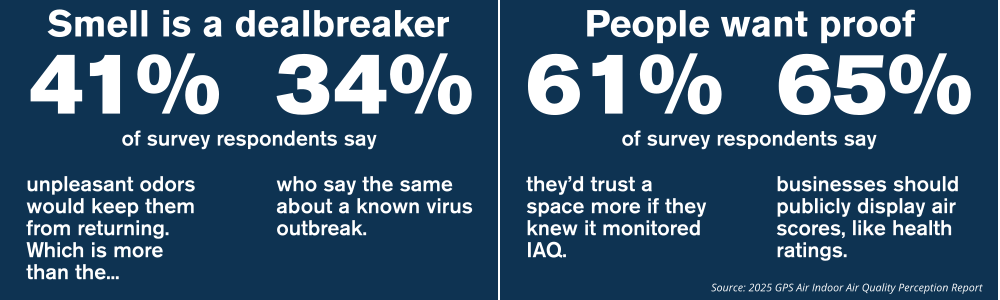
Real-time monitoring as an operational tool
Continuous indoor air quality monitoring provides several operational benefits when it operates in the background.
Early detection of ventilation or filtration issues allows teams to address problems before occupants notice discomfort. Trend data supports preventive maintenance by revealing gradual performance changes.
Monitoring also simplifies communication. Occupants are more likely to trust organizations that can clearly explain current facility conditions. Selecting which metrics to display requires careful consideration. Data governance is important but increasingly managed through automated systems that define thresholds and alerts without requiring constant review. Clear interpretation prevents confusion and maintains credibility.
When paired with a defined framework for evaluating outcomes, monitoring data becomes a powerful tool for demonstrating indoor air quality performance.
 Applying IAQ procedure in practice
As expectations shift from assumed safety to demonstrable performance, organizations need approaches that go beyond prescriptive requirements. The IAQ procedure (IAQP) provides a standard-based framework for achieving and verifying air quality outcomes based on contaminant reduction rather than design assumptions.
IAQP allows organizations and their facilities to meet air quality goals by cleaning the indoor air, targeting specific contaminants, rather than relying solely on fixed ventilation rates. Successful IAQP adoption often depends on selecting technologies that simplify performance and provide closed-loop confirmation, turning IAQP into a verifiable design.
Tools that support IAQP should offer clear, third-party performance data showing how specific contaminants are reduced, including alignment with ASHRAE Standards 145.2 and 52.2. Integration with building management systems is also beneficial, allowing air quality data to be monitored, logged and reviewed automatically. Effective IAQP strategies often combine enhanced filtration, supplemental air cleaning and controlled ventilation within a coordinated system.
By measuring outcomes rather than relying on airflow assumptions, organizations can reduce dependence on overconditioning excess outdoor air. Monitoring practices can automatically capture metrics tied to contaminant control, such as particulate matter, VOCs and formaldehyde, and produce consistent trend data for maintenance planning and review. Systems that include built-in sensing and automated alerts validate that the system is working as designed.
Maintenance considerations cannot be overlooked. Technologies with longer service intervals, clear status indicators and predictable upkeep help sustain performance over time and reduce the burden on facilities teams.
Product selection can simplify IAQP and make it a practical framework for improving indoor air quality while reducing energy and equipment costs.
 Making clean air credible
IAQ is no longer evaluated solely through technical compliance. It is judged through visibility and trust. Organizations that make their facility’s air quality understandable and demonstrable will build occupants’ confidence.
FMs play a central role in this transition. By aligning compliance, performance and transparency through smart product selection, IAQ can move from an assumed condition to a credible standard that supports health, saves time, and reduces energy and operating costs.

Audwin Cash is CEO of GPS Air®, a leading provider of indoor air quality solutions. With prior roles at Regal Rexnord and Acuity Brands Lighting in energy-efficient building technologies, Cash now leads efforts to bring data-driven air cleaning and real-time monitoring systems to market. He holds a bachelor of science in Computer Engineering from Georgia Tech and an MBA from Lehigh University.
References
Top image by Getty Images.
Read more on Occupancy & Human Factors or related topics Occupant Health and Measure and Monitor
Explore All FMJ Topics