
 Membership
 Network
 Regional Sites & Affiliates


 Events
 Participate
 Resources

 Training
 Credentials
 Government


 Content Channels
 Tools
Tools


 Business Overview





Budget Disruptions
When tariffs rewrite the capital plan

Facility management leaders trying to finalize a viable and accurate capital plan already have a tough job. This year, the projecting process became especially volatile. In February, the U.S. Supreme Court modified the tariff framework that most existing duty structures were built on. By April, metal duties had been restructured to 50 percent on specific products, then revised again within the week. Certain capital assumptions for all of 2026 did not make it past the first quarter — and for FM professionals trying to establish a long-term capital plan, their existing numbers were no longer applicable.
Ongoing global tariff volatility continues to increase material costs and delay procurement for essential items needed to repair and replace assets. As a result, many planned infrastructure investments face tariff uncertainty and vulnerability before construction even begins.

The playbook many facilities leaders have relied on — plan for replacement, build a timeline, submit the budget — does not hold up in today’s tariff environment. For facilities leaders planning in 2026, keeping up with tariff volatility requires building capital plans around data to prioritize risk, extend asset life and make investment decisions that hold up when costs keep moving.
Tariffs have given infrastructure a broader audience
It is not only FMs who have been tracking tariffs and their implications on the built environment. Globally, C-suite leaders are making decisions based on fluctuating markets, policy, regulatory shifts and other geopolitical risks. Everyday people are watching their effects on grocery prices, on housing and on the cost of goods. Further, research from Asset Management Software, Siemens, found that average citizens are also paying attention to how tariffs affect the infrastructure of their communities. Fifty-eight percent expect tariffs to raise the cost of maintaining and upgrading local infrastructure, and 81 percent anticipate that tariff-driven cost pressure will delay the public projects their communities depend on, from roads and schools to public buildings and transit systems. Nearly half said they are not confident their local government can absorb the financial strain.
Rarely do facilities and infrastructure break into a broader public conversation, but this is one of those moments. When asked which areas concerned them most, respondents pointed to transportation infrastructure (70 percent concerned), followed by hospitals and health systems (57 percent), and public buildings (53 percent). School facility costs are also drawing attention, with 62 percent of survey respondents expressing concern that tariffs will increase repair and replacement expenses.
The problem with planning around stable costs & timelines
By their nature, capital plans are built on assumptions. Facilities professionals assume the price of materials in the approved budget will remain relatively stable, that the manufacturing window on equipment/materials will follow a predictable lead time, and that building and maintenance costs will not overly fluctuate over a short period of time. However, compared to a 2024 baseline, the cost of construction materials is now up 6 percent, peaking at an estimated 9 percent during summer 2025. HVAC equipment, one of the most exposed categories in a facility’s budget, now faces tariffs as high as 46 percent. A capital plan is only as reliable as the cost assumptions underneath it, and right now those assumptions have a shorter shelf life.
In addition to cost volatility, FMs experience delays in getting the materials and equipment their capital plans depend on. IFMA’s January 2026 Pulse Survey found that nearly three-quarters of facility managers experienced delays in up to 40 percent of their projects in 2025.
 Most plans are built on schedules, not data
Many capital planning models were built around the premise that assets have a useful life, and when they reach the end of it, they get replaced. Replacement planning works best when facility costs are stable, and lead times are reliable.
Most organizations are still running on that model. According to the 2026 Asset Lifecycle Report from Asset Management Software, Siemens, 97 percent of organizations have a 3-5-year capital plan in place, but only 32 percent have performed a facilities condition assessment (FCA), which is the process that verifies whether the asset data those plans are built on is accurate and up to date. This gap suggests that most organizations have not committed to maintaining the data foundation on which capital plans depend. Without asset condition data, a capital plan may be built on asset information that is outdated, incomplete or simply wrong. When facilities leaders plan to simply replace assets on a schedule, the precision of the underlying data matters less. But when costs shift and timelines stretch, replacement date stops being a reliable default, and the quality of asset data becomes the thing that determines whether FM leaders can make defensible decisions on how to prioritize improvements.
The data problem goes further. The same survey found nearly half of organizations with long-term capital plans are not using predictive analytics in their asset forecasting, meaning they are projecting future needs based on historical patterns and schedule assumptions rather than real-time asset condition data.
Instead, preventive maintenance using predictive analytics means facilities leaders can intervene earlier by using real-time condition data to identify assets showing early signs of degradation before they reach a crisis point.
 When organizations conduct FCAs and integrate condition data into their planning, they gain a clearer picture of what is broken, what is underperforming and what is at risk of failure. From there, the question of what to replace, what to repair and what can wait becomes a decision grounded in evidence rather than a calendar, making an organization’s facilities less exposed to the ongoing tariff turbulence.
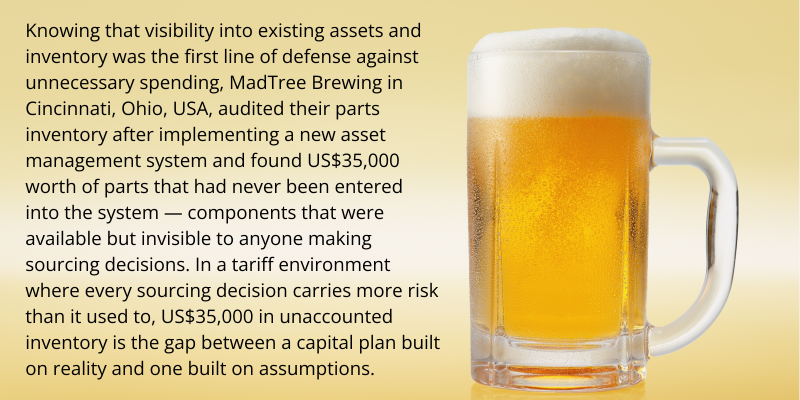
Teachings from the taproomThe Brewer's Association has been vocal about the impact of tariffs on small brewers who rely on imported materials like steel, aluminum and copper across everything from cans and kegs to brewing equipment. Ongoing tariff volatility has created uncertainty for craft breweries. Research from the University of Illinois Urbana-Champaign found that while tariffs may stimulate domestic beer production overall, any market share gains are largely concentrated among multinational firms. Craft breweries, facing higher per-unit production costs that pass on to consumers, could actually lose market share even as the broader domestic category grows. The same research found that across every consumer segment, the likelihood of choosing a beer consistently declined as prices increased, meaning that craft brewers, who have less room to absorb costs without raising prices, need to find savings elsewhere in their operations to stay competitive.
|
What this moment is asking from FMs
The tariff volatility facilities leaders have experienced over the past year has made it clear that the assumptions most capital plans are built on are no longer reliable enough to plan against. With costs increasing, timelines lengthening and communities paying closer attention to the infrastructure that serves them, FMs must adapt how they plan, even when the circumstances themselves remain impossible to predict.

Jennifer Latchford-Perkins, senior government specialist at asset management software, Siemens, has more than 25 years of experience in the state and local government and education markets as a practitioner, consultant and industry advisor. In her role, Perkins helps state and local governments become more efficient using a state-of-the-art solution to manage public assets and help long-term financial planning.
References
Top image via Getty Images.
Read more on Finance & Business or related topics Operational and Capital Budgeting , Financial Analysis and Budget
Explore All FMJ Topics