
 Membership
 Network
 Regional Sites & Affiliates


 Events
 Participate
 Resources

 Training
 Credentials
 Government


 Content Channels
 Tools
Tools


 Business Overview





Checkpoint 2030
Managing Scope 3 emissions to hit climate goals

Facility managers entered a year of rising climate expectations, rapid advances in AI and growing pressure on energy systems. The pervasive use of AI is increasing electricity demand, which pushes utilities and governments to deploy renewable energy faster.
At the same time, many organizations are nearing an important mid-decade checkpoint on their 2030 climate goals. These targets require precise emissions data to understand where progress stands, which investments matter most and how quickly action must be taken. The challenge is that organizations often wait to evaluate climate progress until they have perfect emissions data. But given today’s urgency and operational needs, this approach does not work.
FMs are feeling this pressure directly, which is leading them to rethink how they manage their workload. Many are moving from manual reporting to AI-supported data organization to free up time for scenario modeling and operational improvements.
Understanding the forces shaping today’s demands can help FMs prepare for the decisions ahead — such as how to plan for shifting energy costs, which efficiency upgrades to prioritize, how to evaluate suppliers and where to focus limited resources to support climate goals without disrupting operations.
AI will reshape global energy demand
AI workloads are becoming larger and more integrated across business functions, including logistics, analytics and customer engagement. Data centers that train and run AI applications require enormous amounts of electricity and cooling water, which is creating new levels of pressure for global energy systems.
This demand is prompting utilities, investors and governments to scale renewable energy faster because solar and wind projects can often be deployed more quickly than traditional power plants. In 2024, more than 90 percent of new utility-scale power came from renewable energy.
This is important for FMs because higher electricity demand can increase operating costs and strain local networks. Conversely, the demand can accelerate the energy transitions by moving new capacity into development sooner. It is not yet clear how steep the rise in demand from AI will be, but model training and inference are expected to become more efficient over time.
Companies may settle into more predictable usage patterns as they understand the cost and operational impact of AI power needs. These factors could help steady the rise in energy demand even if overall consumption grows.
The most productive way to address this will be to track regional energy trends, understand grid constraints and prepare for greater variability in energy costs.
 Scope 3 emissions will take on new importance
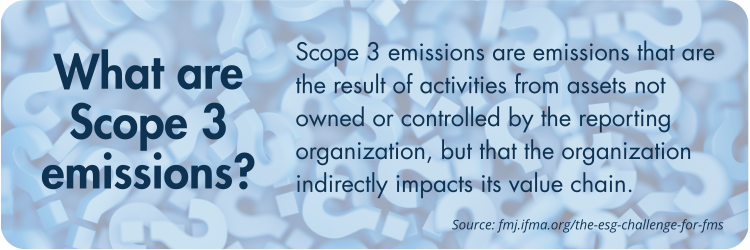
Organizations will turn their attention to emissions that are not under their direct control, known as Scope 3. This includes all indirect emissions across a company’s value chain, from supplier operations and transportation to product use and end-of-life protocols. These emissions often make up the largest share of a company’s footprint, up to 75 percent on average. The problem is that 70 percent of companies say they do not have enough supplier data to calculate Scope 3 impacts accurately.
Without clear supplier data, it is difficult to understand the real emissions impact of materials, equipment and services used across global sites. It also becomes difficult to identify where reductions are most achievable. FMs can close these gaps by asking suppliers for basic emissions information, explaining why the data is needed and setting simple expectations for what will be required in the future early in the process. As this information becomes more consistent, it becomes easier to pinpoint impactful changes and build more accurate emissions profiles across the supply chain.
As more companies ask suppliers for verified emissions data, FMs will need to factor this information into purchasing and planning. Supplier data will influence decisions about equipment, building upgrades and which partners to work with because it reveals how efficiently vendors operate and how much they are affected by energy prices or climate risks. In some regions that heavily rely on fossil fuels, the emissions from manufacturing may be higher than any savings gained from shorter transportation routes. This means FMs cannot assume that sourcing closer to home will always result in lower emissions.
2030 climate goals will push action on imperfect data
Many global companies set their 2030 climate goals early in the 2020s when data systems were less mature and supply chain visibility was limited. At the midpoint of the decade, it is time for organizations to evaluate whether their plans are on track. To do this, they need enough emissions data to understand where progress stands and whether the strategies in place are delivering the expected reductions.
A common challenge is the tendency to wait for perfect data before taking action. This might feel like the right thing to do, but it slows progress. This is especially true when most emissions sit in Scope 3, the most complex information to gather. MIT’s research shows that while 40 percent of companies track Scope 1 and Scope 2 emissions closely, far fewer measure Scope 3 at the same level. This leaves organizations with limited visibility into their largest sources of emissions.
Companies cannot wait for perfect Scope 3 data before taking action, and regulatory pressures are already reinforcing this need. In the U.S. state of California, new disclosure laws require companies with more than US$1 billion in annual revenue operating within the state to publicly report their emissions and financial risks related to climate. In Europe, the Corporate Sustainability Reporting Directive requires many organizations to disclose how sustainability issues affect their business and how their activities affect people and the environment.
 Companies that move forward with transparency can take immediate steps to reduce fuel use, upgrade equipment, address operational inefficiencies and engage with suppliers even when some data points are still being refined.
AI will support Scope 3 data collection
Data collection, utility tracking and emissions reporting are still one of the hardest parts of Scope 3 and typically require a lot of manual effort. MIT research reports 50 percent of firms still rely on spreadsheets to track emissions data in North America. This can make it harder to see information across global sites and update assumptions or timelines.
Research from Optera shows that AI is beginning to help address this gap. Nearly half of sustainability professionals already use AI in some parts of their workflow, whether it is early experimentation or full integration. The rest have at least begun internal conversations about how AI might fit into their work. Broader corporate trends show similar patterns. Gallup found that 44 percent of white-collar workers use AI on the job for tasks like research, summarizing documents and creating starter drafts of internal reports.
 AI can also help with more specialized sustainability work. The World Economic Forum noted that AI can automate the collection of utility and consumption data, validate disclosures and help spot inconsistencies across multiyear data sets. These capabilities are especially helpful for Scope 3.
As organizations gather their data more effectively, AI can then help them use it in more meaningful ways. Better data makes it easier to see where emissions are concentrated, which suppliers need engagement and where operational changes will have the biggest impact.
The International Review of Economics and Finance found that increased AI adoption improves ESG performance for many organizations because it strengthens the underlying systems companies use to manage environmental, social and governance issues. In practice, this often means that AI helps organizations manage the foundational work that supports strong ESG outcomes, such as gathering reliable data, identifying risks earlier and improving consistency across global operations.
Many sustainability professionals remain cautious about letting AI make complex decisions or produce final calculations when it comes to interpreting data and reporting accuracy. For example, AI could potentially flag data anomalies that turn out to be simple meter or billing errors. It is important to remember that it does not replace human oversight, but it can provide needed efficiency without compromising data quality or compliance.
Decarbonization strategies will guide decisions
With changing energy systems, new regulations and higher expectations for accurate data, FMs need practical approaches to reduce emissions while keeping operations steady. Organizations should balance short-term financial pressures with long-term climate goals. This balance is not always easy, but FMs teams are in a strong position to drive progress through targeted actions.
A good starting point is improving energy and emissions data systems. Better data helps organizations see where upgrades or changes in daily operations will have the most impact. Even small adjustments in equipment schedules, building controls or maintenance routines can produce meaningful savings when they are based on accurate information. As AI tools help standardize data and reduce manual reporting, FM teams can spend more time understanding performance trends and less time compiling spreadsheets.
Supplier engagement is another important area, as FMs often manage purchasing for equipment, building materials and contracted services. Reliable supplier emissions data supports better procurement choices. It helps avoid unintended increases in emissions from suppliers with inefficient operations and keeps purchasing aligned with climate goals, especially as more companies add low-carbon requirements into contracts.
FM teams can also support wider decarbonization efforts by identifying opportunities for efficiency improvements and cleaner energy use. This may include optimizing building performance, upgrading to high-efficiency systems, exploring on-site renewables or participating in regional programs that support clean energy development.
Life cycle analysis tools and better carbon accounting software are more widely available and help FMs understand the emissions associated with specific products and processes. As these tools advance, FMs will play a larger role in shaping the organization’s understanding of operating emissions and in identifying the most impactful change opportunities.
Carbon management becomes a core expectation
In the second half of the decade, carbon management will be a part of how every global organization operates. Climate considerations will no longer sit off to the side as separate initiatives. They will need to be built into routine decisions because they help reduce risk, lower operating costs and make organizations more resilient in an evolving energy and regulatory environment.
As expectations rise, FMs will be asked to run efficient buildings while also helping their organizations understand how everyday operational choices impact overall climate goals.

Ty Colman is the CRO and co-founder of Optera. He has spent nearly two decades supporting the sustainability programs of Fortune 500 companies in nearly every major industry. Prior to Optera, Colman worked for Domani Consulting.

Tim Weiss is co-founder and CEO of Optera, oversees the company’s operations, product, and business strategy. Weiss has been at the forefront of corporate sustainability for nearly a decade, supporting Fortune 100 companies and leading NGOs like the World Economic Forum and CDP in advancing science-based targets, climate strategy, and emissions accounting.
Read more on Sustainability , Leadership & Strategy and Facility Operations or related topics Climate Change , Environmental, Social and Governance (ESG) and Carbon Footprint
Explore All FMJ TopicsRelated articles
-

Smart Building Control Systems
The foundation for a grid-interactive buildingBy Andre Marino09.25.2024 -

Smart Building Innovation
Cutting costs & carbon footprints without compromiseBy Andrew Butterworth09.12.2024 -

Chart the Path
Building sustainable cities & a sustainable futureBy Izzat Ali Khan & Aykean Forde12.16.2024
