
 Membership
 Network
 Regional Sites & Affiliates


 Events
 Participate
 Resources

 Training
 Credentials
 Government


 Content Channels
 Tools
Tools


 Business Overview





Closed-loop Systems
Tackling a hidden Legionella threat

As water systems grow more complex and climate patterns shift, Legionella remains one of the most persistent and underestimated risks in the built environment. The threat to public health from Legionnaires' disease will likely further escalate unless decisive action is taken, at scale and pace.
Commonly found in building heating systems, air-conditioning and cooling systems, and some heat pumps, closed-loop water systems are often considered low risk for Legionella because they are sealed and do not normally aerosolize water.
However, in the face of rapidly rising global Legionella counts, this assumption is misleading — there are several hidden threats in closed-loop systems that could increase the risk of Legionella.
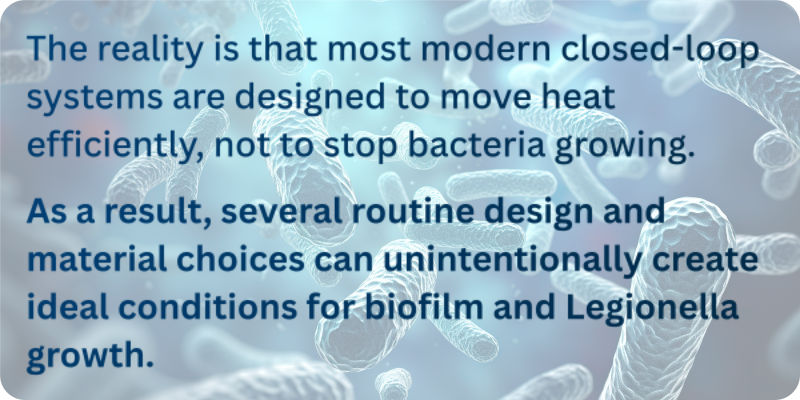 Common polymers such as EPDM, PEX, PVC and polypropylene leach small amounts of biodegradable organic carbon that feed early microbial colonisation. Their surface chemistry and roughness further promote bacterial attachment, allowing biofilms to establish quickly and persistently.
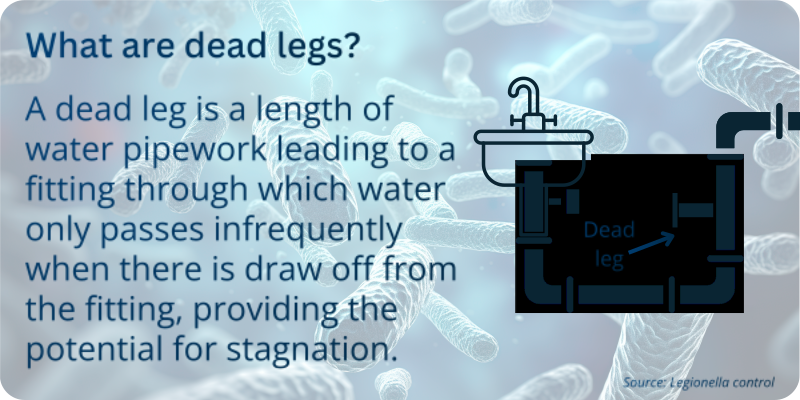
System geometry and flow conditions compound the risk. Oversized pipework reduces velocity, which lowers the shear stress needed to disrupt biofilm. Dead legs caused by insufficiently removed pipework that previously serviced now-redundant equipment can bypass lines while poorly flushed components trap stagnant water where disinfectant residuals vanish. Components like expansion vessels, strainers, balancing valves and plate heat exchangers often contain warm, low-flow pockets that act as long-term microbial reservoirs.
Temperature control is another critical factor. Many low-temperature closed-loop systems operate between 68-113 F (20-45 C), which is the ideal range for Legionella growth. The scope for poor insulation, intermittent use or standby periods escalate matters, allowing systems to drift into this zone for hours or days at a time, giving the bacteria even more favorable opportunities to multiply.
Corrosion and dirt in the system make these problems worse. Rust from carbon steel, along with magnetite and general sediment, can build up and create small protected areas where bacteria can hide. These areas can protect biofilms, allowing them to persist despite routine heat and chemical control measures.
The end result is a critical and yet still largely overlooked Legionella threat that FMs cannot afford to underestimate.
 Best practice recommendations
Though there may be no silver bullet solution a large part of minimizing risks and maintaining disinfection efficacy lies in good design.The priority should be to minimize conditions that allow stagnation or nutrient accumulation. This should include reducing or eliminating dead legs, ensuring consistent circulation across all branches and avoiding oversized pipework that lowers velocity.
Material selection also matters. Choose components with low corrosion potential and surfaces that do not encourage microbial attachment, while also avoiding fiber washers or natural rubber, which can shed nutrients into the system. Incorporating high-quality filtration and magnetic dirt separation also helps prevent particulate build-up, while dedicated flushing points, drain valves and accessible dosing ports make ongoing biofilm management far easier throughout the system’s lifespan.
During commissioning, the system should be cleaned thoroughly before filling to remove oils, debris and residues that act as early-stage biofilm nutrients. A controlled biocide treatment should be applied to neutralize any bacteria introduced during installation. Initial water quality testing is essential — not only for Legionella but also for indicators such as iron and suspended solids, which support microbial growth. Temperature control should then be verified to ensure the system does not drift into ranges that favor bacterial proliferation.
A clear management plan should be established from day one, covering regular flushing, inspection, cleaning and appropriately timed chemical dosing, ensuring disinfection remains effective over the long term.
Education is critical. As Legionella risk evolves, those FMs and their teams who stay up to date with the latest guidance, testing innovations and real-world risk factors will be far better equipped to identify vulnerabilities long before they escalate. Regular training ensures they understand how Legionella behaves, where it hides and how system design, temperature control and maintenance practices influence bacterial growth.
Technological advantages
The good news is that there are several emerging technologies that help FMs and their teams detect and control Legionella in closed-loop systems by providing faster insight, smarter dosing and better detection of microbiological changes.
For example, advanced filtration and magnetic dirt-separation systems can remove finer particulates and corrosion debris, depriving biofilms of the surfaces and nutrients they need to establish. Equally, automated biocide-delivery systems are becoming more sophisticated, with some platforms adjusting dosing based on real-time indicators such as ATP or other microbial activity signals. This allows biocide to be delivered only when needed, improving efficacy and reducing chemical overuse.
Continuous temperature and flow sensors can also be used to provide a constant stream of operational data, enabling operators to spot drifts into the temperature range that favors bacterial replication. These systems also help identify stagnation zones or periods of inadequate circulation long before problems escalate. AI and predictive analytics are being explored to interpret temperature, flow, corrosion and water-quality data to flag when a system is moving toward high-risk conditions.
Rapid on-site Legionella tests — capable of detecting all L. pneumophila serogroups, the most dangerous form of Legionella — are now widely used to verify system conditions immediately, validate corrective actions and monitor high-risk points without waiting days for lab culture results.
Together, these technologies offer a more proactive, data-driven approach to keeping closed-loop systems microbiologically safe. As well as continuous monitoring, they are particularly useful post-remediation to detect the viable but nonculturable forms of Legionella that lab tests miss, which may have been created with typical remediations such as heat shock or biocide shock dosing.
 Making it watertight
There are still significant knowledge gaps across the industry, particularly around how biofilms behave in modern low-temperature, energy-efficient systems, and how operational data can be used predictively rather than reactively. Many stakeholders also underestimate the extent to which materials, hydraulic design, commissioning practices and long-term operation all interact to shape Legionella risk. As a result, responsibilities are often fragmented, with each party assuming someone else will manage the microbiological aspects.
In reality, Legionella prevention is a shared responsibility that must begin long before a system is handed over. Manufacturers influence risk through material choices, component geometry and the guidance they provide. Engineers shape risk through hydraulic design, elimination of stagnation points and specification of monitoring and access provisions. Installers affect risk through commissioning hygiene, flushing quality and early biocide control.
However, the building operator, typically the FM, owns the long-term duty to maintain those protections: verifying temperatures, managing chemistry, flushing low-use areas and conducting regular microbiological checks.
The largest gap is not assigning responsibility, but ensuring each party understands how their decisions affect the next stage. Strengthening that continuity, supported by better data and rapid on-site testing, is key to raising the overall standard of Legionella control.

Greg Rankin, CEO, Hydrosense, is a seasoned technology product veteran with a deep passion for protecting public health from Legionella bacteria. With a decades of experience in technology, marketing, and business development, Rankin's expertise spans end-to-end marketing and product management, with a strong focus on meeting customer’s needs. His career has seen him hold key roles at leading companies such as Oracle, Ingenico and Metaforic, as well as a number of startups, where he honed his skills in delivering innovative solutions to global markets. He fosters a culture of trust, values diversity, and encourages a 'test and learn' approach within his team. He is dedicated to raising awareness about the broader risks of Legionella outbreaks, advocating for greater vigilance and early detection in all sectors.
References
Top image courtesy of Hydrosense.
Read more on Risk Management and Facility Operations or related topics Occupant Health , Furniture, fixtures and equipment (FF&E) and Building Systems
Explore All FMJ TopicsRelated articles
-
A New Approach
Improving business continuity with alarm managementBy Brad Freeman09.09.2024 -

Beware of Growing Cyberthreats
Why it’s time for stronger facility cybersecurityBy Andrew Harris & Eric Headington10.30.2024 -

Going Up?
Keeping elevators safe & compliantBy Dave Myers & Doug Taylor11.06.2024