
 Membership
 Network
 Regional Sites & Affiliates


 Events
 Participate
 Resources

 Training
 Credentials
 Government


 Content Channels
 Tools
Tools


 Business Overview





Closing the Scope 3 Data Gap
Demanding standardized emissions data from restoration & specialty contractors

As mandatory Scope 3 disclosure moves from voluntary best practice to legal obligation, a quiet gap is opening in corporate greenhouse gas inventories — and facility managers are standing directly over it.
In the U.S., California's SB 253, the Climate Corporate Data Accountability Act, requires large companies doing business in the state to begin reporting Scope 1 and 2 emissions in 2026, with Scope 3 following in 2027.
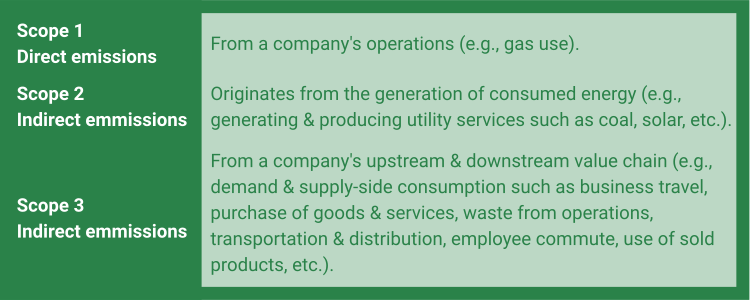 The European Union's Corporate Sustainability Reporting Directive already pulls value-chain emissions into scope for thousands of undertakings, and comparable regulations are advancing across the Asia-Pacific region. The common thread is that the emissions a company does not own — those generated by its suppliers and service providers — are now reportable, auditable and increasingly difficult to estimate.
Most Scope 3 programs handle their recurring suppliers reasonably well. The contracted janitorial firm, the standing HVAC maintenance provider and the annual landscaping vendor produce predictable spending and repeatable data requests.
The gap lies elsewhere: in the specialty-trade vendors who enter a facility reactively. Water-damage restoration crews, fire and smoke remediation contractors, mold and asbestos abatement teams, and emergency mechanical repair services arrive after an event, not on a schedule. They are some of the most carbon-intensive activities a building will ever host — heavy equipment, generators, demolition, hauling, and large volumes of disposed and replaced material — and they are largely invisible in the corporate carbon ledger.
 Why reactive work falls through the cracks
Under the GHG Protocol, the emissions from these vendors generally land in Scope 3, Category 1 (Purchased Goods and Services) and Category 5 (Waste Generated in Operations). California's 2027 Scope 3 phase-in concepts place Categories 1 and 5 in the first wave — precisely where restoration and specialty-trade activity concentrates. The exposure is not deferred; it is first in line.
The problem is structural. A restoration contractor is engaged in the worst hours of a building's life: after a burst pipe, a kitchen fire or a flooded server room. Procurement happens under duress, often through an insurance carrier or third-party administrator rather than the facility's normal sourcing channel. The vendor is selected for speed and certification, not for reporting maturity. Most restoration firms have no mechanism for producing emissions data and no contractual reason to start. The engagement ends, the invoice is paid and the carbon goes uncounted.
Restoration is only the sharpest edge of a much wider pattern. The same invisibility attaches to nearly every trade that crosses a building's threshold outside the recurring-services contract: the emergency plumber, the crew swapping a failed compressor, the abatement team, the specialty contractor brought in for a one-off. It extends into capital territory. Replacing a chiller, re-roofing, modernizing an elevator, retrofitting a building-management system — this is the restoration and renewal of the building itself, and it carries some of the largest embodied-carbon line items an occupier will ever report. Such equipment falls under Scope 3, Category 2 (Capital Goods); the old units hauled away and the demolition debris fall under Category 5. Whether the trigger is a flood or a planned capital improvement, the carbon enters and leaves through the same door — recorded by no one.
A burden that belongs to the occupier, not the owner
Here a distinction the FM profession understands intuitively becomes financially consequential.
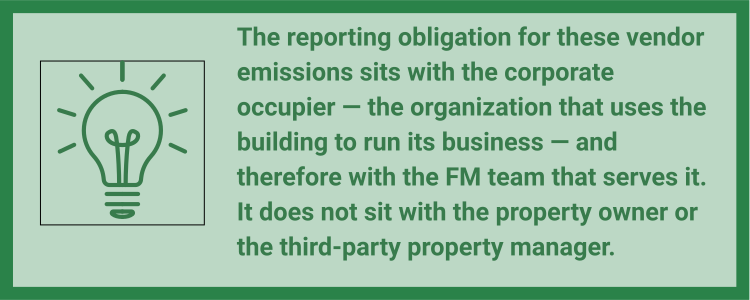
The two roles report to fundamentally different standards. A property owner or manager carries an asset-side burden, measured through frameworks such as GRESB, ENERGY STAR benchmarking and local building performance standards; the questions concern the building's energy intensity and the embodied and operational carbon of the asset. A corporate occupier carries an operational disclosure burden under the GHG Protocol, SB 253 and CSRD; the questions concern the emissions generated during the organization's own operations — including the contractors it hires. When a restoration crew dries out a corporate occupier's flooded office, those emissions are the occupier's Category 1 line item, regardless of who holds title to the building.
Conflating the two leads reporting teams to assume the landlord will somehow account for restoration carbon. The landlord will not. It is not the landlord's Scope 3. It is the occupier's — and the FM is the only person in the organization who knows when the crew showed up, what they did and what left the building on a truck.
The profession with the most leverage
If the obligation lands on the occupier, so does an opportunity no other party in the built environment can claim. Three groups touch this work, and only one is positioned to standardize it.
The vendors are siloed. Each trade optimizes its own job and sees only its own slice; a restoration firm, a mechanical contractor and an elevator modernizer share no common data format and have no commercial incentive to invent one. Asking a fragmented, reactive vendor base to self-organize around emissions reporting has already been tried, and it has not produced a standard.
The property owners and managers are removed. Their work happens at the portfolio and reporting level — benchmarking assets, answering investor questionnaires — not in the mechanical room when the decision is made about how a failed unit leaves the building. They can write lease clauses, but they are not present at the point of work.
The FM is neither siloed nor removed. The FM is inside the building, at the friction point where every one of these trades is authorized, scoped, supervised and signed off. That position is leveraged in the most practical sense: the power to make standardized emissions data a condition of access and of payment, applied uniformly across every contractor who enters — the plumber, the restoration crew and the capital-project team alike. No vendor can impose that consistency from inside its silo, and no owner can impose it from the portfolio level. Only the occupier's facility team sits at the single chokepoint through which all this work flows.
That makes the FM profession — and the organizations that represent it — the natural origin point for leadership on contractor Scope 3 data. The party with the most operational control over the work is also the one with the most to gain from capturing it cleanly, and the most standing to set the expectation that the trades will meet.
Why estimation is running out of room
For years, the answer to hard-to-collect Scope 3 categories has been the spend-based proxy: multiply dollars by an industry-average factor and move on. That route is narrowing. The GHG Protocol's ongoing Scope 3 revision prioritizes primary, supplier-specific data over industry averages and signals that corporate-level allocation will no longer suffice for diversified suppliers whose activities vary widely from job to job. A restoration contractor is the textbook diversified supplier: a smoke-damage job and a Category 3 water loss produce radically different emissions for similar invoice totals. An average buries exactly the variance that matters. Coverage expectations compound the pressure — the guidance that companies account for most Scope 3 emissions leaves little room to quietly exclude an entire class of high-intensity work. The EU's Omnibus package has introduced some bounded proxy-data flexibility for European filers, but that is a reason to standardize intake, not abandon it. The direction of travel is the same everywhere: toward primary data, captured at the job, documented at the source.
Emerging methodologies for closing the gap
A handful of practitioner-led methodologies are filling the void. Industry groups are developing standardized vendor emissions questionnaires; carbon-accounting platforms are adding supplier data-request modules; and at least one open framework, the Restoration Carbon Protocol, has been published to make reactive restoration work machine-readable. Its core artifact is a compact per-job record — on the order of a dozen fields — in which each data point is mapped to its GHG Protocol category and a named emission factor, and each value is flagged as either primary data or a proxy. Captured fields typically include equipment and vehicle runtime, fuel and power source, chemicals and consumables, debris volume by waste stream, disposal method and facility, and demolished versus replacement materials.
The specific framework matters less than the pattern these efforts share: the data must be captured at the job, by the contractor, at the moment of work, in a structure the occupier's reporting team can ingest without rekeying. The FM’s task is not to perform the emissions math. It is to build the intake — to make standardized data a condition of the engagement before the next emergency, rather than a forensic reconstruction after it.
A practical intake for FMs
Three moves convert principle into program.
First, a contractor emissions checklist attached to every reactive engagement and capital project. At minimum, it should capture equipment and generator runtime with fuel type; vehicle trips and approximate mileage for crew and hauling; debris volume by waste stream with disposal method and receiving facility; quantities of material demolished and removed versus installed in replacement; and the job's classification and duration. Each item should be tagged primary or estimated, so the reporting team can see data quality at a glance.
Second, procurement language that makes the data nonoptional. A short clause in the master services agreement or vendor onboarding packet — "Vendor shall provide per-job emissions data in the requesting organization's specified format as a condition of final invoice approval" — moves collection upstream of the crisis. Contractors respond to contract terms and payment triggers far more reliably than to post-event questionnaires, and the same clause fits neatly inside the green-lease provisions many occupiers are already negotiating.
Third, an ingestion framework that routes the data into the existing Scope 3 inventory rather than a spreadsheet. That means deciding in advance which Category 1, Category 2 and Category 5 buckets each field maps to, defining acceptable proxies for the cases in which a vendor cannot supply a number, and documenting the factor source and vintage used — the provenance discipline assurance providers are beginning to expect across all of Scope 3.
The window is now
The first SB 253 deadlines arrive in 2026, Scope 3 follows in 2027, and the value chains of European-exposed multinationals are already inside CSRD's reach. Reactive vendors and capital projects do not become easier to capture after the deadline; they become easier only when the intake is built before the next loss.
 The rest will be reconstructing carbon from invoices, after the trucks have gone.

William Tygart is the founder of Tygart Media, a content infrastructure firm focused on built-environment ESG data standards and the contractor-side reporting frameworks that support corporate sustainability disclosure. His work explores how facility management, restoration contracting and emerging regulatory regimes intersect at the Scope 3 reporting boundary.
References
Top image via Getty Images.
Read more on Sustainability and Facility Operations or related topics Operations and Maintenance Planning , Sustainable Facility and Carbon Footprint
Explore All FMJ TopicsRelated articles
-

Smart Building Control Systems
The foundation for a grid-interactive buildingBy Andre Marino09.25.2024 -

Smart Building Innovation
Cutting costs & carbon footprints without compromiseBy Andrew Butterworth09.12.2024 -

Chart the Path
Building sustainable cities & a sustainable futureBy Izzat Ali Khan & Aykean Forde12.16.2024