 Membership
 Network
 Regional Sites & Affiliates


 Events
 Participate
 Resources

 Training
 Credentials
 Government


 Content Channels
 Tools
Tools


 Business Overview





Constant Contact
Communication tech's role in long-term business continuity
In 2020, a whirlwind of uncertainty swept the globe as businesses met a challenge that was previously unaccounted for in their strategic plans: a pandemic. From pivoting to a remote work model to finding new ways to meet safely, two questions have loomed over the facility management industry since the start: How (and when) will the world get back to normal? And what changes are needed to ensure a smooth transition back?
In the last year, many organizations opted to keep employees working remotely, wherever possible. Now, with a viable vaccine rolling out and eyes are ahead to a still uncertain future, FM teams are tasked with preparing buildings for capacities more closely resembling pre-pandemic, while remaining flexible and agile in their preparations for whatever comes next. These facility reopening plans must include strategies that best serve a population that is equally apprehensive and excited about the possibility of returning to them.
Communications technology can support FMs in creating more effective, accessible and data-rich environments across numerous industries. This technology can take the form of all-in-one software platforms, physical digital displays for wayfinding with built-in communications functionality, thermal screening kiosks and more.
Digital signage for wayfinding & traffic control
Wayfinding and signage in buildings has long been an important consideration for FMs. They maintain traffic flow, provide key information points and relieve receptionists or other front-line workers in a building.
Interactivity is one of the key benefits that digital signage and wayfinding brings over traditional building directories or static signs. Effective modern wayfinding is more than just showing a visitor where they need to go in a building — it provides suggested routes, such as one-way traffic flow, syncs with real-time data to show occupancy and can be updated by FM and IT teams with little technical savvy needed.
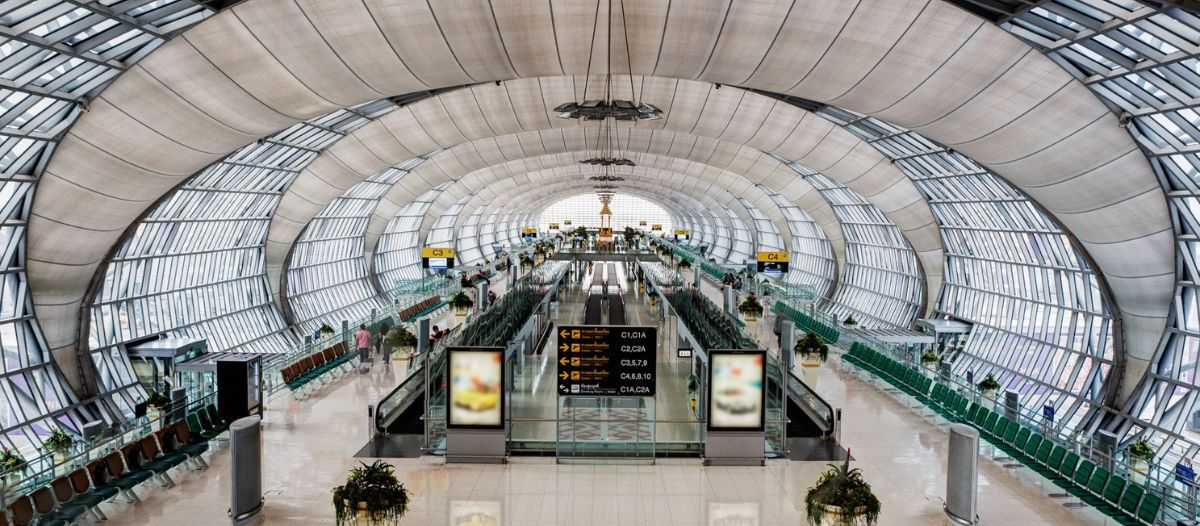
Post-COVID-19, the way in which this interactivity occurs is even more critical. Providing visitors with ways to safely access information, push updates to hundreds of displays and show building occupancy is important to ensure safety protocols are met. In the past, groups of people clustered together around maps at an airport, for example, to determine gate locations, find food and shopping, or entrances and exits.
Now, social distancing requirements challenge this old way of accessing information. Touchless access and control reduce physical touchpoints, control crowds and support social distancing whether it is through voice commands, gestures or mobile QR code scanning. A visitor can simply walk up to a digital sign, point their mobile phone at a QR code, and instantly be connected to the same map with wayfinding functionality from their own personal device. This functionality is not limited to malls or transportation hubs – practically any building can benefit from implementing signage that can be accessed via QR codes. For buildings that already had digital signage, this functionality can usually be added to existing signage easily.
Thermal scanning & temperature checks
One important tool for facilities that exploded in popularity after the onset of COVID-19 is thermal scanners. Temperature checkpoints became mandatory in buildings as an added layer of protection against viral spread. At an entry, providing a temperature screening before a building visitor has entered traffic-heavy parts of the venue can significantly reduce the risk to other visitors and help notify staff when there is risk of viral spread in the facility. Many of these thermal scanners are built into full kiosks or displays. Another popular feature often grouped alongside thermal scanning in these displays is instant video calling to connect a receptionist or other employee to voice chat with an individual remotely to provide next steps and instructions after the scan has been completed. This ensures that the screening and check-in process is seamless, as well as safe, by eliminating the need for face-to- face interaction.
Depending on the venue’s need, the check-in kiosks can be customized with an abundance of features: touch-free navigation, facial and mask recognition, multi-user recognition, informative displays for communicating guidelines or accessibility to maps for one-way navigation. To reduce touch points, many kiosks can be equipped with voice control prompts and hands-free video calling to allow for instant communication and directions. Even as a vaccine is rolled out, the use of temperature checkpoints will likely remain an important tool for ensuring public comfort and inspiring public confidence in returning to offices and other buildings.
AR-based wayfinding
Beyond temperature scanning, wayfinding technology backed by AR will also be important for building accessibility in the future. One example of this is on a large corporate campus. A visitor could approach a digital sign with built-in wayfinding, scan the map with a QR code, access the most direct or required route (i.e., one-way traffic only to reduce physical touchpoints), and with AR capabilities, be given step-by-step directions through their smartphone’s camera. This technology allows FMs to easily map out routes for building occupants and helps ensure compliance as buildings reopen and prepare for the future.
The ability to add pop-up notifications as a user is walking through a route is also compelling. For example, a notice about a restricted section of a building or an area with bathrooms, is easily seen in real-time instead of having to navigate back to a mobile or physical map.
Sensors for powerful, actionable data
The ability to access detailed occupancy and building data is a game changer for FMs looking to closely monitor occupancy, set increased regular cleaning schedules and make decisions on space management, along with other important facility considerations.
Take for example, a large office building that is phasing in employee reoccupancy. Sensors embedded in lighting, displays and meeting rooms are all collecting data on how a space is being used.
FMs can use this data to plan space allocation or schedule cleaning for workspaces that are rotated out or even relocated if a department or employee is infected. If they find that a certain meeting space is consistently not being used, or being used more frequently upon building reopening, they can dedicate additional cleaning time to that space. They could also use that same data to make decisions that feed into office management and IT teams.
Hotdesking is the ability to quickly and efficiently adjust or dedicate spaces for work or meetings. This practice can help employees feel safe about the desk, office or meeting room they are occupying, when it was last cleaned and who the last occupant was for contact-tracing purposes. It is another example of how sensor-based data can be made actionable. This floorplan data can be leveraged by management teams to determine new approaches to social distancing to gain insight into which floor configurations are working and have real-time access to how employees are navigating within the office space.
FMs can leverage usage data gleaned from sensors, voice commands and more to auto-generate the best schedules and shortest paths to ease of accessibility, with health in the forefront of the analysis.
Building data can also be leveraged for making decisions around improving energy footprints — the move toward sustainability continues gaining momentum as FMs are tasked with finding ways to ensure buildings are operating within energy efficient guidelines.
Conclusion
There are a multitude of considerations for FMs in preparing buildings for reopening and ongoing management post- COVID. Communication technology such as digital signage, wayfinding and content management systems bring people together, communicate changes and important messages, streamline operational costs and resources, and support productivity. When implemented into a larger operations plan, this technology is an important tool to bring teams back to work safely and keep businesses working effectively.

Tomer Mann, chief revenue officer at 22Miles, has more than 15 years of expertise in digital signage. Committed to enhancing visual communication services for diverse sectors, he innovates to simplify digital content and elevate user experiences.
Read more on Communication and Real Estate or related topics Communication Management and Space design and planning
Explore All FMJ Topics