
 Membership
 Network
 Regional Sites & Affiliates


 Events
 Participate
 Resources

 Training
 Credentials
 Government


 Content Channels
 Tools
Tools


 Business Overview





Construction-to-FM Hard Service Transition Strategy
Logic, methodology & workforce design for new assets

In many new developments, handovers are treated as the moment when the project team gives keys, drawings, certificates and assets to the facility management team. This view is too narrow. Construction completion does not automatically create operational readiness. A system may be installed but not maintainable. A certificate may exist but not be easily retrievable. A defect may be known but not assigned. A technician may know how to repair equipment but not how to record, escalate or communicate.
The most difficult part of transition is not the asset transfer itself. It is the conversion of a project delivery organization into a service operation. The people may remain the same, but their success criteria change. A construction site rewards speed, coordination and completion. FM operation rewards safety, reliability, customer trust, auditability, life cycle cost control and continuous improvement.
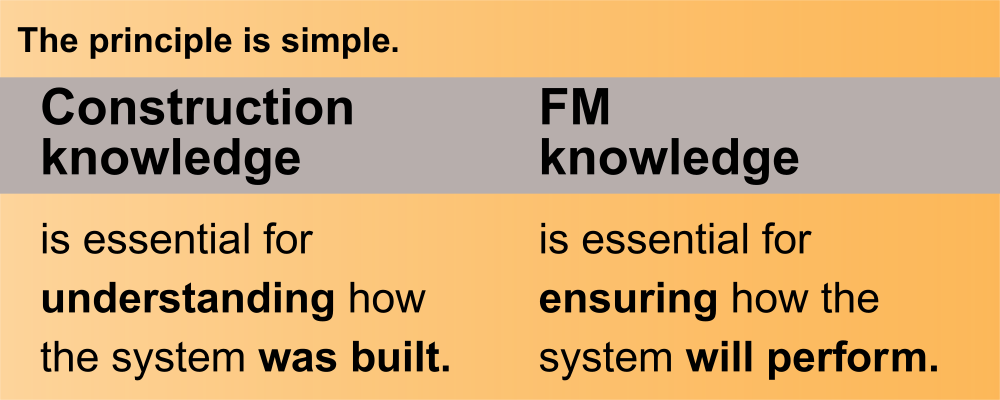
The purpose of a transition strategy is to protect both forms of knowledge. Construction-background personnel understand site history, hidden issues, contractor interfaces and system boundaries. FM-experienced personnel understand service delivery, preventive maintenance, SLA/KPI management, reporting, supplier control and customer communication. A strong transition blends both.
Methodology & logic
The proposed methodology follows four questions:
-
What stage are we in?
-
What is the main operational risk?
-
What mix of people is needed?
-
What evidence proves readiness?
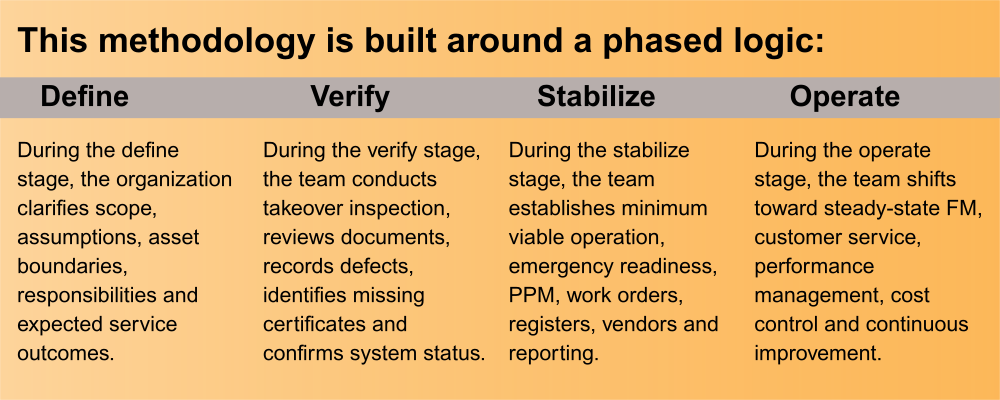 The methodology should be applied through a visible governance rhythm. This includes weekly transition reviews, a single action tracker, clear owners, target dates, evidence requirements and escalation rules. Without this rhythm, transition becomes a collection of good intentions. With it, leadership can see whether readiness is improving, whether responsibilities are clear and whether the operation is moving from project dependency to service control.
This approach prevents two common mistakes. The first is over-reliance on construction personnel, which can leave the operation reactive and weak in service discipline. The second is over-reliance on FM personnel who lack project history, which can cause missed defects, unclear warranty responsibility and slow system familiarization.
Table 1. Stage logic & main objectives
|
Stage |
Main Objective |
Dominant Logic |
Key Evidence |
|
Construction |
Complete the asset safely and according to design |
Delivery, schedule, quality, commissioning |
Test records, completion certificates, commissioning reports |
|
Takeover inspection |
Clarify what can be accepted, what is defective and what is missing |
Verification, risk, responsibility boundary |
Takeover minutes, defect register, baseline report |
|
Vacancy or pre-occupancy operation |
Protect assets and maintain minimum safe operation |
Preservation, compliance, readiness |
PPM records, emergency logs, BMS trends, reports |
|
Stable operation |
Deliver reliable, customer-facing FM service |
Service, performance, life cycle value |
KPI dashboard, work orders, audits, customer feedback |
Role changes across the transition
Job titles may remain unchanged, but role meaning changes significantly.
A site manager
-
In construction, focuses on progress, coordination and issue resolution.
-
During takeover, the same level of manager must organize inspection, confirm scope, manage exceptions and protect the operator from unclear responsibility.
-
In FM, the manager becomes a service leader responsible for client confidence, resources, risks, budgets, KPIs and team maturity.
A supervisor
-
In construction, pushes work forward.
-
During takeover, the supervisor leads inspection teams, verifies locations, captures evidence and classifies issues.
-
In FM, the supervisor controls shift, inspections, work orders, safety behavior, response performance and closure quality.
An engineer
-
In construction, focuses on design compliance, installation, testing and technical clarification.
-
During takeover, the engineer must judge maintainability, operability, missing information, warranty exposure and system readiness.
-
In FM, the engineer should become a reliability and life cycle thinker, using root cause analysis, data trends, energy review and maintenance strategy.
A technician
-
In construction, is usually task oriented.
-
In FM, the technician must be safe, responsive, service-minded and evidence-minded. Repair skill alone is not sufficient. A mature FM technician follows SOPs, uses permits, protects customers, records findings, closes work orders properly and escalates risks.
Table 2. Role mindset shift
|
Role |
Construction Mindset |
Takeover Mindset |
FM Operation Mindset |
|
Manager |
Deliver the project |
Accept only with clarity and evidence |
Lead service, risk and performance |
|
Supervisor |
Push tasks and crews |
Check, record and classify |
Control shifts, work orders and closure |
|
Engineer |
Meet design and technical requirements |
Confirm readiness and maintainability |
Improve reliability and life cycle performance |
|
Technician |
Complete installation or repair tasks |
Identify and record defects |
Serve safely, respond quickly and document fully |
Discipline-specific differences
Different technical disciplines require different transition ratios and objectives.
-
Electrical teams need project-background personnel during takeover because they understand distribution routes, switchgear history and testing gaps. However, stable FM requires strong discipline in switching procedures, permits, thermal scanning, essential loads and statutory compliance.
-
Mechanical and HVAC teams must move from installation and commissioning to comfort, humidity, ventilation, equipment preservation, filter management, water treatment and energy performance.
-
Plumbing teams must focus on flushing, stagnant water, sump pumps, odor, backflow and flooding response.
-
Fire and life safety teams require the highest compliance discipline: impairment control, fire watch, testing records, authority readiness and emergency response must be continuously maintained.
-
BMS and smart platform teams must shift from point installation to alarm management, trend review, offline device tracking, control logic governance and reporting.
Procurement, contracts & supplier management
The transition also changes procurement logic.
-
During construction, procurement is package-based and milestone-driven.
-
During takeover, it supports testing, defect correction, missing documentation, temporary controls and specialist verification.
-
During vacancy operation, it must create the minimum resource base: tools, PPE, MRO items, critical spares, emergency materials and call-out vendors.
-
During stable operation, procurement becomes a service assurance function.
FM supplier selection must look beyond price. Vendors should be assessed by qualification, response time, safety practice, reporting quality, spare parts access, statutory capability, warranty interface and emergency recovery support. A low-cost vendor without reliable response capability may create higher life cycle risk.
Contracts should also change. FM contracts should define scope, response expectations, reporting, evidence, escalation, safety obligations, spare parts logic, performance review and replacement mechanisms. Supplier management should be visible through approved vendor lists, call-out matrices, monthly reviews and corrective action tracking.
Recommended workforce mix
A phased workforce mix is recommended.
-
During takeover inspection, construction-background personnel should represent at least 60 percent of the team. Their site memory is critical for identifying hidden defects, system boundaries and contractor responsibilities.
-
During initial vacancy or pre-occupancy operation, the number of construction-background personnel may remain stable while new recruitment focuses on FM-experienced people.
-
During stable operation, construction-background personnel may remain as technical memory holders, warranty coordinators and system boundary experts.
FM-experienced personnel should still be included to assess future operation, documentation, service impact and evidence requirements.
A balanced ratio of about 50 percent construction-background and 50 percent FM-experienced personnel is practical.
However, as the team expands, FM-experienced personnel should become the majority. A long-term target of about 30 percent construction-background and 70 percent FM-experienced personnel is often healthy.
Table 3. Suggested manpower mix
|
Stage |
Construction-Background Personnel |
FM-Experienced Personnel |
Main Reason |
|
Takeover inspection |
60 percent or above |
Up to 40 percent |
Site history and defect identification are critical |
|
Initial vacancy operation |
About 50 percent |
About 50 percent |
Balance project memory with FM system building |
|
Stable operation |
Around 30 percent |
Around 70 percent |
Service delivery, KPIs and customer management dominate |
If construction-background personnel remain too dominant, the operation may stay reactive, informal and weak in documentation. If there are too few, the team may lose project memory and become dependent on contractors for basic history. The right answer is not replacement, but planned transition.
Organization design by stage
The organization should evolve with the stage. Construction organizations are package-based and project-driven. Takeover organizations should be inspection-based and system-based, with clear leads for documentation, defects, system verification and HSE. Vacancy operation should become building-based and shift-based, supported by mobile maintenance, BMS monitoring, planning, help desk, procurement and reporting. Stable operation should become a mature FM structure covering service delivery, engineering reliability, customer interface, compliance, energy, supplier performance and continuous improvement.
Keeping a construction organization unchanged after handover creates unclear accountability. Imposing a mature FM organization too early may also fail if asset baselines, documents and resources are not ready. A phased structure is therefore required.
6-month Transition Program
A six-month transition period is recommended for construction-background personnel.
Training should include customer service, FM service culture, SLA/KPI awareness, PPM, work orders, reporting, evidence control, HSE, permit to work, lockout/tagout, NCR/CAPA, root cause analysis, cost awareness, vendor management and communication.
Training should be practical, not classroom-only.
-
Mixed-team coaching is most effective.
-
Pair construction-background personnel with FM-experienced supervisors and engineers.
-
Review real work orders, real defects, real inspections and real reports.
-
Ask not only whether a problem was fixed, but whether it was recorded, communicated, closed and prevented from recurring.
Management should review the transition monthly using indicators such as defect closure quality, PPM compliance, response performance, safety behavior, report accuracy, customer feedback and repeat failures. This makes the transition visible and correctable.
From project completion to FM capability
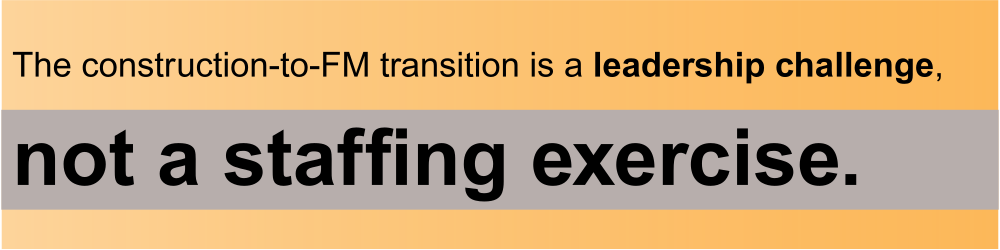 Project memory should be preserved, but converted into operational capability. A successful FM operation requires a blended team combining construction knowledge with FM maturity. Early, project memory protects the operator from blind takeover. Later, FM capability protects the asset from poor service, cost and repeated failure.
A mature FM operation shows clear capability. Managers provide direction, client confidence, coordination and accountability. Supervisors maintain shift control, discipline, inspection quality and escalation. Engineers apply data, reliability thinking and life cycle analysis. Technicians work safely, respond quickly and document properly.
Supporting functions matter. Document control makes information retrievable. Procurement ensures vendors, tools and spare parts support operations. HSE embeds safety into daily work. Planning and CMMS teams convert field activity into measurable performance. Energy and smart platform teams turn data into decisions. Customer communication becomes proactive and evidence-based.
Successful FM also depends on cultural consistency. A closed work order is a documented service event, not only a repaired asset. A monthly report is a management tool, not an administration tool. A supplier meeting is a risk control process, not commercial discussion.
The objective is not simply to move people from construction to operation. It is to build a team that understands the asset, controls risk and protects service quality. When planned, trained and measured, a new asset can move from project completion to reliable operation.

Xingya Yong, CFM, FMP, is a senior facility management professional with over 20 years of experience in technical operations, hard services management, project transition and integrated FM system development. He has led and contributed to major FM tendering, takeover inspection, technical proposal development and performance management initiatives across China and the Middle East, with strong expertise in ISO 41001, QHSE, SLA/KPI management, CMMS, maintenance strategy, vendor coordination and operational readiness. Yong has extensive FM experience across industrial manufacturing facilities, laboratories, R&D environments, corporate offices, commercial complexes, international airport terminals, CBD city-operation projects, critical environments, multi-site portfolios and large-scale hard services operations. He combines practical engineering knowledge with strategic FM management capability, positioning him as an experienced FM practitioner in international hard services and operational management.
References
Top image via Getty Images.
Read more on Leadership & Strategy , Project Management and Communication or related topics Team Management , Project Closeout and Communication Management
Explore All FMJ TopicsRelated articles
-

Artificial Intelligence in FM
The stakeholder’s perspectiveBy Dr. Jake Smithwick & Dr. Kenneth Sullivan & Nneka Ubi05.01.2024 -

Mastering Change in Hybrid Environments
Insights from global operational leadersBy Meg Swanson09.02.2024 -

Plugged In
Solving the data disconnect in real estate and FMBy Amanda Muzzarelli & James Waddell07.01.2024