 Membership
 Network
 Regional Sites & Affiliates


 Events
 Participate
 Resources

 Training
 Credentials
 Government


 Content Channels
 Tools
Tools


 Business Overview



Data, Not Dogma
Attracting more employees back to the office

With more organizations rethinking their workplace management strategies to meet the new challenges facing hybrid work, the most forward-thinking workplace leaders see their hybrid strategy as an evolving ecosystem rather than a fixed blueprint.
Because hybrid workforces are dynamic, their needs shift with new projects, changing seasons, hiring cycles and leadership changes. Collaboration intensity also tends to rise and fall. To meet these swings, and ensure workplace strategies remain relevant, workplace leaders now require fresh methodologies that treat the workplace like a living laboratory. The management of hybrid work must become a continuous global experiment in how people connect, collaborate and create value.
The first experiment was an attempt to get more workers back into the workplace by imposing strict return-to-office (RTO) mandates. But many companies have since learned that RTO mandates in hybrid work environments are rarely effective. Instead, they are often counterproductive and tend to trigger employee resistance, reduce trust and harm morale.
While RTO mandates are meant to boost collaboration and productivity, evidence shows employees see them as control, not collaboration. As a result, mandates frequently harm employee satisfaction, retention and well-being, with little proof of consistent productivity gains.
RTO policies also often fail because they do not address why employees are not coming in, such as poor work environments, unclear purpose or friction-heavy commutes to the office. In addition, blanket rules tend to ignore role differences, personal circumstances and global cultural contexts.
 Facility management teams play a key role in this important shift by being repositioned as ongoing stewards of workplace experience, not just custodians of space or deliverers of one-off projects.
Accurate occupancy and collaboration data is the most powerful tool workplace leaders and FMs have as they try to create a high-performance workplace in the global hybrid world.
Occupancy data shows which spaces are popular, underutilized or overcrowded, while collaboration data highlights when and how teams interact (frequency, patterns, duration and who needs to sit near whom). It also identifies true collaboration hotspots versus areas that only appear busy.
Constantly gathering and analyzing this space usage data will help organizations improve their hybrid workplace by designing tailored workspaces that reflect employees’ real needs, and work schedules that genuinely enhance the employee experience, thus the appeal of the office.
To build this evidence base, organizations must gather insights from multiple sources, such as:
-
Employee workplace surveys: To capture sentiment, preferences and pain points.
-
Interviews & focus groups: Provide qualitative depth. Some companies initiated an employee-led led working group into their space redesign, ensuring frontline voices shaped the outcome.
-
Space utilization data: Occupancy sensors and Wi-Fi signals can accurately reveal real-time usage patterns, measuring how a space was used and how full or empty the space was over a given time frame.
-
Booking systems: Analyses of desk and room reservations will show demand trends and highlight bottlenecks.
Accurate collaboration data can also be obtained from meeting-room analytics, digital collaboration platforms, cross-team scheduling tools, calendar metadata and visitor logs.
It is essential for FM teams to monitor the five core metrics that help shape hybrid strategy:
1. Occupancy & vacancy - How many seats are filled versus empty?
2. Utilization rate - How often are spaces used relative to their capacity?
3. Attendance patterns - Which days and times see peaks or troughs?
4. Sharing ratios - How many employees share desks or rooms, and is the ratio sustainable?
5. Experience, engagement & sentiment - How do employees feel about the space, and does it support their productivity and well-being?
 Similarly, accurate measurement of space utilization can be split into five metrics:
 Average office space utilization rate
The average percentage of space in a building, floor or zone occupied by employees compared to the space’s total capacity over a specific period.
 Peak space utilization rate
The utilization rate of office spaces when they are at their peak (or highest) people count. This rate is typically used to determine which day of the week is the busiest, but it can also be used hourly.
 Weekly space utilization patterns
The daily utilization rate over a standard working week that illuminates weekly occupancy patterns. For most organizations using hybrid working, weekly space utilization rates tend to peak on Tuesdays, Wednesdays and Thursdays, and drop on Mondays and Fridays.
Long-term space utilization trends
The overall direction of office space utilization in the long term. Similar to weekly space utilization, but with the intent of tracking how employees use the office space over weeks, months and years.
 Predicted space utilization rate
Expected workplace space utilization levels based on current patterns and trends.
Accurate data using the above metrics provides an objective insight into how often spaces are actually used, not how often management believes they are used. It also reveals peak days and times, underused zones and any mismatches between supply and demand.
In addition, measuring space usage from a mix of sources enables FM teams to cover the organization’s entire portfolio while attaining the right level of detail more broadly for smaller spaces like meeting rooms and collaboration spaces.
Together, these metrics provide a holistic view. They do not just measure how space is used; they show how it is experienced. When combined with collaboration data — who meets who, how often, and in what formats — these insights can be transformed into evidence-based personas of workplace behavior that will inform decisions about office layout, team neighborhoods and meeting space ratios.
Integration is the key to developing a successful strategy for hybrid work environments. Data alone is meaningless unless FM teams can take advantage of the latest AI-driven workplace technology to connect the dots. They need to gather diverse quantitative and qualitative datasets, integrate these insights to reveal patterns; then share their findings in compelling ways that engage stakeholders, thus enabling the data to be translated into design and scheduling decisions.
Because hybridwork is not static, an ongoing cycle of test > learn > refine will ensure continuous improvement and keep the workplace in line with evolving employee needs and work patterns.
An approach that includes pilots of new layouts, new team zones and scheduling patterns, combined with feedback loops through surveys and behavioral analytics, will reduce the guesswork behind office redesigns. The result will be a workplace that evolves with employee behavior, rather than one frozen in outdated assumptions. It means the office will become the easiest place to do certain kinds of work — not a place where employees begrudgingly commute to sit in on more video calls.
In the past, organizations tried to lure employees back into the office with perks, such as free lunches, ping-pong tables or wellness rooms. While these may be appreciated, they are no longer sufficient. Employees now demand a purposeful reason to come into the office. They also want meaningful connection and environments that support their work. Data-driven strategies provide the foundation for delivering all of these expectations.
Encouraging purposeful collaboration will foster innovation and make presence more meaningful, while aligning workspaces with tasks will enhance productivity. When employees feel the office amplifies their work rather than obstructs it, higher performance will naturally follow.
But such a major shift requires workplace leaders to reframe the office as a hub of collaboration, culture and meaning,not a compliance checkpoint. This means in-office time must be meaningfully different from remote time, and leaders should transparently articulate the why behind office time, supported by evidence not obligation.
 Workplace leaders can cultivate purposeful presence by aligning natural team rhythms (sprints, retrospectives, onboarding cycles) with physical presence to maximize collaboration. They can also use data-led insights to create intentional, value-driven office days. This includes initiatives such as project kick-offs, community events and collaboration days. In addition, emotional and cultural incentives will help foster mentorship, innovation energy, social connectedness and a greater sense of belonging.
Scaling AI-informed tools responsibly and consistently across the whole organization, with human oversight, also has a key part to play in the shift to data not dogma and purposeful employee presence:
-
AI can automate experimentation by constantly analyzing usage patterns and recommending adjustments.
-
Sensor-plus-AI combinations provide real-time occupancy dashboards and space optimization recommendations.
-
AI improves forecasting: predicting peak days, space demand and team co-presence needs.
-
Intelligent scheduling systems automatically suggest optimal in-office days for teams.
-
AI-informed tools can map collaboration networks to identify connectors, bottlenecks and high-value interactions.
-
AI-supported experience apps can guide employees to available rooms, quiet spaces or colleagues on site.
-
AI also enables FM teams to make proactive, data-rich decisions rather than reactive ones.
With the hybrid world inherently global, multinational organizations must also balance this reframing of the office with the cultural differences, regulatory environments and diverse employee expectations in the territories in which they operate.
In some regions, employees may value collective rituals and prefer synchronized office days. In others, individual autonomy may be paramount, requiring more flexible scheduling. FMs must adapt workplace strategies to local contexts while still maintaining global coherence.
Here again, data not dogma must be the guiding principle. Evidence will reveal what works best in each setting, preventing leaders from imposing a single one-size-fits-all model across diverse geographies.
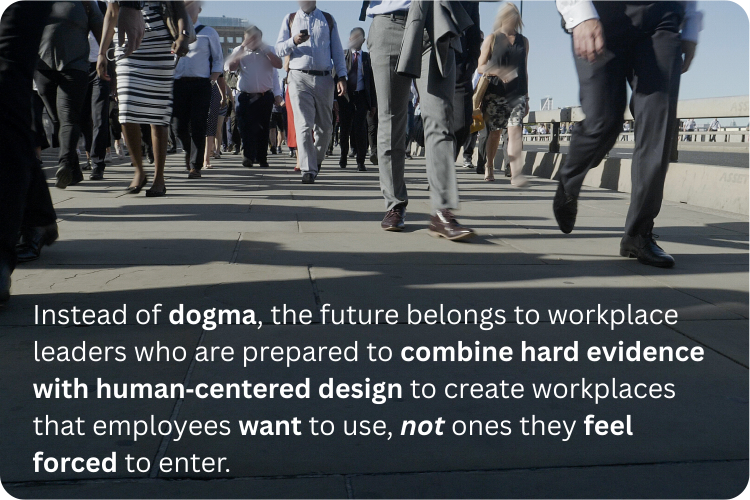
The lesson is clear: across global workforces, dogma and decree are blunt instruments in a nuanced hybrid world. By harnessing accurate occupancy and collaboration data, tailoring workspaces and schedules, and communicating the why behind in-office presence, the office will cease to be a place where employees are forced to go. Instead, it will be a place where they choose to go, and organizations will be better placed to create thriving, high-performance hybrid workplaces.

Stefania Vatidis holds a BS degree in Business and Political Economy from NYU's Stern School of Business. She joined leading workplace solutions provider HubStar as a strategist in 2023 and was recently promoted to Growth Marketing Manager. She is a regular contributor to leading FM and HR publications on key workplace issues.
Read more on Workplace , Emerging Topics , Occupancy & Human Factors and Facility Technology & Data Management or related topics Data strategy and information management , Space Management , Workplace Utilization and Collaboration
Explore All FMJ Topics