
 Membership
 Network
 Regional Sites & Affiliates


 Events
 Participate
 Resources

 Training
 Credentials
 Government


 Content Channels
 Tools
Tools


 Business Overview





Driving Down Retail & Restaurant Energy Costs
Using EMS to take control
Optimizing energy spending is a perennial challenge for facility managers at multi-unit retailers and restaurants. The condition of their energy-intensive capital equipment — such as HVAC, lighting, signage, refrigerators, freezers, ovens, fryers and dish machines — has a critical impact on their shoppers’ or diners’ experience, which in turn affects revenues and profits. Brands thrive when guests can always depend on an attractive and comfortable environment, or a perfectly prepared signature treat, no matter which location they visit. That incentivizes them to return and bring new customers. Equipment must operate efficiently and effectively for that to happen.
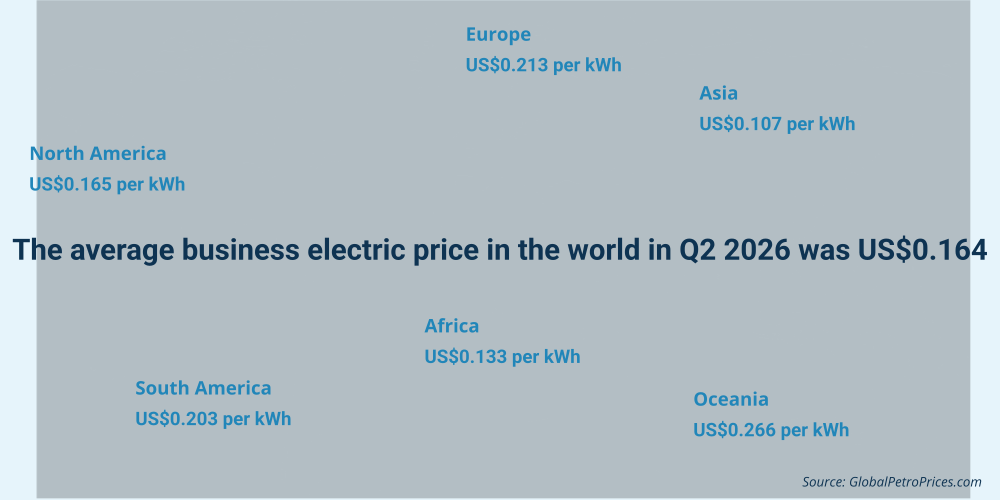
But retail and restaurant FMs must balance their brands’ dependence on this equipment with today’s economic realities. Recent energy prices have been high around the world. According to GlobalPetrolPrices.com, average business rates for electricity rose 7.13 percent worldwide from Q1 2025 to Q1 2026. In the first quarter of this year, Oceania had the highest business rates (USD 0.243 per kWh), with Europe close behind (USD 0.217). In the U.S., electricity prices have risen faster than the cost of living for several years.
 Taking control through energy management
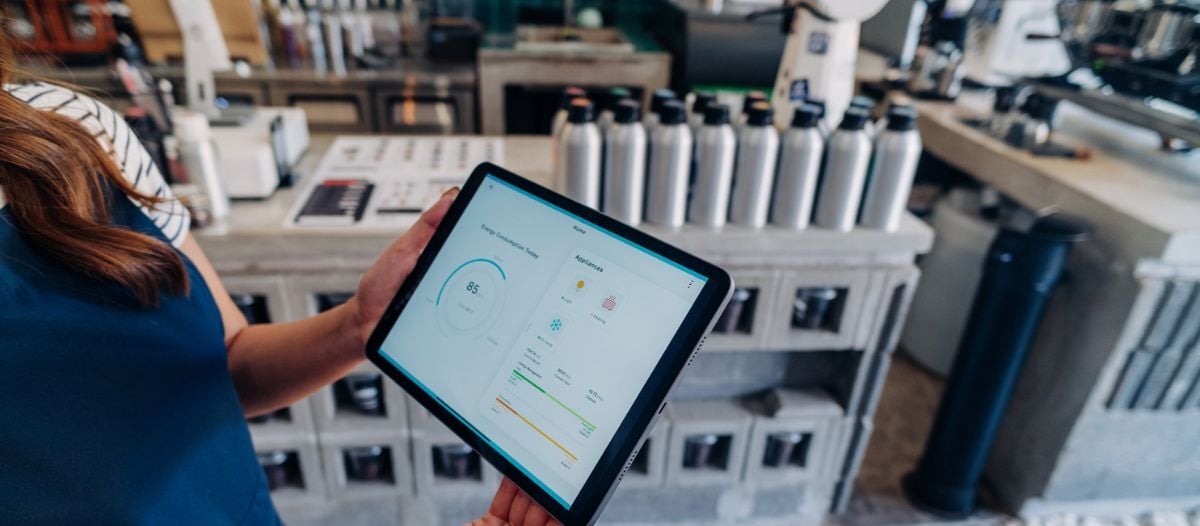
Energy management systems (EMS) based on Internet of Things (IoT) technologies help retail and restaurant FMs elevate the shopping/dining experience while minimizing their energy spending. FMs harness these systems to control and monitor their capital equipment from a single platform — even for global portfolios. These systems help FMs ensure that every piece of equipment is performing at its peak. They also provide an early warning system to prevent quality and safety issues, such as food spoilage because of a malfunctioning refrigerator.
The process of installing an energy management system is relatively simple and straightforward. Many FMs subscribe to these systems as a service. Their partners install gateways, sensors and thermostats at each location, connecting their capital equipment to the cloud.
Once installation crews complete this process, which usually takes no more than a day at each site, FMs have instant visibility into what is happening with their equipment across dozens, hundreds or thousands of locations, and often surface a surprising number of hidden issues. Actionable equipment data, dashboard reports and alerts to outliers (such as freezer temperatures rising in the middle of the night) empower them to uncover and prevent potential problems like breakdowns that can have serious financial consequences. One restaurant, for example, discovered kitchen staff cooking some proteins before fully defrosting them in time to preempt this hazardous practice. The system’s temperature data provided the early warning they needed. Another brand discovered a malfunctioning rooftop air-conditioning unit that kept running, undetected, because of a faulty switching issue. A third brand found that the top units of stacked ovens were wearing out prematurely because kitchen staff found it uncomfortable to bend down and use the lower units.
Harnessing automation capabilities
FMs not only save energy costs by paying attention to EMS data; systems’ automation capabilities contribute to savings, as well. FM teams use them to drive consistent temperature, lighting and signage regulation across the enterprise. They adjust set points and schedules to account for variables such as holidays, time zone changes or closures due to storms. This strategy by itself can lead to a 10-20 percent reduction in an enterprise’s energy costs. One major U.S. retailer with more than 1,000 locations lowered its spend by more than US$2 million per year by automating heating, cooling and lighting, as well as HVAC analysis.
Other areas that EMS solutions support include:
 Preventive maintenance: Successful management of energy costs depends on robust preventive maintenance programs. Industry research indicates that reactive equipment maintenance can cost three times as much as proactive maintenance. The costs cascade when equipment that could have been maintained breaks down. For instance, a convenience store with a broken freezer might have to discard thousands of pounds of food. A restaurant with the same issue might also have to close temporarily due to health regulations. Data from EMS software provides early indicators of pending breakdowns, such as frost buildup, in time to stop them from happening.
 Diagnostics for first-call resolution: When FMs request a truck roll, they always hope for first-call resolution. They use EMS to get closer to that goal. Newer systems have remote diagnostic capabilities and can even pinpoint a specific component that needs replacing. This helps ensure technicians have the advanced information and parts they need to immediately resolve problems when they arrive on site.
 Triage: When FMs have real-time insights into their equipment health, they are well positioned to build and update fix lists, prioritized by level of urgency, and make smart use of every truck roll.

Extend appliances’ useful life: It may or may not make sense to discard inefficient equipment that is far from the end of its useful life. EMS systems provide troubleshooting guidance to inform repair-versus-replace decisions. A system might recommend cleaning the coils of a sluggish refrigerator, for example. In some cases, that strategy can lower the unit’s energy consumption by 30 percent and delay its eventual trip to a landfill.
 Staff coaching: During cooler months, it is not unusual for retail staff to keep store doors open to entice shoppers to browse, wasting enormous amounts of heat. They may also override temperature set points if they detect problems with the thermostats and leave for the night before resetting the temperature. EMS data catches these problems across every location, prompting management to research their causes and initiate any necessary staff retraining.
 Simplifying complexity: How people shop is blurring the lines between convenience stores and restaurants. FMs navigating a C-store’s expansion into the restaurant business also must navigate a rising level of complexity. As they install more equipment with new functionality, EMS data simplifies it — enabling them to diagnose and fix problems they have not previously encountered.
 Tracking usage: Many European retailers and restaurants heavily track and report on the energy consumption of their cooking and refrigeration equipment. EMS data provides further insights and points to opportunities to change behaviors for additional savings.
 Reducing demand charges: In the U.S., a portion of retailers’ and restaurants’ electric bills, often 20-30 percent, is comprised of peak demand charges. These are based on the highest amount of power used during a specific period of time, such as 15 minutes. Many FMs integrate AI solutions with their connected HVAC equipment to drive down those costs. These solutions analyze variables such as operating patterns and weather predictions, then sequence HVAC loads so that they do not peak at the same time. This often lowers charges by an additional 5-10 percent, building on preexisting savings from energy management systems.
When retailers and restaurants take full advantage of these capabilities, the financial benefits can be significant. A restaurant brand saved more than US$20 million in energy costs and achieved a 21 percent reduction in energy usage by implementing an EMS across more than 800 locations. FMs used the system to:
-
 Monitor each HVAC unit’s energy usage at the breaker panel and record temperatures in the supply and return ducts. This helped them stay on top of issues such as short cycling compressors and rooftop units struggling to reach the second cooling stage.
 -
Develop thermostat setting templates to send to an entire region with one click or swipe, instead of programming every location’s thermostat separately.
-
Review weekly reports on walk-in refrigerators and freezers needing attention based on temperature data so that food safety limits were never compromised.
-
Track HVAC equipment performance enterprise-wide to prioritize replacements.
Going beyond energy
Other applications for these smart, IoT-based systems range from optimizing spending on fryer oil to automating routine tasks like temperature monitoring for increased operational efficiency. Even in inflationary times, there are savings opportunities to be had. The data from energy management systems gives multisite retail and restaurant FMs a new way to surface them across the enterprise.

Jay Fiske is president of Powerhouse Dynamics, an Internet of Things (IoT) solution provider for eliminating waste in the operations of multi-site foodservice and retail facilities. Fiske is a technology executive and investor with more than 30 years of experience building businesses and bringing innovative technology products to market. As president of Powerhouse Dynamics, he is responsible for the company's overall strategy and operations, including sales, marketing, R&D, finance, human resources and other administrative matters. Before joining Powerhouse Dynamics, he held leadership positions at several technology companies, including vice president of operations at Wakonda Technologies; general partner at the Massachusetts Green Energy Fund (MGEF), a venture capital fund focused on early-stage investments in climate technology; and various roles in business development and product management at Teradyne, Incorporated. Fiske holds an MBA and an MS in Mechanical Engineering from the Massachusetts Institute of Technology, where he was a Fellow in the Leaders for Global Operations (LGO) program, and a BS in Mechanical Engineering from Yale University.
References
Top image via Getty Images.
Read more on Sustainability or related topics Energy
Explore All FMJ TopicsRelated articles
-

Smart Building Control Systems
The foundation for a grid-interactive buildingBy Andre Marino09.25.2024 -

Smart Building Innovation
Cutting costs & carbon footprints without compromiseBy Andrew Butterworth09.12.2024 -

Chart the Path
Building sustainable cities & a sustainable futureBy Izzat Ali Khan & Aykean Forde12.16.2024