 Membership
 Network
 Regional Sites & Affiliates


 Events
 Participate
 Resources
 Training
 Credentials
 Government


 Content Channels
 Tools
Tools


 Business Overview



Driving Value with the Fitwel Portal
How to track and communicate workplace wellness improvements

The rise of the wellness market has spurred a new level of innovation across a range of industries as companies strive to differentiate themselves in pursuit of impacting the triple bottom line of people, planet and profits. The real estate industry is no exception, with buildings that promote health and wellness becoming an ever-increasing priority for REITs, developers and building owners. The Global Wellness Institute estimates that the wellness real estate sector grew 6.4 percent between 2015 and 2017, and it reached a value of US$134.3 billion in 2017. The organization went on to predict the sector will grow eight percent between 2017 and 2022, achieving an expected valuation of US$197.4 billion over that five-year period.
A decade ago, the idea of a “healthy building” was not widely understood or prioritized. Today, however, this concept has become unavoidable within the design and development industries as it is increasingly interwoven with the ever-growing focus on sustainability. As facility managers are increasingly well aware, the health-promoting aspects of buildings depend on a range of factors, including structural elements, design decisions and operational policies. The operational choices made by a facility manager directly impacts not only the building itself, but also the health and wellbeing of its occupants. Facility managers play a critical role in operationalizing strategic efforts and ensuring building priorities are successfully implemented. As the real estate industry has become increasingly focused on designing for human health, facility managers are leading the way in transforming these priorities into realities.
Driving investment
Unsurprisingly, the expansion of the wellness market has been largely supported by investors and the notable growth of Environmental, Social and Governance (ESG) and impact investing. Investors are looking to put their funds toward companies positively impacting the world, whether through decreased energy use, community investment, healthy design, or another meaningful commitment. In addition, 78 percent of millennials see workplace quality as important when choosing an employer. And 69 percent will trade other benefits for better workplaces. In an effort to attract both investors and employees, employers are beginning to place a stronger emphasis on workplace design and employee wellbeing. The state of the workplace is now viewed as vital to employee health, wellbeing and productivity. This directly impacts the role of facility managers, who are increasingly called on to operationalize health-promoting environments.
The Fitwel Certification System, developed by the U.S. Centers for Disease Control and Prevention (CDC) and the U.S. General Services Administration (GSA), and operated by the Center for Active Design (CfAD), provides evidence-based strategies to guide facility managers with their implementation efforts. It also provides the technology necessary to track project progress and report impact.
Increasing accessibility
Fitwel is accessed and administered through a web portal, which provides comprehensive information on the strategies, sample evidence and verification documentation required for certification. The Fitwel Portal was designed based on a vision of facility managers being able to walk through a property, iPad in hand, while selecting the strategies their building is already meeting and which ones would require additional enhancements. The Fitwel Portal also features a benchmarking option, which allows buildings to receive a numerical score that can be improved over time by enacting incremental changes.
By benchmarking a building, facility managers can view areas of opportunity and identify which strategies to prioritize in order to have the largest impact on occupants and achieve Fitwel Certification. With access to the Fitwel Portal, users are able to evaluate the current status of how their building is performing across evidence-based health metrics in a matter of hours.
The Fitwel strategies and metrics provide facility managers and property management companies with a tool to begin the conversation with building occupants and tenants around health-promoting design and operational strategies. Menkes Developments Ltd., an integrated real estate company with a property management arm, was able to employ the core concepts of Fitwel to launch its Healthy Spaces program. The certification system was used as a way to discuss the process and benefits with their building tenants.
Based on his experience applying Fitwel across the Menkes portfolio, Menkes Director of Sustainability Jon Douglas says, “We view Fitwel as a great initiative to allow us to engage with our tenants in new ways, and as a way to measure our performance in promoting health and wellbeing at our properties. We want to create opportunities for our occupants to live their healthiest lives by making this goal convenient and actionable to them, and Fitwel is a practical program to support Menkes in delivering on this objective."
Menkes has already successfully applied Fitwel in four of its buildings. They were able to use the certification system and the Fitwel Portal as tools to support the properties’ increased focus on health and wellness. Menkes Senior Property Manager Taryn Kelly says, “Fitwel has enabled us to gain valuable insight into the way we operate our buildings.”
Fitwel was designed with facility managers in mind. Before launching publicly, the Fitwel Portal and strategies were pilot tested by facility managers in 89 existing buildings across the United States in 2015. The buildings spanned rural, suburban and urban environments to ensure the system would be practical, rigorous and widely applicable. In a follow-up evaluation of the pilot study, 97 percent of participants reported that Fitwel’s portal is user-friendly, and 84 percent reported that they have a better understanding of how their buildings support healthy behaviors.
Since this study, the portal has been updated to provide additional functionality, increased automation and a smoother process for the user. Companies can now organize projects into portfolios, which they can break down by size, project type, region, or any other defining attribute. In addition, companies can add project collaborators as needed. This enables a full project team to engage with the Fitwel Portal. The portal currently has more than 1,000 users representing over 25 countries. In total, they are working on the more than 600 projects.
During the certification process, all communication between the project team and the Fitwel Certification Team takes place within the portal. While the Fitwel team is always available for questions, all formal submissions, reviews and certifications take place within the Fitwel Portal, ensuring that all documentation is hosted in one place.
 Data-Driven Enhancements
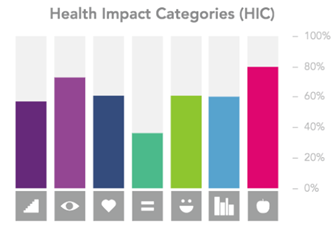
Through its digital platform, Fitwel also enables users to track a range of data points and evaluate the impact their projects are having on occupants’ health. Fitwel identifies impact based on seven Health Impact Categories:
-
Increases Physical Activity
-
Promotes Occupant Safety
-
Reduces Morbidity and Absenteeism
-
Supports Social Equity for Vulnerable Populations
-
Instills Feelings of Well-Being
-
Impacts Community Health
-
Provides Healthy Food Options
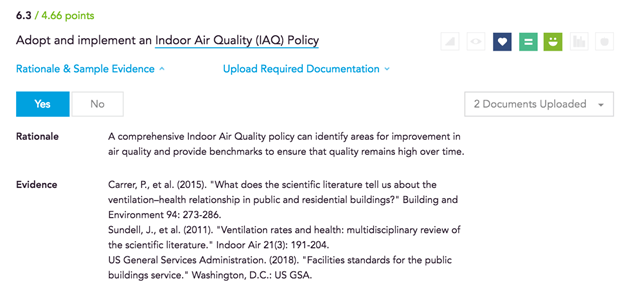
Facility managers can see the impact that improved indoor air quality has on morbidity and absenteeism and the importance of lighting when it comes to instilling feelings of wellbeing among occupants. Through the benchmarking and certification process, facility managers can use the Fitwel Portal as a guide to demonstrate to other vested parties, including occupants, building owners and investors, how they are working to address some of today’s most pressing health concerns.
Moving forward
In a world where physical activity continues to decline, stress and anxiety are rising, and chronic diseases are responsible for nearly 70 percent of deaths worldwide, a commitment to health and wellness is more important now than ever before. Design can have a powerful impact on our health. Through the strategic use of technology to provide easy access to impact data and an intuitive certification system, facility managers can continue to integrate the evidence-based strategies popularized by Fitwel in pursuit of a healthier world. They can also use this technology to communicate their impact and successes to their targeted occupants. The structures in support of this movement are in place and the momentum is evident. The time to build on that momentum is now, and facility managers will continue to be a critical player, leading the way toward a healthier and more sustainable future.

Reena Agarwal is the founding chief operating officer at the Center for Active Design (CfAD), where she conceptualizes and directs initiatives that foster healthy and engaged communities. Prior to launching CfAD, Agarwal was a director of sustainability at the New York City Department of Design and Construction where she focused on regulatory and legislative efforts that promoted environmental sustainability and health in building design. She also has over a decade of experience working as both an architect and planner, where she specialized in zoning and building code compliance.

Sara Karerat is a senior analyst at the Center for Active Design (CfAD), where she supports the organization’s initiatives that pair public health research with design strategies to improve the health of communities both domestically and internationally. Previously, Karerat worked as a communications associate with the Partnership for a Healthier America, where she developed strategic campaigns to motivate healthy behavior change among target populations. Karerat holds a Master of Public Health from Columbia University and a Bachelor of Arts from Hamilton College, where she majored in Public Policy.
References
CBRE. (2016). Millennials: Myths and Realities.
World Health Organization. (2018). Noncommunicable diseases and their risk factors.
Images from Fitwel Portal. Courtesy of the Center for Active Design.
Read more on Workplace or related topics Wellness and Well-being
Explore All FMJ Topics