
 Membership
 Network
 Regional Sites & Affiliates


 Events
 Participate
 Resources

 Training
 Credentials
 Government


 Content Channels
 Tools
Tools


 Business Overview





Energy Savings
Using EMIS to unlock potential

Commercial buildings are full of hidden energy savings potential, and facility managers and building owners are now reaping the cost-saving benefits of data analytics through the use of Energy Management and Information Systems (EMIS).
The tools that make up the category of EMIS can provide real-world benefits to facilities by identifying no- or low-cost changes to save energy, ensuring performance doesn’t drift after the installation of energy efficiency measures, and providing building operators deeper insight into the energy use of their facility. Energy use that is not tightly managed can drive up the operating costs of a building.
What is an EMIS?
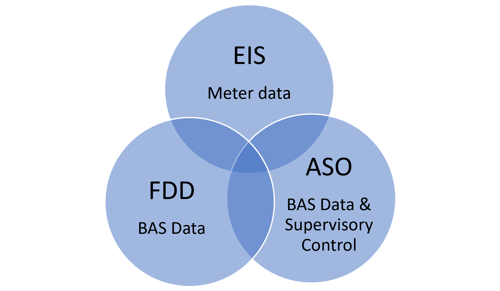 EMIS are the broad and rapidly evolving family of tools that monitor, analyze and control building energy use and system performance. The data generated from EMIS tools enable FMs to operate their buildings more efficiently and with improved occupant comfort by providing visibility into and analysis of the energy consumed by lighting, space conditioning and ventilation, and other end uses.
EMIS tools typically have one or more of the following areas of functionality:
-
Energy information systems/Advanced EIS: The software, data acquisition hardware and communication systems used to store, analyze and display building energy data. EIS are a subset of EMIS that are focused on meter-level monitoring. Advanced EIS incorporate analysis that typically includes predictive energy models using interval meter data.
-
Fault detection & diagnostic systems: Software that automates the process of detecting faults and suboptimal performance of building systems and helps to diagnose their potential causes. FDD are a subset of EMIS that focuses on system-level monitoring using Building Automation System (BAS) data. FDD tools are typically applied as a separate software application that pulls data from the BAS and may provide a report of the duration and frequency of faults, cost and/or energy impacts, and relative priority levels.
-
Automated system optimization: Software that continuously analyzes and modifies BAS control settings to optimize HVAC system energy usage while maintaining occupant comfort. These tools read data from the BAS and automatically send optimal setpoints back to the BAS to adjust control parameters based on data such as submetered energy use. Two-way communication with the BAS distinguishes ASO solutions from FDD.
Many EMIS include both EIS and FDD functions within the same software tool. Some software includes all three functional areas. EMIS functions can be implemented individually or in combination and are intended to support facility staff and management efforts to meet higher levels of comfort and performance.
What sets EMIS tools and technology apart from previous era of energy analysis tools are the visualization and analytics now available. Seeing the building portfolio’s energy use in near-real time (15-minute intervals) presents higher granularity data, allowing for a more timely analysis than monthly utility bills.
Web-accessible energy data also provides a window into usage beyond the facilities staff; finance, building operations, energy managers and even building occupants can all pull pertinent information for their own analysis and reporting.
How is BAS different from EMIS?
BAS are used to control building heating, ventilation and air-conditioning (HVAC) systems, and in some cases, building lighting and security systems. The BAS is excellent at maintaining indoor temperature, humidity, ventilation and lighting conditions; however, BAS often lacks the ability to answer questions such as: how much energy is consumed at different times of the day? Does the airside economizer behave appropriately? Under what conditions is there excessive simultaneous heating and cooling? EMIS tools EIS, FDD and automated system optimization tools (ASO) supplement the BAS to facilitate analysis and management of building energy use.
The Smart Energy Analytics Campaign
The Smart Energy Analytics Campaign is a program sponsored by the U.S. Department of Energy through the Better Buildings Initiative and managed by Lawrence Berkeley National Laboratory (Berkeley Lab) that encourages the use of a wide variety of commercially available EMIS technologies and ongoing monitoring practices to help uncover those energy-saving opportunities and improve building performance. IFMA was an organizing partner in the original design of the campaign and contributed to the outreach plan to target building owners and operators.
The campaign aims to increase adoption of EMIS technologies, helping bring analytics into the mainstream as they are currently underutilized. In the Smart Energy Analytics Campaign, owners, FMs, energy managers and f commercial building operators receive expert technical support and national recognition for their efforts. In the four years since the start of the campaign, 103 participant organizations have joined, representing more than 5,900 buildings and more than 500 million square feet.
Participating building types include universities, commercial real estate, hospitals, grade schools, grocery, retail and hospitality. These facilities are either starting to procure an EMIS or have an EMIS installed and are experienced in its use and benefits.
Campaign participants have access to specialized peer discussions on relevant areas of FDD use. There can be great insights gained from hearing the story of an FM describing the many decisions made: figuring out what EMIS features to include in the request for proposal, how to assess the different vendor offerings, how to plan the data management strategies, how to train staff on the EMIS tools and more. Campaign participants have said these webinars were especially welcome, because it is often hard to find unbiased opinions from actual users of these technologies. A majority of these webinars and other resources are posted on the site and available for anyone to access.
Another popular feature of the Smart Energy Analytics Campaign is the opportunity for a participant to apply for recognition awards for energy performance, innovation, largest portfolio and best practice. For those who are in the first phase of their building’s EMIS implementation, there is also a new installation category.
Case in point:One IFMA Corporate Sustaining Partner, ISS Facilities, representing Hewlett Packard Enterprises (HPE), has been awarded Best Practice using Fault Detection and Diagnostics in a Portfolio. In this case, the primary goal was energy savings at HPE and getting a good return on investment, however additional benefits emerged. Using FDD, the ISS team discovered problems and implemented fixes such as scheduling air handlers off when zones were unoccupied, minimizing simultaneous heating and cooling, and identifying broken valves and sensors. The FDD tool has not only kept tabs on things that aren’t working, the software also recommended operational improvements, like adding variable frequency drives and implementing temperature and pressure reset control strategies. |
How cost effective are EMIS?
One of the contributions the Smart Energy Analytics Campaign has made to the field of energy data analytics is to gather real-world details of how EMIS tools are used and the actual costs from the participating building owners. Over the last three years, the campaign has assembled the most comprehensive dataset available on analytics installation and use.
Based on data from campaign participants and from similar studies, building owners with EIS achieved a median energy savings of 4 percent (US$0.04/sq. ft.) and participants with FDD achieved a median savings of 9 percent (US$0.24/sq. ft.).
It is important to note that savings are not solely attributed to operational measures. Occasionally, savings may include changes to the building that are not directly related to analytics. Buildings are constantly changing; for example, occupants can move out, energy-efficient equipment may be installed or natural disasters may disrupt the normal operations, thereby presenting an uneven energy profile of the building.
The campaign releases an annual report with more detail on the types of costs that were analyzed, with calculations of simple payback periods for EIS and FDD.
What enables successful EMIS?
Through the course of talking with more than 100 participants in the campaign, certain best practices have been identified.
|
Best Practices for Successful EMIS |
|
|
EMIS Specification and Selection |
|
|
EMIS Installation and Configuration |
|
|
Analytics and Visualization |
|
|
Organizational Process |
|
What’s next for the Smart Energy Analytics Campaign?
In the summer of 2020, the campaign will end in its current form and website, but all existing participants and any new building owners who are interested may join the Better Buildings Alliance EMIS Technical Team and receive many of the same technical support features of the campaign.
There are many other useful materials available on these websites that provide a wealth of information on EMIS, DOE’s Better Buildings and technical research from the Berkeley Lab team.

Claire Curtin is a program manager at Lawrence Berkeley National Laboratory, supporting research on EMIS. Previously, she was with Pacific Gas & Electric in the Commercial Whole Building Demonstration project and administering Automated Demand Response utility programs for EnerNOC and Global Energy Partners. Curtin spent more than 20 years as a senior producer and designer in the computer gaming industry with Electronic Arts, Maxis and Broderbund Software.

Hannah Kramer is an affiliate to the Building Technology and Urban Systems Division at the Lawrence Berkeley National Laboratory. She holds a master’s degree from the Energy and Resources Group from UC Berkeley. Her research focuses on building energy performance monitoring and diagnostics and supporting how owners implement monitoring-based commissioning. Kramer has authored numerous studies and resources on commissioning and building performance.
References
Top image via Getty Images.
Read more on Sustainability and Finance & Business or related topics Energy , Sustainable Facility and Operational and Capital Budgeting
Explore All FMJ TopicsRelated articles
-

Smart Building Control Systems
The foundation for a grid-interactive buildingBy Andre Marino09.25.2024 -

Smart Building Innovation
Cutting costs & carbon footprints without compromiseBy Andrew Butterworth09.12.2024 -

Chart the Path
Building sustainable cities & a sustainable futureBy Izzat Ali Khan & Aykean Forde12.16.2024