
 Membership
 Network
 Regional Sites & Affiliates


 Events
 Participate
 Resources

 Training
 Credentials
 Government


 Content Channels
 Tools
Tools


 Business Overview





Energy Sustainability
Looking ahead to the next decade
Green technology is driving global energy storage installations from a modest 9 GW/17 GWh deployed as of 2018 to 1,095 GW / 2,850 GWh by 2040, according to the latest forecast from research company BloombergNEF. This 122-fold boom of stationary energy storage over the next two decades will require a US$662 billion investment, according to BNEF estimates. It will be made possible by further sharp declines in the cost of lithium-ion batteries, on top of an 85 percent reduction in the 2010-18 period.
As states push clean energy policies, a number are also investigating how they can adapt their utility grids and business models for emerging resources. Nearly every state took some regulatory or legislative action on broad grid modernization or utility business model reform in 2018, with 42 states acting in the second quarter on questions of advanced metering infrastructure, storage deployment, data access and revenue reforms, according to the North Carolina Clean Energy Technology Center.
Energy storage systems will drive FM energy sustainability
As utilities plan to decarbonize their systems, many see the current boom in natural gas generation as a bridge to a low-carbon future providing dispatchable power to balance out intermittent renewables on their systems. Continued advancements in battery technology, however, could make that bridge shorter than anticipated.
In November 2018, California regulators approved four battery projects for utility Pacific Gas & Electric (PG&E) to replace three gas plants that had sought ratepayer financial support. The batteries, including two of the world's largest planned projects, represented the first time that a utility and its regulators sought to directly replace multiple major power plants with battery storage.
California has ambitious environmental and battery storage targets, but large-scale storage is also spreading to states without those policies as battery prices decline. Last summer, generator Vistra announced plans for a 42 MWh storage facility connected to a solar farm in Texas, which would be the state's largest battery.
While smaller in scale, the recent growth in utility-size batteries is outpaced by behind-the-meter installations, which analysis firm Wood Mackenzie says grew more than 300 percent in 2017 alone. Going forward, Bloomberg analysts expect lower prices and increasing market participation options for storage like Federal Energy Regulatory Commission's (FERC) recently approved Order 841 will beget more than 100 GWh of storage capacity in the U.S. by 2040.
Lithium-ion battery costs continue to drop
BNEF’s Energy Storage Outlook 2019, predicts further halving of lithium-ion battery costs per kilowatt-hour by 2030, as demand takes off in two different markets – stationary storage and electric vehicles. The report models the impact of this on a global electricity system increasingly penetrated by low-cost wind and solar energy.
Just 10 countries are on course to represent almost three quarters of the global market in gigawatt terms, according to BNEF’s forecast. South Korea is the lead market in 2019, but will soon cede that position, with China and the U.S. far in front by 2040. The remaining significant markets include India, Germany, Latin America, Southeast Asia, France, Australia and the U.K.
In the U.S., a review of compliance filings submitted by grid operators in response to the FERC Order 841 shows that Independent System Operators (ISOs) and Regional Transmission Organizations (RTOs) are complying with FERC's directive, but work much remains.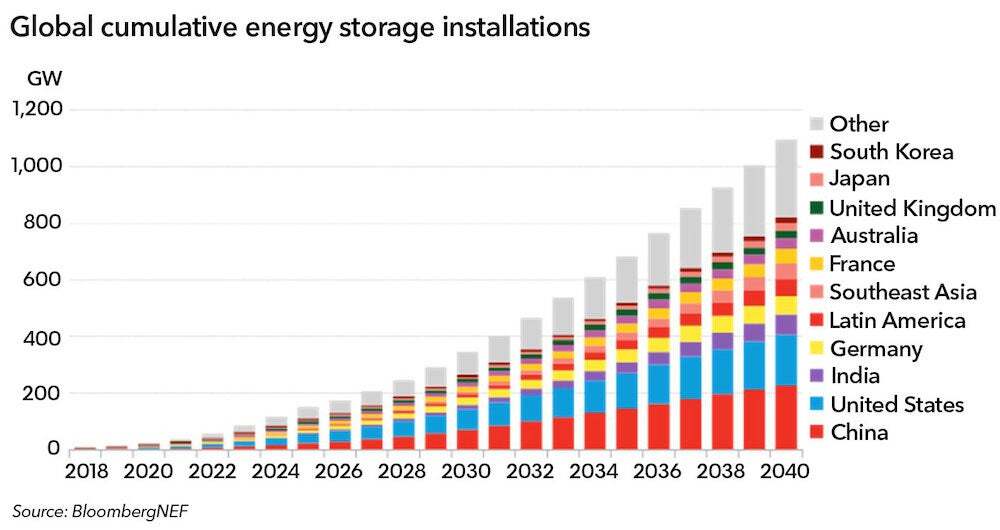
Distributed energy resources (DERs)
Utilities, keen to prevent load loss to rooftop solar and the like, initially tried to slow the trend with fees and rate designs that discouraged adoption of such resources. But increasingly—and after a series of lengthy state policy battles—they are beginning to recognize that Distributed Energy Resources (DERs) can also provide benefits to the grid and if managed correctly, will become a reliable Behind the Meter (BTM) power resource.
California Independent System Operators (CAISO) refers to storage as a "vital strategy" to meet the state’s goal of 100 percent zero-carbon electricity by 2045. The state's current oversupply of solar power in the middle of the day and subsequent drop-off in the evening has led to a curtailment of solar. With more storage on the grid, the oversupply of solar could be captured and used later in the day, reducing the need for curtailment and increasing the grid operator's ability to balance load, CAISO said.
Electric vehicle (EV) growth will become an energy demand issue
As batteries become cheaper they hold promise for utilities not just as stationary sources of power, but mobile ones as well. By 2050, the National Renewable Energy Laboratory says electric vehicles could increase U.S. power demand by up to 38 percent, providing an important source of power demand growth for utilities and opportunities to use the vehicles' batteries to meet grid needs.
In 2018, utilities realized this opportunity, ramping up their lobbying and public relations efforts around EVs. In the third quarter alone, 32 states and D.C. took some action on electric vehicles, including the approval of utility EV charging programs in Massachusetts, Rhode Island and, earlier, in Nevada.
In the years to come, utilities across the nation are likely to intensify these efforts, pushing for approval to own EV charging stations, studying new rate designs to incentivize charging and finding new ways to aggregate fleets of vehicles to modulate their charging for grid needs.
EVs could overwhelm the grids
The power demand from the 20 million EVs expected to be on U.S. roads by 2030, up from today's 1.1 million, could overwhelm the nation's grids.
However, the coming EV load could deliver great value to utilities and their customers if it is shifted away from high-priced peak demand periods. That would increase utilities' electricity sales without adding stress to their grids, while also lowering drivers' charging costs. Investing in the communications systems and planning needed to properly manage charging can deliver transportation electrification's full value, stakeholders told Utility Dive.
EVs are the biggest electric load opportunity for utilities since the 1950s air conditioning explosion, a May 2019 Smart Electric Power Alliance (SEPA) study reports. But without proper planning to integrate that load, "EVs could lead to grid constraints and increased transmission and distribution peaks" that require new "peaker plants, unplanned grid upgrades, and other costly solutions."
"There is already adequate charging infrastructure technology to incorporate real-time pricing and use price signals to shift charging from peak demand periods to times when utilities have renewables over-generation," the report adds.
 The future of EV energy storage
The threat to the grid represented by EV growth will not be from a lack of the Electric Vehicle Supply Equipment (EVSE) used for charging. An estimated 9.6 million EV charging ports will be needed by 2030, according to the Edison Electric Institute, but 2018's 1.2 million North American charging ports will grow 10 times to more than 12.6 million by 2027, according to Navigant.
With the electrification of trains, trucks, buses and other vehicles, the coming load could be overwhelming. "But worst-case scenarios assume transportation electrification would happen without optimizing the grid, and there are ways to optimize. Managing the number of cars charging, and when they charge, will determine the real load."
Solar PV systems
Energy rates and solar policies are in flux, posing a major threat to new solar projects. One major pricing trend—adopted by utilities across the country—is an increasing emphasis on time-variable rates and demand charges. For an average commercial energy user today, 60 percent of energy spent is based not on how much energy is used, but when it is use.
In California, for example, utilities have changed the timing and price of Time of Use (TOU) rates in a way that diminishes solar project economics unless developers pair solar with energy storage.
Utilities have also increased demand charges by more than 100 percent across the last decade. That means businesses are charged more for their peak energy usage each month—and if those peaks occur when time-based rates are highest, it can mean a huge energy bill, and can impact the savings from solar energy.
Solar energy alone does not address the most expensive demand peaks, which now with the new rate structures often occur in the late afternoon when solar production drops. By employing both solar and energy storage, businesses can reduce not only energy charges, but also address demand peaks that may occur when solar output goes down.
During the same period in which energy storage experienced incredible growth, the solar industry witnessed radical threats to existing solar economics due to changing policies and rates. Around the country, Net Energy Metering (NEM) and other market rates and programs have changed substantially over the last few years and will continue to change in the years ahead.
Zero net energy (ZNE) standards & challenges
In 2008, the California Public Utility Commission (CPUC) issued its Zero Net Energy (ZNE) goals for all new residential construction by 2020 and for commercial buildings by 2030. California’s ZNE Standard is already in place through the state’s energy and green building standards codes (Title 24 Parts 6 and 11) to achieve the 2020 and 2030 ZNE construction targets. The 2013 Energy Code will reach 70 percent of the residential ZNE goal, the 2016 Energy Code reaches 85 percent and the 2019 Energy Code will meet the 100 percent goal of ZNE. By 2030, every new school is required to be a ZNE building.
ZNE buildings have zero net energy consumption, meaning the total amount of energy used by the building on an annual basis is roughly equal to the amount of renewable energy created on the site. These buildings still produce greenhouse gases because on cloudy (or non-windy) days, at night when the sun isn't shining, and on short winter days, therefore, conventional grid power is still the main energy source.
Because of this, most zero net energy buildings still get half or more of their energy from the grid. Buildings that produce a surplus of energy over the year may be called "energy-plus buildings" and buildings that consume slightly more energy than they produce are called "near-zero energy buildings" or "ultra-low energy houses.”
To help attain these ZNE measures, California requires their existing buildings to be energy efficient. To ensure attainment of these goals, CALGreen building code requirements were adopted by the California Building Commission (CBC), and included in modified Part 11, of the Title 24 building code.
To summarize the California Energy Efficiency Strategic Plan, the state has ambitious goals for the development of zero net energy buildings. These include:
-
All new residential construction will be zero net energy (ZNE) by 2020.
-
All new commercial construction will be ZNE by 2030
-
50 percent of commercial buildings will be retrofit to ZNE by 2030
-
50 percent of new major renovations of state buildings will be ZNE by 2025.
-
AB 758 – Comprehensive Energy Efficiency in Existing Buildings Law
-
AB 802 – Mandatory Energy Benchmarking & Disclosure

Corey Lee Wilson is a California native and founded the IFMA Inland Empire Chapter in 2013 where he was president from 2013-19. He is the president of CLW Enterprises, and project manager for MicroNOC Inc. He holds a BS in Economics from California State Polytechnic University Pomona, is an IFMA FMP, LEED AP O+M Specialty, CMAA CCM, and a member of the USGBC-LA Chapter. He is an energy savings consultant that facilitates cost-effective and efficient energy reduction and battery backup systems that reduces energy usage that lowers operational costs.
References
Top image via Getty Images. Article images courtesy of Corey Lee Wilson.
Read more on Sustainability or related topics Energy
Explore All FMJ TopicsRelated articles
-

Smart Building Control Systems
The foundation for a grid-interactive buildingBy Andre Marino09.25.2024 -

Smart Building Innovation
Cutting costs & carbon footprints without compromiseBy Andrew Butterworth09.12.2024 -

Chart the Path
Building sustainable cities & a sustainable futureBy Izzat Ali Khan & Aykean Forde12.16.2024