
 Membership
 Network
 Regional Sites & Affiliates


 Events
 Participate
 Resources

 Training
 Credentials
 Government


 Content Channels
 Tools
Tools


 Business Overview





Estimating Kazakhstan’s FM Market
Size, sector structure & revenue drivers
Facility management is increasingly recognized as a strategic function that underpins asset performance, operational continuity, health and safety compliance, and cost optimization across both public and private sectors. Beyond traditional maintenance and cleaning activities, modern FM integrates technical operations, energy management, compliance assurance and workplace services, enabling organizations to focus on their core business activities. In emerging economies, FM also plays a critical role in extending asset life cycles and improving operational resilience in often challenging climatic and logistical conditions.
Kazakhstan’s FM market was projected to reach approximately US$2.4 billion in 2025, supported by a resource-intensive industrial base, expansion of commercial real estate, and increasing adoption of outsourced and integrated FM models. While FM penetration remains below developed-market benchmarks, structural drivers — including regulatory compliance, digital transformation, and environmental, social and governance (ESG) priorities — are accelerating market maturation.
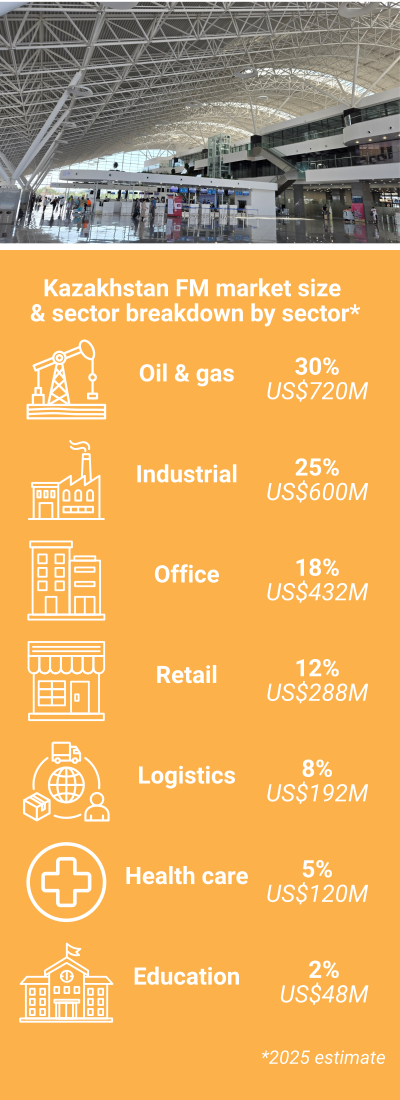 The market is structurally anchored in the oil and gas (O&G) and mining and industrial sectors, which together account for more than 50 percent of total FM expenditure, supported by offices, retail and logistics in major urban centers. These sectors are characterized by complex asset portfolios, safety-critical operations and continuous maintenance requirements.
FM has evolved into a strategic discipline underpinning asset reliability, operational continuity, workforce safety and energy performance. Kazakhstan, the largest economy in Central Asia by GDP, presents a particularly compelling case for FM market analysis. The country’s vast geography, extreme continental climate and heavy concentration of capital-intensive assets create structurally high demand for maintenance and support services. FM is therefore not merely a support function, but a prerequisite for safe and reliable operations across energy, mining, manufacturing and infrastructure assets.
Kazakhstan is a major global supplier of hydrocarbons and minerals, including oil, gas condensate, uranium, copper, ferroalloys and coal. These sectors operate large, technically complex facilities with continuous operating cycles, high safety exposure and strict regulatory requirements, all of which drive sustained FM demand and thus play a critical role due to structural factors:
-
A resource-driven economy, with mining contributing approximately 12 percent of GDP.
-
The oil & gas sector contributes an estimated 35 percent of GDP and approximately 70-75 percent of exports.
-
Rapid urbanization and commercial real estate growth in the cities of Almaty and Astana
-
By 2024, combined Class A and B office stock in Almaty and Astana exceeded 3 million square meters.
-
Macroeconomic fundamentals remain supportive. Real GDP growth reached approximately 4.0 percent in 2024 and is projected to accelerate to between 4.5 percent and 5.0 percent in 2025 according to the World Bank, with the International Monetary Fund projecting growth as high as 5.9 percent. Growth is driven by increased oil output, industrial expansion, infrastructure investment and gradual diversification into manufacturing and logistics. As asset bases expand and age simultaneously, demand for both hard FM (technical maintenance, utilities, integrity management) and soft FM (cleaning, catering, waste, workplace services) is expected to rise.
Methodology
The market estimate is based on a top-down macroeconomic model using Kazakhstan’s projected 2025 GDP of US$300–305 billion (IMF World Economic Outlook, 2025).
FM global benchmarking and market maturity are commonly measured as a percentage of GDP (i.e., approximately 1.5-2.0 percent for developed markets and 0.6-1.0 percent for emerging markets
A conservative FM expenditure ratio of 0.8 percent of GDP — aligned with emerging market benchmarks but demonstrates above-average maturity in industrial FM — results in a midpoint estimate of US$2.4 billion with a sensitivity analysis suggesting a range of US$1.8-3 billion, depending on outsourcing maturity, labor cost structures and scope definitions.
Kazakhstan is positioned between single-service outsourcing and integrated FM, with rapid progression toward digitalization.
Sectoral allocations are informed by national GDP composition and adjusted for FM intensity. Capital-intensive and safety-critical sectors such as O&G and industrial assets are weighted more heavily, while commercial sectors reflect moderate but growing FM demand.
Kazakhstan’s O&G and mining sectors are dominated by large operators and consortia, many operating under production-sharing agreements. These entities manage extensive asset portfolios, camps and infrastructure requiring continuous FM support.
Mining production exceeded 257 million metric tons in 2023, with sector revenues projected to exceed US$30 billion by 2025. While profitability varies by commodity and export conditions, baseline FM demand remains structurally stable due to safety, compliance and asset integrity requirements.
This sector allocation reflects FM intensity, asset criticality and regulatory requirements as large extractive/O&G sector and significant industrial output (mining, heavy industry) require high levels of maintenance and third-party services.
Office stock in Almaty and Astana is also growing. Commercial real estate development in Almaty and Astana underpins demand in the office and retail segments. By Q4 2024, Astana’s high-quality office stock reached 624,102 square meters, while Almaty’s total office stock reached 2.37 million square meters. In 2023 alone, nearly 596,000 square meters of office space was commissioned, signaling continued medium-term FM demand.
 Typical FM market estimate & contract-size ranges (annual)
Oil & Gas - KZ Market value estimate - US$720 million
-
Onshore field/plant/camp services - per contract estimate more than US$500,000-50 million per year.
-
Large capital-intensive assets (wells, processing plants, camps, pipelines) need ongoing maintenance, integrity, camp housekeeping & specialized cleaning.
-
Big projects (Tengiz expansion & others) drive demand for outsourced FM. Major O&G sites often carry the largest single-contract values.
-
Industrial - Market value estimate - US$600 million
-
Factories, refineries, plants: - per contract estimate US$50,000 - 5 million per year.
-
Small factories: less than US$100,000
-
Medium plants: US$200,000-1 million
-
Large continuous plants/refineries: US$1-5 million.
-
-
Manufacturing and mining sites require mechanical/electrical maintenance, predictive maintenance & housekeeping.
-
Industrial FM intensity depends on age of plants & outsourcing maturity (Kazakhstan has sizeable industrial output).
-
Offices
-
KZ Market value estimate - US$432 million
-
Growing office stock in Almaty/Astana (new completions announced annually). Offices are typically smaller-ticket contracts but numerous; cleaning and soft FM dominate. Using office cleaning benchmarks & published office area figures (class A/B stock), the office slice fits the central number.
Retail (malls)
-
KZ Market value estimate - US$50,000-3 million per year
Logistics/Warehousing
-
KZ Market value estimate - US$20,000-1 million per year
Health care (hospitals)
-
KZ Market value estimate - US$100,000-5 million per year (size & complexity vary)
Education (schools/university campus)
-
KZ Market value estimate - US$10,000-500,000 per year
Key observations:
-
O&G remains the dominant segment due to high asset complexity.
-
Industrial and mining sectors drive high technical FM demand.
-
Commercial real estate is the fastest-growing segment.
Sector dynamics
Industrial & mining FM
Kazakhstan’s mining sector generates approximately US$600 million in FM demand annually. Key service components include:
-
predictive maintenance using IoT & CMMS systems
-
regulatory inspections & compliance
-
industrial housekeeping & safety management
These requirements reflect increasing adoption of reliability-centered maintenance strategies.
Commercial real estate & integrated FM
Urban FM markets are evolving toward integrated service delivery:
-
bundled contracts combining technical and soft services
-
portfolio-based service delivery models
-
energy optimization aligned with ESG requirements
Localization & workforce development
Localization remains a key market characteristic:
-
compliance with national content requirements
-
development of local technical workforce
-
cost optimization through reduced reliance on expatriates
This trend aligns with broader economic policy objectives and enhances long-term sustainability of FM delivery.
Digitalization & ESG integration
FM services in Kazakhstan are increasingly shaped by:
-
CMMS and IoT-enabled asset monitoring
-
predictive analytics for maintenance optimization
-
energy efficiency and emissions reduction initiatives
Case study: Large-scale industrial FMTengiz Expansion Project – The Tengiz oilfield expansion (over US$40 billion investment) represents a benchmark for FM delivery in extreme industrial environments. FM scope includes:
This case illustrates the scale and complexity of FM in Kazakhstan’s oil & gas sector. Strategic implications: Integrated FM as the growth engineClients increasingly prioritize:
Digital transformation - Competitive advantage is increasingly linked to:
Localization advantage - Local expertise provides:
ChallengesLow outsourcing penetration
Regulatory complexity
Oil price dependency
|
Conclusion
Kazakhstan’s FM market represents a structurally resilient and evolving sector, underpinned by strong macroeconomic fundamentals, a resource-intensive industrial base and expanding commercial real estate assets.
 O&G and industrial assets form the backbone of FM demand, driven by safety-critical operations, large-scale infrastructure and continuous production requirements. These sectors favor long-term, high-value FM contracts and increasingly require integrated service delivery, digital maintenance systems and strict compliance management. Offices, retail, logistics, health care and education provide additional depth to the market, particularly in urban centers such as Almaty and Astana, where portfolio-based and standardized FM solutions are gaining traction.
While FM penetration in Kazakhstan remains below developed-market benchmarks, structural drivers — including aging assets, workforce optimization, ESG expectations and technology adoption — are expected to support gradual convergence. For FM service providers, success will depend on sector-specific expertise, strong health and safety performance, localization of delivery models and the ability to scale from single-service contracts to integrated FM solutions. For investors and policymakers, the FM sector represents an enabler of productivity, asset preservation and long-term economic efficiency.
While FM penetration remains below developed-market benchmarks, the trajectory is clearly toward:
-
integrated service delivery
-
digitalized asset management
-
ESG-aligned operations
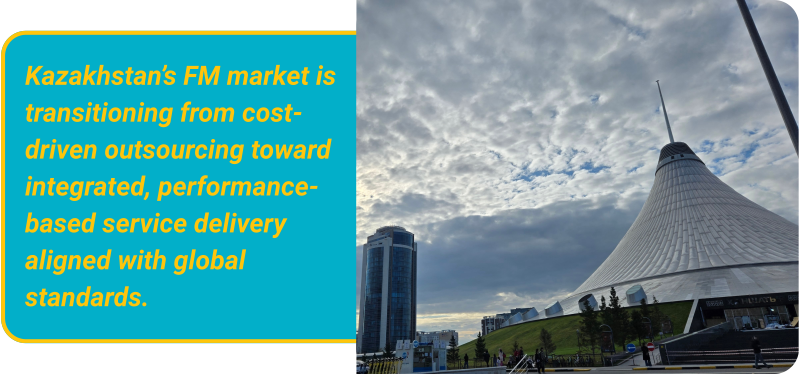
Kazakhstan’s FM market is transitioning from cost-driven outsourcing toward integrated, performance-based service delivery aligned with global standards.
For FM providers, success will depend on combining technical expertise, scalable delivery models, and strong local capabilities.
As Kazakhstan continues to modernize its industrial base and commercial infrastructure, facilities management is likely to transition from a cost-focused support function to a strategic contributor to operational excellence. This evolution positions the FM market not only as a reflection of economic growth, but as a key facilitator of sustainable and resilient development in the country.

Bakytzhan Orazaliyev, MSc, FMP, PMP, CSSBB, is a senior facilities management leader, serving as the head of facilities and technical operations for a major organization in Kazakhstan & Central Asia region. An active advocate for the profession, Orazaliyev is passionate about integrating digital transformation and sustainable operational strategies to achieve high-performance facilities. He focuses on leveraging technology to drive operational efficiency and professional development, thereby advancing the FM industry in emerging international markets and positively impacting organizational success and the workplace experience.
References
Images provided by Bakytzhan Orazaliyev.
Read more on Finance & Business , Real Estate and Facility Operations or related topics Operations and Maintenance Planning , Operational and Capital Budgeting and Real Estate Management
Explore All FMJ Topics