
 Membership
 Network
 Regional Sites & Affiliates


 Events
 Participate
 Resources

 Training
 Credentials
 Government


 Content Channels
 Tools
Tools


 Business Overview






|
It is a Monday morning in a building operations center managing eight commercial sites. A facility management team is using three building management system (BMS) dashboards, and have 10,000 active alerts queued. Two work orders from Friday remain unresolved, and somewhere in that stack a failed compressor is vibrating away outside safe parameters and threatening thousands of dollars of critical inventory that is now beginning to thaw. They will find it — eventually — but if it is the 40 minutes they think it will take, it is already too late. |
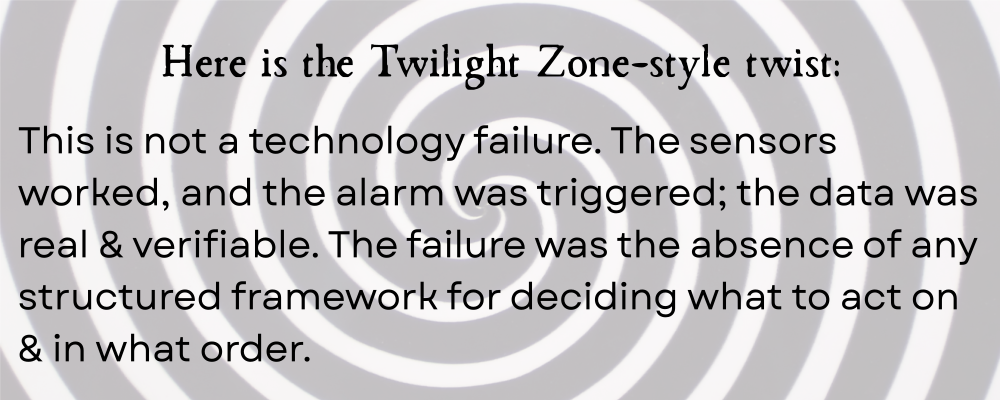
The gap between data and decision is where most modern facility operations break down. But it does not have to be that way.
The problem in numbers
 The conditions driving this breakdown are structural. As of 2026, the IFMA Workload Index continues to signal a crisis, with a reading of +43, confirming that workload is significantly outpacing capacity.
Nearly 43 percent of facility management teams remain chronically understaffed, a deficit compounded by widespread hiring freezes affecting nearly two-thirds of the industry.
The workforce pipeline is failing to close this gap. With the average industry age now exceeding 50, and the final wave of Baby Boomers reaching retirement age by 2030, the sector faces a retirement cliff. There are increasingly complex assets to manage, but a shrinking pool of institutional knowledge to draw from.
The technology intended to bridge this gap is, in many cases, widening it. Across multi-site commercial portfolios, alarm floods can now exceed 100 alerts per day. Despite this, only 24 percent of professionals report that their BMS actively helps identify the root cause of HVAC inefficiencies.
What is facility triage?
In clinical medicine, triage exists for a specific reason: when resources are finite and stakes are unequal, a principled method is needed for deciding what gets attention first. A broken wrist and a cardiac arrest cannot be treated as equivalent problems simply because they arrived at the same time.
The same logic applies to facility management, and for the same reasons. FM triage is a prioritization and work automation schema that allows FMs to classify incoming alerts and tasks by actual risk: to occupants, to operations, and to regulatory compliance. It separates the urgent from the merely active.
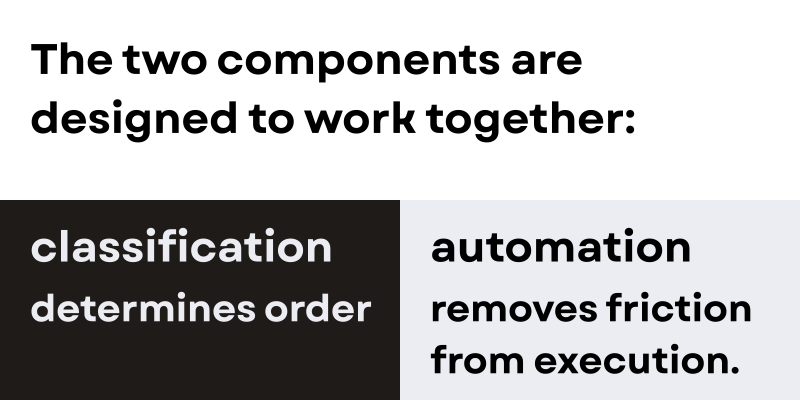
The concept has two practical components. The first is a prioritization schema; a risk-based classification system that moves the FM from "What arrived in my inbox?" to "What actually matters?"
The second is work automation: removing the FM from the role of information transcriber — copying sensor data between systems, manually creating work orders from alert logs — and returning their attention to making informed decisions that require experience and context.
Taken together, FM triage goes beyond being a product category and instead an operating philosophy; it applies whether a team is managing three sites or 3,000.
The distinction between prioritization and automation matters, as a framework that only ranks alerts still leaves the FM doing the administrative work downstream. One that only automates task creation without a ranking logic still leaves the team working through a flat queue.
Why existing technology falls short
The building technology market is not short of solutions. Enterprise BMS platforms from the major manufacturers are capable and data-rich, but they require specialist expertise to configure and interpret.
For the majority of multi-site operators outside the top tier of portfolio complexity, they are considerably more (and more expensive) than what is needed.
At the other end of the market, consumer-grade smart building products offer simple automation but limited precision. A thermostat that learns a schedule is not the same as a system that can correlate sensor patterns across an air handling unit and surface a fault before it becomes a failure.
The middle ground — precision decision-support without enterprise complexity — is where the majority of FM operations actually sit. And it is precisely this segment where prioritization frameworks matter most because operators here rarely have the redundancy to absorb a missed fault.
The gap is not a criticism of any particular product category, but a structural observation about what the market has, and has not, built. Decision-support tools that surface the right fault to the right person at the right time are a different class of solution from dashboards that display everything and leave the FM to sort it.
A framework FMs can apply
Facility triage translates into a repeatable four-step process. It does not require a specific platform. It necessitates structure and discipline.
Step 1: Consolidate
The first failure point in most FM operations is fragmented data. Sensor readings live in one system, maintenance history in another, work orders in a third. Before any prioritization is possible, the relevant inputs — current alert state, asset history, inspection records, known fault patterns — need to be visible in a single asset-level view.
More importantly, alarms (out of specification readings by sensor) should be consolidated to alerts, which are at the asset level. This prevents more than one suggestion or recommendation per asset, minimizing the volume of data FM teams need to process.
Step 2: Classify
Once data is consolidated, every active alert should be assigned a severity tier. A practical four-tier model works for most contexts:
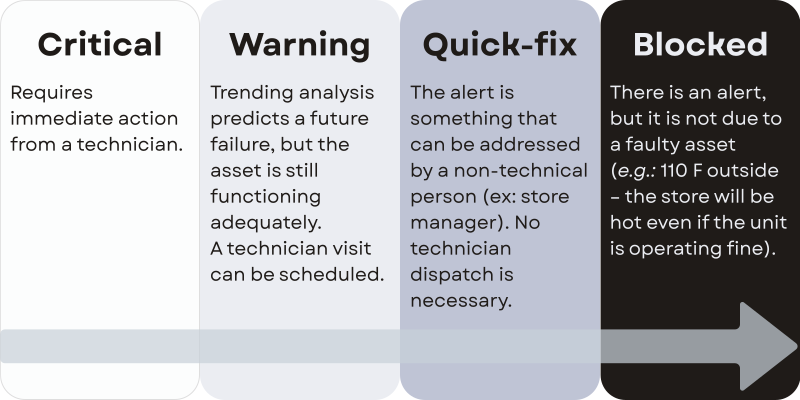
Classification should be driven by four variables: impeding threat of systems failure; a high likelihood of future failure; whether it needs qualified technical intervention or can be handled onsite by a non-technical team member; or whether an external influence (e.g. temperature) has triggered an alarm threshold without actually causing a fault. Any alert that cannot be classified against those criteria is a signal that the underlying data is insufficient.
Step 3: ActThe value of triage is only realized at the point of action. A work order should reach the technician with everything they need: asset location, model and serial number, sensor readings, fault pattern summary and relevant maintenance history. The goal is zero information-gathering at site. When a technician arrives already briefed, mean time to repair drops and first-fix rates improve. This is where automation earns its keep — not in deciding what to do, but in pre-loading the context that makes action faster and more reliable. |
Step 4: Review
Triage frameworks degrade without feedback. After each work order closes, the classification should be validated: was the assigned tier correct? Did a warning or quick fix alert escalate into an urgent one before it was addressed? Reviewing classification accuracy over time is how the framework improves. It is also how teams build the institutional knowledge to get ahead of the faults they currently discover too late.
AI as amplifier, not replacement
The concern that AI will displace experienced FM is understandable, but it misreads what the technology actually does inside a triage model. The work it eliminates is transcription work: reading alert logs, comparing sensor thresholds, drafting work orders from scratch, routing tasks manually.
None of that is where experienced FMs create value. The judgement calls — which fault is actually dangerous given a specific building's occupancy profile, which contractor to deploy for an emergency callout, whether a pattern of readings indicates something the sensor data alone cannot explain—those require a professional.
AI adoption in FM is on track to surpass US$12 billion globally this year, growing at more than 33 percent annually. That investment, correctly applied, should return FMs to the work only they can do.
What good looks like
The operational picture shifts when a triage framework is working. Technicians arrive on site prepared, not investigative. Critical faults are surfaced in minutes, not discovered hours after the fact. The 80/20 split — 80 percent planned maintenance, 20 percent reactive — that the industry treats as best practice becomes achievable rather than aspirational.
The economics follow. Unplanned maintenance costs between three and nine times more than planned work. Each dollar invested in preventive maintenance returns an average of $5 in avoided costs. A triage system does not just make operations cleaner; it makes the financial case for proper resourcing.
Perhaps one of biggest yet more unquantifiable upsides of FM triage is that the transparency it offers FMs is more likely to cultivate a greater sense of trust in these systems. And while the dollar sum is not immediately obvious, over time, it certainly materializes, be via higher staff retention figures or receiving multiyear service discounts from vendors.
The bottom line
There is a persistent tension in the built environment. On one hand, the high cost of control systems creates a financial barrier, restricting the amount of data flowing from commercial buildings to the cloud.
On the other, even when that data is captured, it rarely leads to better outcomes. The problem is that data without a prioritization framework is noise. Facilities triage does not eliminate uncertainty but does structure the response to it.
For an industry managing an accelerating resource gap, the structure is not just a nice-to-have — it is the only sustainable way to bridge the gap between expensive infrastructure and actionable insight.

Clayton Callander is the president of Field Technologies, a building automation and controls company. Callander graduated from the U.S. Naval Academy in 2013 with a naval architecture degree, then specialized in nuclear engineering. After working in the U.S. submarine force for seven years, he attended to Harvard Business School, graduating in 2021.
References
Top image via Getty Images.
Read more on Leadership & Strategy or related topics Strategic Planning and Strategy
Explore All FMJ TopicsRelated articles
-

Artificial Intelligence in FM
The stakeholder’s perspectiveBy Dr. Jake Smithwick & Dr. Kenneth Sullivan & Nneka Ubi05.01.2024 -

Mastering Change in Hybrid Environments
Insights from global operational leadersBy Meg Swanson09.02.2024 -

Plugged In
Solving the data disconnect in real estate and FMBy Amanda Muzzarelli & James Waddell07.01.2024