
 Membership
 Network
 Regional Sites & Affiliates


 Events
 Participate
 Resources

 Training
 Credentials
 Government


 Content Channels
 Tools
Tools


 Business Overview





From Risk Registers to Early Warning
A practical FM approach for MENA
In facility management, risk is rarely a surprise in its earliest form. A major complaint often begins as a delayed response. A system failure may begin with repeated minor alarms. A financial problem may begin with small budget deviations that no one connects. A handover dispute may begin with missing drawings, unclear responsibilities or defects that are accepted too casually.
The issue is not always a lack of information. More often, information is scattered across inspection sheets, helpdesk logs, maintenance records, reports and emails. The challenge for FMs is to convert these scattered signals into useful management insight.
Large mixed-use assets may combine public areas, parking, cooling systems, life safety systems, digital controls and specialist contractors in one operating environment. A small weakness in one area can quickly affect service quality, safety, reputation and cost.
The limit of the traditional risk register
Most FM organizations already have some form of risk register. It may include strategic risks, operational risks, financial risks, legal and compliance risks, market risks and project risks. It may also include FM-specific issues such as incomplete asset data, delayed preventive maintenance, contractor underperformance, safety nonconformity, customer complaints, document control weakness and handover defects.
A risk register creates visibility and a shared language. However, a register can easily become a static table. It may be prepared for an audit, a tender, a management review or a corporate requirement, but then sit quietly in a folder. The risks are listed, but the organization is not necessarily warned when those risks begin to move.
|
For example, the statement “training is inadequate” is valid, but it is not yet a management tool. What exactly should be monitored? Training completion rate? Competency test results? Number of incidents caused by human error? Number of technicians not authorized for critical tasks? Unless the risk is connected to measurable indicators, it remains a concern rather than an early warning. |
From risk item to indicator
A practical early warning system begins by improving the quality of the risk item itself. The risk should describe a possible condition or event in plain operational language. “Asset management risk” is too broad. “The asset register is incomplete or inconsistent with site conditions” is much clearer. Once the risk is clear, the indicator becomes easier to define.
 Each key risk should have indicators. A handover risk may be monitored through the percentage of inspected areas, number of missing operation and maintenance manuals, number of open critical defects, percentage of equipment not energized or tested, and number of unclear responsibility boundaries. A maintenance risk may be monitored through preventive maintenance completion rate, corrective work order aging, repeat failure rate and downtime of critical systems.
Customer service risks can be monitored through complaint closure time, repeated complaints, reopened cases and escalation rate. Financial risks can be monitored through budget variance, unapproved expenditure, delayed payment, missing supporting documents and abnormal cost movement. Compliance and safety risks can be monitored through overdue corrective actions, expired permits, incomplete training, near misses and recurring audit findings.
The important point is that the indicator must be practical. A perfect indicator that cannot be measured is not useful. FM teams should start with data they already have: CMMS records, helpdesk data, inspection forms, contractor reports, training records, incident logs, financial summaries and management meeting actions. If the data is not reliable, improving the data process becomes part of the risk response.
Making thresholds simple enough to use
An indicator only becomes an early warning when it has a threshold. In practice, a simple traffic-light model often works well: green for normal, yellow for attention, orange for warning and red for urgent escalation. The value of this model is not sophistication, but clarity.
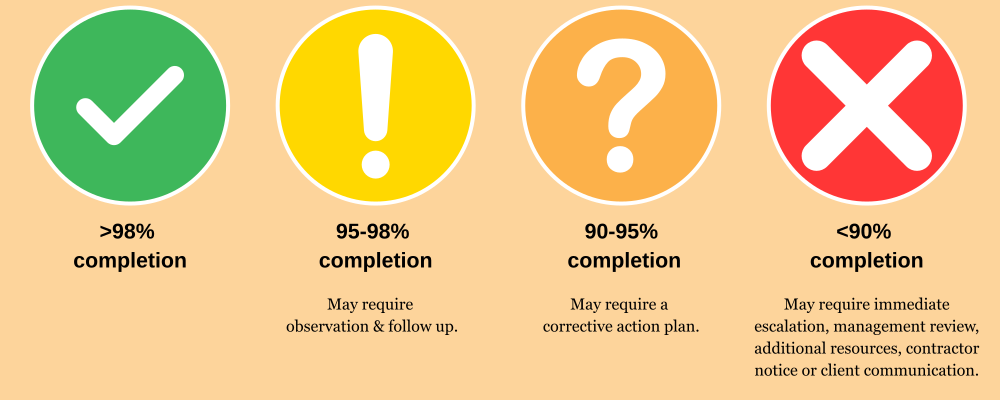 For example, a preventive maintenance completion rate of 98 percent may be green, 95 to 98 percent may be yellow, 90 to 95 percent may be orange, and below 90 percent may be red. For critical life safety systems, the thresholds may be stricter. For less critical services, the thresholds may be more flexible. The threshold should reflect contractual requirements, regulatory obligations, service level agreements, risk appetite and operational reality.
The danger is designing thresholds only in a meeting room. If thresholds are unrealistic, teams will ignore them. If thresholds are too loose, they will not warn early enough. The best approach is to start with reasonable values, test them during operations, and adjust them as the organization learns.
Ownership turns data into action
An early warning system is not a dashboard exercise. It must lead to responsibility and action. Every indicator needs an owner, a review frequency and an agreed response. The owner may be engineering, property management, customer service, finance, procurement, health and safety, human resources or a senior manager. The review frequency should match the speed of the risk. Some indicators need daily review, while others may be weekly, monthly or quarterly.
When a threshold is crossed, the expected action should be clear. A yellow warning may require observation and follow-up. An orange warning may require a corrective action plan. A red warning may require immediate escalation, management review, additional resources, contractor notice or client communication. The system should also record the action owner, target date, evidence and closure decision.
This closed-loop discipline is where many systems fail. A warning is not closed because someone says it is closed. It is closed because evidence shows that the condition has returned to an acceptable level. Evidence may include inspection photos, CMMS records, test results, updated documents, signed checklists, training records or management approval.
Learning from handover & early operations
Handover is one of the best areas to apply early warning thinking. In many projects, the transition from construction to operation is not a clean line. Construction completion, testing, commissioning, defect rectification, fit-out, authority requirements and early FM mobilization may overlap. Documents may be partial. Equipment may not be fully energized. Some responsibilities may still be unclear.
If the FM team only relies on a final handover meeting, many problems will be discovered too late. A risk indicator approach allows the team to monitor readiness progressively. How many areas have been inspected? How many critical systems have valid test records? Which assets do not have complete data? Which defects affect safety, access, maintainability or future operation? Which documents are still missing? Which items require client, contractor or authority decision?
This approach also improves communication. Instead of saying, “handover is not ready,” the FM team can show the readiness status with facts. That makes discussions with owners, project teams and contractors more constructive. It also protects the FM organization from accepting unclear risks without proper records.
The MENA context: Why early warning mattersIn the Middle East and North Africa, FM teams often operate in environments with rapid development, ambitious project schedules and high service expectations. Assets can be technically advanced, but the operating organization may still be forming. Teams may include people from different countries, languages and professional backgrounds. Contractors and subcontractors may vary in maturity. Documentation quality may differ from one package to another. Climate also matters. Heat, dust, water quality, cooling demand and high occupancy expectations place pressure on systems and people. For this reason, technical indicators related to HVAC performance, filtration, water treatment, energy consumption, system alarms and critical spare parts can be leading signals of future operational issues. The regional context also creates an opportunity. Many new assets are being mobilized with digital tools from the beginning. If FM teams design risk indicators early, they can connect them with CMMS, BMS, helpdesk and reporting processes. This is easier than trying to rebuild the risk system years later. |
Keeping the system practical
The most common mistake is to make the system too large. A spreadsheet with hundreds of risks and dozens of columns may look professional, but it may not be used. FM teams are busy.
 A practical method is to maintain a broad risk library in the background, but select a smaller group of priority risks for active monitoring. These should include life safety, critical systems, contractual compliance, major cost exposure, customer experience and regulatory obligations. The organization can expand the system later as data quality improves.
A second point is to use the same logic across levels. Senior management may only need a short summary of red and orange risks. Department managers may need trend charts and action plans. Site teams may need simple checklists and daily exception reports. The same risk can therefore be reported differently depending on the audience, while the underlying data remains consistent.
A third point is regular review. Some indicators will prove useful. Others will not. Some thresholds will need adjustment. Some risks will disappear, while new risks will emerge. Risk management should not be frozen. It should develop with the asset, the contract, the client and the operating team.
The takeaway
For FM leaders, the purpose of an early warning system is not to predict every failure. That is impossible. The purpose is to reduce avoidable surprises. A good system helps leaders see where attention is needed, where resources should be shifted, which contractors require intervention, which costs are drifting, which defects are not closing, and which safety or compliance matters require escalation.
It also changes the culture of risk management. Instead of discussing risk only during audits or annual reviews, teams begin to discuss risk during normal operations. Risk becomes part of maintenance planning, customer service review, financial control, contractor management and leadership decision-making.
The best systems are the ones people trust and use. They are built on clear risks, reliable data, realistic thresholds, accountable owners and disciplined closure. They help FM teams move from reactive firefighting to proactive management.
As the regional built environment expands and expectations rise, this capability becomes more important. FM professionals have an opportunity to show that risk management is not simply a corporate requirement. It is a practical way to protect people, assets, service quality, money and reputation.
A risk register remains a useful foundation, but it should not be the final destination.
 It does not need to start perfectly. It can begin with a focused list of critical risks, a few practical indicators and a clear review rhythm.
Over time, the organization will learn which signals matter. The risk system will become stronger, and management conversations will become more evidence-based. For FM professionals in the Middle East and North Africa, this is not only a better way to manage risk. It is also a way to demonstrate leadership in a complex and fast-changing operating environment.

Xingya Yong, CFM, FMP, is a senior facility management professional with over 20 years of experience in technical operations, hard services management, project transition and integrated FM system development. He has led and contributed to major FM tendering, takeover inspection, technical proposal development and performance management initiatives across China and the Middle East, with strong expertise in ISO 41001, QHSE, SLA/KPI management, CMMS, maintenance strategy, vendor coordination and operational readiness. Yong has extensive FM experience across industrial manufacturing facilities, laboratories, R&D environments, corporate offices, commercial complexes, international airport terminals, CBD city-operation projects, critical environments, multi-site portfolios and large-scale hard services operations. He combines practical engineering knowledge with strategic FM management capability, positioning him as an experienced FM practitioner in international hard services and operational management.
References
Top image via Getty Images.
Read more on Risk Management and Facility Operations or related topics Risk Management and Operations
Explore All FMJ TopicsRelated articles
-

A New Approach
Improving business continuity with alarm managementBy Brad Freeman09.09.2024 -

Beware of Growing Cyberthreats
Why it’s time for stronger facility cybersecurityBy Andrew Harris & Eric Headington10.30.2024 -

Going Up?
Keeping elevators safe & compliantBy Dave Myers & Doug Taylor11.06.2024