
 Membership
 Network
 Regional Sites & Affiliates


 Events
 Participate
 Resources
 Training
 Credentials
 Government


 Content Channels
 Tools
Tools


 Business Overview




From Strategy to Execution
Implementing a real estate master plan

From Los Angeles to Beijing, Paris to Panama City, there is a common trait among facilities and properties managers: they are perceived as firefighters, always running to their next emergency.
Between saving the world and filling Excel files, they also participate in something invisible: strategic planification. But how can FMs find the time and clear mind to take a step back and decide their organization’s assets’ future?
That can be accomplished with a real estate master plan (REMP). Behind these four words is a method which helps to create a long-term (generally at least 10 years) portfolio strategy.
REMP involves many stakeholders across the built environment teams, C-suite and often even the assets’ end users.
In France, it has been structured in a tool for cities with more than 3,500, guiding them, with the help of a real estate consulting company, to rationalize public real estate, reduce costs and speed up on energy savings.
The four-step method and lessons learned in France can be insightful, both for public and private portfolios.
 The consultant and the portfolio owner define how they will work together, ownership’s main goals, identify the stakeholders involved in the REMP and, most importantly, the single point of contact (SPOC) on the ownership side.
The SPOC is vital to the REMP’s success because they will ensure that the consultant has all the necessary data, documents, access and historical/institutional knowledge for complete understanding of the portfolio.
Important documents include regulatory control reports, expense reports from the previous five years, asbestos and general environmental, health and safety reports, urban planning documents, building plans and local regulation and compliance documentation (for example, accessibility standards).
This phase is also crucial for planning the REMP’s next steps and building audits.
For the consultant’s side, it is important to control the timeline of the project. If it is too short, there may not be enough time to analyze documents, data and audit results. This can lead to building the REMP on false assumptions.
If the timeline is too long, the ownership side could be less involved and runs the risk of new events such as a major building repair or replacement, or even key facility or property personnel departing from the ownership side, which could drastically change the REMP.

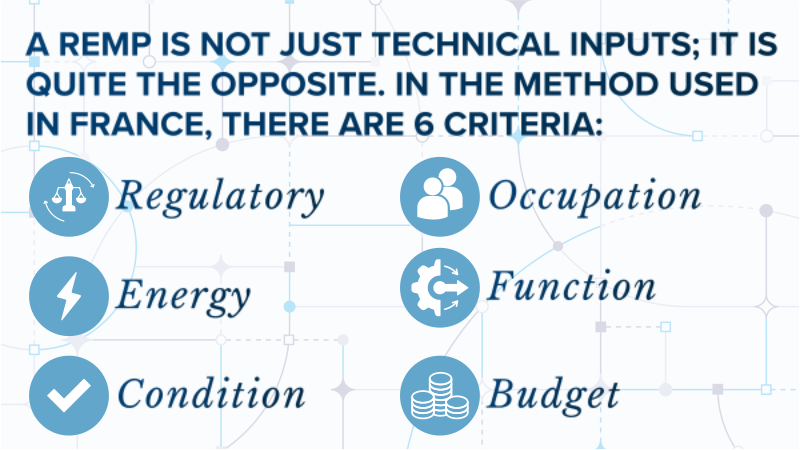 Each one of these criteria is studied by the consultant to form a 360-degree view of every asset within a building or portfolio.
The regulatory stake will assess the property’s status regarding its current and future regulatory obligations. It requires the consultant to be acutely familiar with and aware of local regulations.
The energy and condition criteria can easily be used to compare the studied building/portfolio in reference to appropriate standards.
The occupancy criteria will define how and when occupants use the building. Is the building often empty? Is only half of the building being used? Is the building used for another destination that is its first purpose?
The functional criteria can be hard to understand. It is important to know the building’s location and how it interacts with and within its neighborhood. It will also study opportunities for its reversibility.
Finally, the budget criteria will analyze the financial balance of the assets.
This is where choosing the right consulting company is important: if the consultant specializes in a narrow range of expertise — for example, energy or maintenance — the risk to the ownership organization is that the analysis may only focus on one or two criteria aspects.
Also, this phase should not be rushed, considering the amount of data and analysis that must be completed.
Finally, the consultant should also interview the stakeholders on the ownership side after walking through the portfolio. With a walkthrough, the consultant will be able to ask more targeted questions to the right members of the stakeholder team.
 By the end of the previous step, both the consultant and the ownership sides should have a basic knowledge of buildings and the portfolio. This phase builds master plan proposals and discussions on choosing one and moving forward.
The French approach requires the consulting company to propose three master plans, but for smaller portfolios two master plan proposal scenarios can be enough.
Each proposed scenario is based on audit results, ownership goals, and the impact of future regulations and compliance. In France, for example, the last several years have brought binding regulations on energy efficiency. Compliance must be included in the scenarios, perhaps with different scalable paths.
Also, it is important for both sides to maintain open lines of communication so that goals are understood and proposed master plans do not deviate too far from ownership’s expectations.
At the beginning of this phase, the consultant and the ownership team will clarify the strategic points with the consultant, building those into an action plan with projected KPIs.
A long-term REMP typically spans 10 years. However, there are cases where 15- and 20-year plans can be proposed and implemented.
 After the ownership team has chosen one of the scenarios, it is now time to fine tune the plan and chart a course of action.
The last phase consists of detailing the chosen scenario and turning it into a concrete REMP.
The consultancy side should present a global guide to the ownership team who will carry out the strategies defined in the REMP.
The action plan should be staggered over six-month periods.
Regarding deliverables, the REMP should at least include a global report on each building in the portfolio, a document dedicated to energy consumption and the course of action.
The French method offers ownership the possibility to add an additional phase, whose goal is to follow the complete realization of the REMP. To achieve this, the consulting company and the ownership team should meet every six months for two years to track if the REMP is applied properly. If there are problems with execution, then both sides should discuss those issues to understand why these problems occur and how to correct them, if needed.
 Before considering a master plan there are important points for both the ownership and consulting sides.
Choosing a master plan consultant is more than just choosing a company. Ownership is selecting a team — one that will be dedicated to leading discussions, identifying goals and developing a strategic course of action that will chart the organization’s operations and maintenance for years to come.
This team should have demonstrated knowledge and skills in both facility and asset management. Some consultants could assign an architect or an HVAC engineer, but even if their knowledge and skills are applicable, they are not necessarily sufficient for a full-scope real estate strategy. Both facility and asset management skills are needed to cover all aspects of a REMP.
From a consulting perspective, creating a real estate master plan for a client can be a difficult job, particularly during the audits and scenarios steps. The audits phase is time consuming for the owner team but may identify latent issues. It is important not to ignore any data, document or issue. The goal is to induce difficult discussions, not to influence decisions. Consultants should be able to create and stimulate the debate.
France is internationally known for three things: cheese, the Eiffel Tower and an “highly complete” normative environment.
Too many standards can be counterproductive, nevertheless a positive point of those standards is that they have been influenced by very smart people. Developing and executing a real estate master plan is among those standards.
From a day-to-day perspective, a REMP seems like an obscure tool used to create a new Excel form nobody will ever read. Nothing can be further from the truth.
Engaging a REMP means taking control of a portfolio’s future while building a stronger knowledge base that any facility or asset manager could only dream of. However, it is also an opportunity to view the future through three scenarios and compare their outcomes.
A real estate portfolio can no longer be nonchalantly managed, regardless of whether it is public or private. Real strategy must consider the actual state of the portfolio, ownership’s goals and external factors, such as regulations.
The real estate master plan includes these dimensions, making it an ideal decision support tool.

Tristan Ragusa has worked as a consultant in technical maintenance and facility management. Now, he continues these activities and is partner in an IWMS company. Soon, he will also be a part of the EMEA YP Initiative.
References
Top image via Getty Images.
Read more on Leadership & Strategy , Real Estate and Finance & Business or related topics Operational and Capital Budgeting , Strategic Planning and Real Estate Management
Explore All FMJ TopicsRelated articles
-

Artificial Intelligence in FM
The stakeholder’s perspectiveBy Dr. Jake Smithwick & Dr. Kenneth Sullivan & Nneka Ubi05.01.2024 -

Mastering Change in Hybrid Environments
Insights from global operational leadersBy Meg Swanson09.02.2024 -

Plugged In
Solving the data disconnect in real estate and FMBy Amanda Muzzarelli & James Waddell07.01.2024