
 Membership
 Network
 Regional Sites & Affiliates


 Events
 Participate
 Resources

 Training
 Credentials
 Government


 Content Channels
 Tools
Tools


 Business Overview



From the Start
Reducing worker risk in industrial equipment design

Designing for safety is designing for risk management. Every machine feature, from a mechanical guard to a pressure relief system, represents an engineering response to potential hazards that could endanger operators or disrupt operations. Industrial risk management is multifaceted and requires attention to personnel, process, facility and productivity risks. When design teams apply risk assessment principles early in the concept phase, they can identify the full array of exposure points and integrate safeguards that reduce risk at the source.
The goal is to balance protection, performance and cost without compromising compliance. As emerging technologies like automation and remote monitoring expand risk profiles, a disciplined safety-by-design approach remains the most effective strategy for managing operational uncertainty and sustaining workforce protection.
Early-stage risk assessment shapes better design outcomes
Early identification of process-related risks enables design teams to define constraints more accurately, resulting in more successful implementation. When safety becomes an afterthought, implementing countermeasures grows exponentially more difficult, time-consuming and costly. Addressing hazards during the concept phase creates opportunities for mechanical solutions and integrated protections that would be impractical to retrofit later.
Effective risk assessment begins with stakeholder feedback. While some project teams intentionally stay small to maintain agility, safety-critical processes benefit from broader input early in development. Understanding existing challenges and how proposed changes might introduce additional hazards helps uncover risks that small teams might overlook. For example, one manufacturer operating a diesel engine production plant includes 20 stakeholders in project reviews. Although this approach extends the design timeline, implementations consistently succeed because safety concerns rarely emerge as surprises.
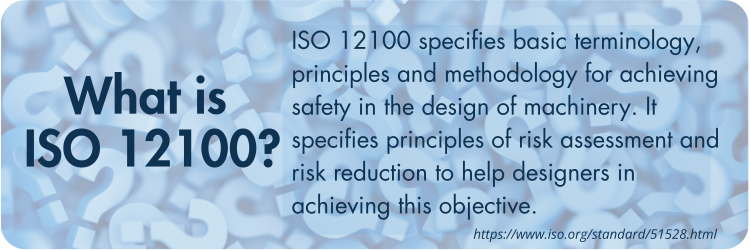
The process requires a structure. Tools like ISO 12100 provide systematic frameworks for identifying and quantifying hazards based on severity, likelihood, and frequency. These assessments generate scores that help teams distinguish genuine risks from perceived problems and then determine appropriate response. These responses may include adding sensors and automation or relying on operator training, signage, and physical guarding. Because cost and lead-time constraints make it impractical to engineer against every eventuality, risk scoring helps teams direct resources where they matter most. A core decision-making team ultimately translates stakeholder input and risk scores into design criteria, ensuring accountability while incorporating diverse perspectives into requirements that guide the entire development process.
FM participation in the design process
Facility managers play an essential role in integrating safety from project inception, starting with safety requirements included in the bid process to ensure consistent safeguards across vendors. FMs can stay plugged into the design team’s work through milestone reviews, which helps to ensure safety is not an afterthought. The key is designating representatives, such as FM, IT, or manufacturing personnel, for stakeholder meetings where they can raise site-specific concerns and operational realities.
The value these representatives bring lies in their “if-then” thinking. If power fails, what happens? If a header develops a leak, what is the consequence? Developing scenarios helps design teams understand site-specific vulnerabilities and operational realities. Early involvement allows FM teams to distinguish between risks addressed by engineered controls and those managed administratively, informing decisions such as sensor redundancy, ventilation backup and fail-safe valve settings. Integrating these elements during initial installation, rather than as field modifications, reduces both schedule and cost.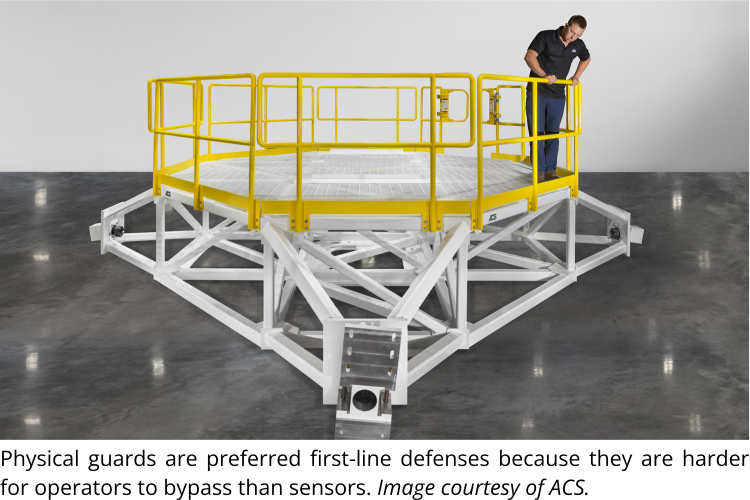
 Engineering strategies for managing high-risk factors
Understanding what happens when equipment fails or shuts down determines how effectively teams can protect operators and facilities. Different shutdown scenarios, such as soft stops, emergency stops, and complete power loss, each create distinct risk profiles that require specific engineering responses.
Heat, motion & pressure
Managing stored energy represents one of the most critical design challenges. When an emergency stop activates, the preferred outcome is for all energy to be released immediately so the system reaches a safe state. A hydraulic press with large springs and rams illustrates the complexity: stopping hydraulic flow does not eliminate spring tension, which can create hazards for maintenance personnel. The solution requires deliberate energy release, whether through spring discharge mechanisms, permanent stops that hold components in safe positions, or controlled venting of pneumatic and hydraulic pressure.
Valves present similar considerations throughout a facility. Depending on their power source and position, valves may need to spring closed, spring open or rely on backup batteries to reach fail-safe states. Planning these responses early proves far more effective than retrofitting solutions after installation.
Safe atmosphere & ventilation requirements
Air conditions created by specific equipment require careful attention to their shutdown scenarios. Equipment that generates hydrogen or other hazardous off-gases requires ventilation systems designed to continue operating during emergencies, often relying on secondary power sources. Before permitting door access to operators, it is crucial for the sensing systems to verify that the atmosphere is safe. The goal is to prevent operator exposure to flammable gas concentrations or oxygen-depleted environments that can develop when primary systems fail.
Process-specific considerations
Not all mechanical systems behave the same during power-loss events, requiring tailored safety approaches. A complete building power failure affects equipment differently than an operator-initiated emergency stop or a controlled shutdown. Fuel systems may trap combustible material in lines or experience over-pressurization as the process normalizes to ambient conditions unless safety relief valves prevent these hazards. Steam systems need similar protection to avoid burst pipes. Natural gas panels typically employ double block and bleed isolation, stopping flow upstream and downstream while venting the intermediate section outside the building, to ensure the space remains safe for personnel entry. Understanding these process-specific failure modes during the design phase allows teams to specify appropriate components, backup systems, and isolation methods before the equipment arrives at the facility.
Controls & instrumentation: Ensuring systems respond safely
Sensor selection involves considering what needs to be measured and how instruments might fail. A temperature sensor malfunction may register zero, stop transmitting or behave unpredictably. How the control system interprets such failures determines whether the system shuts down safely or continues operating under hazardous conditions. For example, if a temperature sensor in a process heater fails, an operator-initiated emergency stop may not trigger a shutdown if sensors do not detect rising temperatures. These conditions can cause scorched insulation or fire, underscoring the need for shutdown protocols and sensor networks designed to account for faults to ensure equipment can reliably enter a safe state.
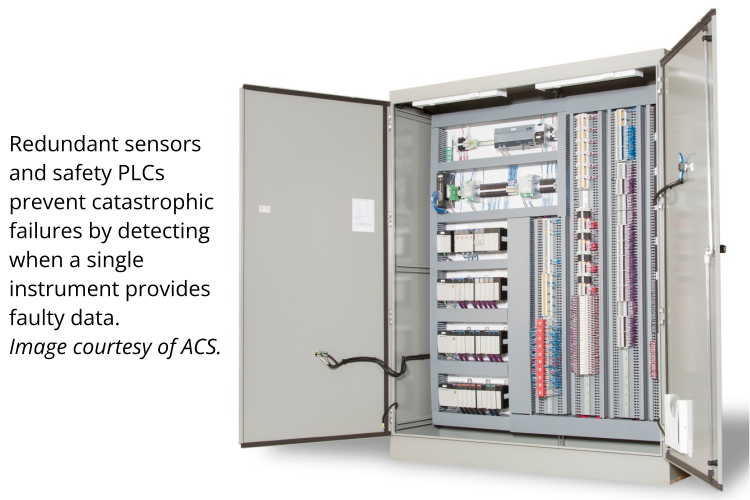
 Redundant sensors and smarter programmable logic controllers (PLCs) can detect these failures, but they come at a significant cost, sometimes tripling controller investment and adding thousands of dollars per measurement point. The design challenge is determining which risks justify that expense. Risk assessment tools help identify where sensor failure could trigger catastrophic outcomes versus situations that can be managed through operator training, signage or physical barriers. Not every wet floor requires networked liquid detectors and heat cameras. In some cases, simple procedures and drainage provide sufficient mitigation.
Layering protection across hardware and software requires coordination. PLCs monitor devices and execute real-time control logic, while separate software systems may manage setpoints and sequences. If these layers do not communicate properly, unsafe conditions can develop. Hierarchy matters because safety-critical logic often runs on dedicated safety PLCs or safety-instrumented systems with their own integrity levels, separate from standard process control. Designing these layers to fail predictably, with clear alarm escalation and automatic shutdown sequences when data becomes unreliable, prevents operators from encountering equipment that appears functional but has lost protective oversight.
Balancing protection, uptime & cost
Safety assessment tools help teams categorize risks into need-to-have, nice-to-have, and do-not-need-to-focus categories. A problem that could burn down a building but occurs once in a million operations might warrant an inexpensive sensor rather than continuous fire watch personnel. The objective is a proportional response that matches the protection level to the actual risk severity and likelihood.
Mechanical solutions often provide reliable, cost-effective protection. If conveyor operators worry that a 90-degree turn causes tipping, restricting the turning space and installing a static catch plate below may address the issue without redesigning the entire system. Problems solved mechanically, using guards, stops or geometric constraints typically prove more durable than control-based solutions.
Even well-designed safety systems must account for operational realities. Safety mats may work effectively for months, but accumulated oil and grease can cause malfunctions. Light curtains and interlocks can create nuisance downtime, pressuring maintenance teams to circumvent safeguards. This tension between safety and uptime demands an honest assessment during the design phase. Design teams can ask themselves how much control complexity the facility can support without generating false alarms that erode system trust. Identifying this balance requires ongoing conversation between design teams and facility representatives who understand both workforce culture and maintenance capabilities that sustain safety features long term.
 Designing for human behavior
The tension between safety systems and operational demands ultimately revolves around human behavior. Operators may bypass protections under pressure to produce or for convenience. Mechanical solutions resist circumvention more effectively than electronic safeguards, making them the preferred first line of defense. The long-term effectiveness of electronic protection depends on workforce culture and training.
Training requirements differ by role. Operators need task-focused instruction, such as specific work steps, posted procedures reviewed regularly and a clear understanding of how their actions affect process safety. Maintenance and engineering staff require deeper equipment knowledge, including alarm interpretation, restoring safe states, and recognizing when process problems signal larger facility issues. Both groups benefit from training that addresses not only how to operate safely, but also what to do during abnormal conditions.
New technologies & challenges
Emerging technologies expand capabilities and risk profiles, requiring facilities to adapt their safety strategies:
-
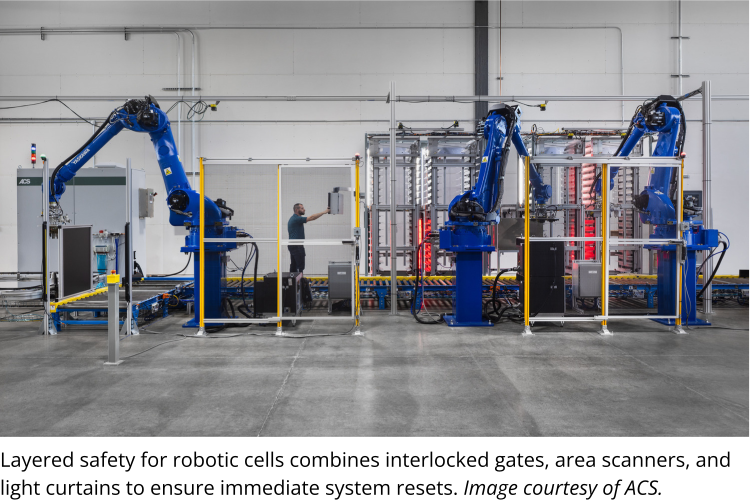
Robotics & automation safety. Modern robotic cells use multiple protection layers, interlocked gates with position feedback, area scanners for intrusions, and physical guarding as a backup. If any layer detects unsafe conditions, the system shuts down and requires a manual reset. Vision systems and advanced robotics can remove operators from hazardous environments, shifting their role from production to oversight.
-
Remote monitoring dependencies. As remote monitoring grows, [BV1.1]more systems operating unattended for extended periods need robust fail-safes. Heartbeat protocols verify continuous communication; if it fails, alarms trigger immediately. It is vital for process-level safeguards, such as monitoring temperature, pressure, and product quality, to function independently, even if remote systems lose connection, preventing single points of failure.
-
Diverse approaches to emerging risks. Battery testing illustrates how new technologies generate varied mitigation strategies. Lithium-ion thermal runaway management differs across facilities. Some use cameras, while others employ internal backup monitoring or monitored partial charging. Production-level safety protocols lag behind product development standards, with requirements varying by jurisdiction and insurer. This variability demands flexible strategies as technology and regulations mature.
 Translating early planning into long-term protection
With a safety-by-design mindset, FMs and their teams play a critical role in shaping industrial equipment that protects people, preserves assets, and supports reliable operations. Providing early input on standards, site constraints, and risk priorities to design teams ensures integrators build safety into every stage rather than adding it on later. By staying engaged through milestone reviews, teams can distinguish essential safeguards from low-value additions and adjust designs as real-world details emerge. When facilities approach safety as an ongoing collaboration, rather than a final checklist, they create systems that adapt over time while keeping workers and processes secure.

David Suehs, is director, Machine Design at ACS. Suehs has extensive experience in the comprehensive process of designing systems, guiding them from conceptualization through build and commissioning. His role extends to overseeing the technical intricacies of equipment construction at the ACS Manufacturing Facility. Suehs develops strategic plans for equipment installation and commissioning, demonstrating proficiency in leading multidisciplinary teams through the seamless execution of design, build, installation and commissioning tasks.
References
Top image by Getty Images.
Read more on Risk Management and Occupancy & Human Factors or related topics Risk Management , Emergency preparedness, response and recovery and Occupant Safety
Explore All FMJ TopicsRelated articles
-
A New Approach
Improving business continuity with alarm managementBy Brad Freeman09.09.2024 -

Beware of Growing Cyberthreats
Why it’s time for stronger facility cybersecurityBy Andrew Harris & Eric Headington10.30.2024 -

Going Up?
Keeping elevators safe & compliantBy Dave Myers & Doug Taylor11.06.2024