
 Membership
 Network
 Regional Sites & Affiliates


 Events
 Participate
 Resources

 Training
 Credentials
 Government


 Content Channels
 Tools
Tools


 Business Overview





From Vulnerable Assets to Resilient Anchors
10 essentials for climate-ready buildings

Facility managers are now stewards of resilience. As climate extremes disrupt supply chains, damage infrastructure and challenge occupant safety, their role extends far beyond maintenance. As the demands on the FM industry weigh heavier, its professionals require a globally applicable framework to help facilities anticipate, withstand and recover from disasters while maintaining functionality, protecting assets and supporting community stability.
Climate change as a facility imperative
Rising temperatures, more frequent extreme storms and wildfires, and accelerating sea-level rise are redefining the risk landscape for buildings worldwide. Industrial, commercial and campus facilities are now on the front line of climate disruption. Insurance premiums are climbing, power outages are more common and “once-in-a-century” floods occur several times within a decade. For FMs, resilience is no longer optional; it is a core business function that safeguards occupants, protects capital and preserves operational continuity.
Keeping people safe, productive and connected is the ultimate measure of facility management success. Climate resilience extends that mission to the long term — ensuring that operations can withstand and recover from shocks while continuing to deliver value to occupants and the surrounding community.
 A proven framework: The 10 essentials
The United Nations Office for Disaster Risk Reduction (UNDRR) offers a practical roadmap through its Disaster Resilience Scorecard for Industrial and Commercial Buildings. Adapted from the global “Ten Essentials for Disaster Risk Reduction,” the scorecard evaluates resilience across governance, risk assessment, financial strategy and community engagement. It enables building owners and managers to establish a baseline, identify gaps and prioritize investments.
These essentials emphasize that a facility cannot be resilient in isolation. Every decision — from site design and materials to supplier contracts and maintenance budgets — can either compound or reduce a facility’s exposure to risk. Its fate is intertwined with the wider community’s infrastructure, emergency preparedness and social fabric. For example, even a structurally hardened building remains vulnerable if access roads flood or if power and water networks fail.
Organize for resilience

Resilience begins with governance. Organizations that integrate resilience into executive decision-making outperform peers when disasters strike. For example, having a central coordination point — sometimes called a chief resilience officer or equivalent — who convenes internal and external stakeholders and ensures roles and responsibilities are clearly defined. Regular review of resilience plans, updated for evolving climate science and land-use changes, creates momentum for continuous improvement.
Understand & use risk scenarios

Effective FM demands a detailed understanding of both current and future risks. Scenario planning should capture the combined impacts of multiple hazards, including cascading failures such as a power outage during a heatwave or a flood disrupting supply chains. Incorporating projections for sea-level rise and changing storm patterns allows managers to future-proof capital investments.
Strengthen financial capacity

Even the best-designed building will falter without the resources to recover. Financial plans and contingency funds sufficient to maintain cash flow through prolonged insurance settlements or supply-chain delays are key. Globally, climate-related disruptions are already raising operational costs and cutting revenue across industries. Allocating dedicated resilience budgets and establishing clear funding mechanisms ensures that critical upgrades and rapid recovery are feasible.
Pursue resilient urban development
 Resilience extends beyond the facility’s walls. Compliance with up-to-date building codes is a minimum requirement, leading organizations go further by adopting voluntary resilient-building standards such as ASTM E3429-24: Property Resilience Assessment (PRA), released in 2024, or following the EU Technical Guidance on Adapting Buildings to Climate Change. Site design should also reduce vulnerability — incorporating natural drainage, floodplain protection and heat-island mitigation. Such investments not only reduce damage but can lower insurance costs and enhance long-term asset value.
Safeguard natural buffers
 Green infrastructure — such as bioswales, green roofs and locally sourced renewable energy — provides critical ecosystem services that protect buildings and surrounding communities. Appointing a responsible person to monitor and maintain these features over time may support efficient operations and maintenance. Natural buffers absorb stormwater, reduce heat stress and offer a first line of defense against climate shocks.
Build institutional capacity
 A resilient facility depends on the skills and knowledge of its people. FMs must ensure access to training and data to support evidence-based decision-making. Whether through in-house expertise or partnerships with external professionals, continuous capacity building strengthens preparedness and speeds recovery.
Engage stakeholders & the community
 Disaster resilience is a shared responsibility. It is important to engage tenants, employees, neighbors and local authorities in planning and drills. Community collaboration not only improves emergency response but also builds the social capital that speeds up post-disaster recovery. In many regions, local partnerships have proved as critical as physical infrastructure in sustaining operations.
Protect critical infrastructure dependencies
 Facilities depend on external lifelines — power, water, transportation and communications. Assessing these dependencies and developing redundancy plans is essential. Backup power generation, diversified water sources and alternative supply routes reduce the risk of cascading failures when regional infrastructure falters.
Plan for emergency response
 Comprehensive emergency response planning, including regular drills and clear communication protocols, ensures that staff and occupants know how to act when a crisis occurs. The best plans integrate with citywide emergency services and are updated frequently to reflect new threats and lessons learned.
Enable post-disaster recovery
 Finally, resilience must extend into the recovery phase. Plans should address not only rapid physical repairs but also business continuity — protecting revenue streams and employee livelihoods. The Resilience Advantage notes that 40 percent of small businesses never reopen after a major disaster, and another 25 percent close within a year. For facility managers, early investments in continuity planning and insurance coverage can mean the difference between temporary disruption and permanent loss.
 The economics of resilience
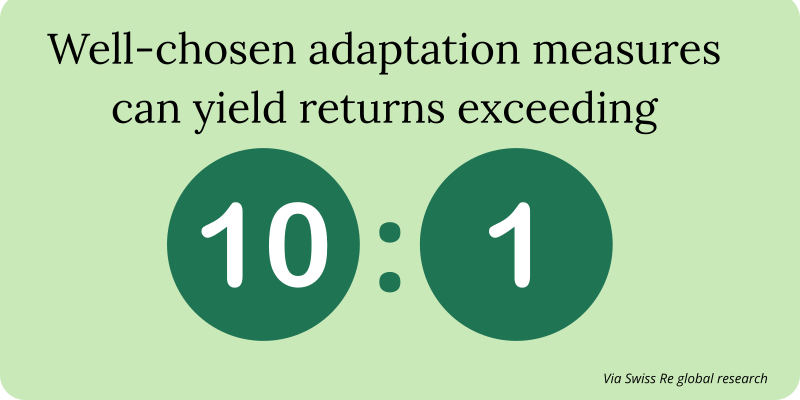
Evidence continues to show that resilience is not just prudent risk management — it is sound financial strategy. The National Institute of Building Sciences has found that private-sector resilience retrofits can save an average of US$4 for every US$1 invested, and as much as US$6 per US$1 for hurricane mitigation. Studies by Zurich Insurance and the Wharton Risk Center report that each dollar spent on flood prevention can prevent US$5 in future losses, while Swiss Re’s global research concludes that well-chosen adaptation measures can yield returns exceeding 10:1.
These findings hold across building types and geographies: investing in stormwater upgrades, wind-resistant facades, backup power or passive cooling measures consistently yields savings through avoided downtime and reduced insurance costs. For FMs, these numbers translate directly into stronger asset valuations, lower total cost of ownership and improved investor confidence. Resilience planning also strengthens ESG performance and investor confidence. The data makes clear that climate resilience is not a sunk cost — it is an investment in long-term business performance.
Integrating the essentials
These 10 action areas are interdependent. For example, robust governance (Essential 1) supports financial planning (Essential 3), which in turn funds natural buffers (Essential 5). An organization that invests in community engagement (Essential 7) often gains better intelligence on external infrastructure risks (Essential 8). FMs should view the essentials as a holistic system rather than a checklist.
Global lessons & practical steps
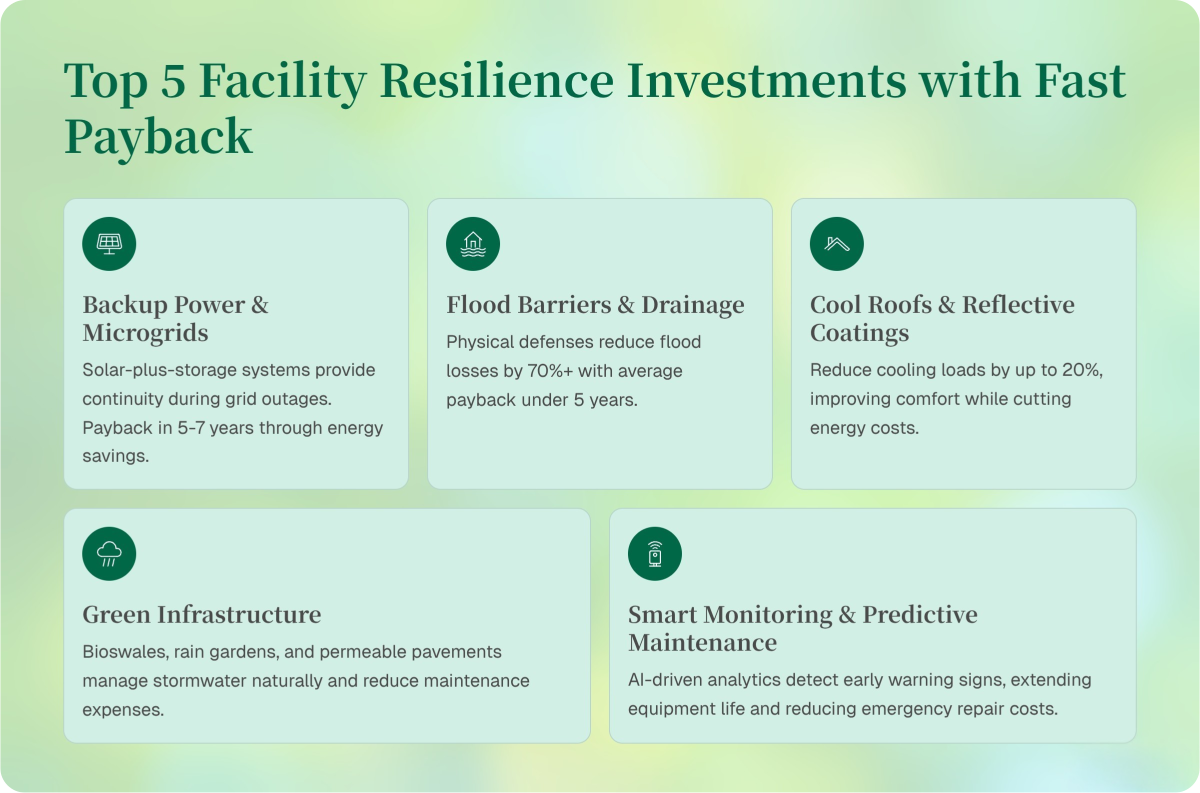
Experience shows that climate-ready facilities yield both risk-reduction and financial benefits. Manufacturing plants in Southeast Asia that implemented green-infrastructure retrofits reduced flood losses while cutting cooling costs. European hospitals that diversified power supplies maintained critical services during regional blackouts. Industrial parks in Australia and the Caribbean are installing renewable microgrids to keep essential operations online during grid failures. In regions such as South Asia and Africa, cool roofs and reflective coatings are cutting interior temperatures by up to 5 C during heatwaves, reducing energy demand while protecting occupant health. Across Europe and East Asia, digital twins and predictive maintenance systems are helping managers visualize vulnerabilities and plan interventions before failures occur. Together, these approaches illustrate that resilience innovation is not confined to any one geography — it is fast becoming the global baseline for operational excellence.
 The road ahead
The climate crisis is a global challenge, but facility managers have a pivotal role in shaping the built environment’s response. By applying the UNDRR scorecard’s 10 essentials and the actionable guidance from The Resilience Advantage, organizations can evolve from vulnerable assets into resilient anchors for their organizations and communities. The work requires planning, investment and collaboration — yet it delivers enduring value: buildings that safeguard lives, sustain economic activity and remain reliable in an uncertain climate future.

Joyce Coffee, LEED AP, is president of Climate Resilience Consulting, co-author of The Resilience Advantage and a recognized leader in climate adaptation and resilience implementation.

Dr. Robert Macnee, PhD, is deputy director at CRC and co-author of The Resilience Advantage: A Small Business Guide to Preparing for Floods, Heatwaves, Wildfires, and Other Climate Disasters.
References
Resources for further action
Facility managers can explore these publicly available, noncommercial resources:
-
UNDRR Disaster Resilience Scorecard for Industrial and Commercial Buildings – a free, detailed assessment tool and action guide.
-
The Resilience Advantage: A Small Business Guide to Preparing for Floods, Heat Wildfires and other Climate Disasters – practical strategies and checklists for business continuity.
-
First Street Foundation’s Risk Factor – interactive maps of heat, flood and wildfire risk.
-
ASTM E3429-24: Property Resilience Assessment (PRA) – a new standard for climate-resilient real estate due diligence.
-
EU Technical Guidance on Adapting Buildings to Climate Change – a guidance document that includes best practices, existing methods, resilience/risk-assessment and rating approaches.
-
Minergie – an advanced performance standard integrating energy efficiency, renewable energy and comfort; its latest iterations also address resilience to climate extremes and operational continuity.
-
Climate Bonds Standard v4.3 – a global framework embedding resilience into climate finance, influencing how investors and insurers evaluate built-environment projects.
Read more on Leadership & Strategy , Sustainability and Risk Management or related topics Climate Change , Facility Resilience and Asset Management
Explore All FMJ TopicsRelated articles
-

Artificial Intelligence in FM
The stakeholder’s perspectiveBy Dr. Jake Smithwick & Dr. Kenneth Sullivan & Nneka Ubi05.01.2024 -

Mastering Change in Hybrid Environments
Insights from global operational leadersBy Meg Swanson09.02.2024 -

Plugged In
Solving the data disconnect in real estate and FMBy Amanda Muzzarelli & James Waddell07.01.2024