
 Membership
 Network
 Regional Sites & Affiliates


 Events
 Participate
 Resources

 Training
 Credentials
 Government


 Content Channels
 Tools
Tools


 Business Overview





Going Up
Training security on steep stadium stairs
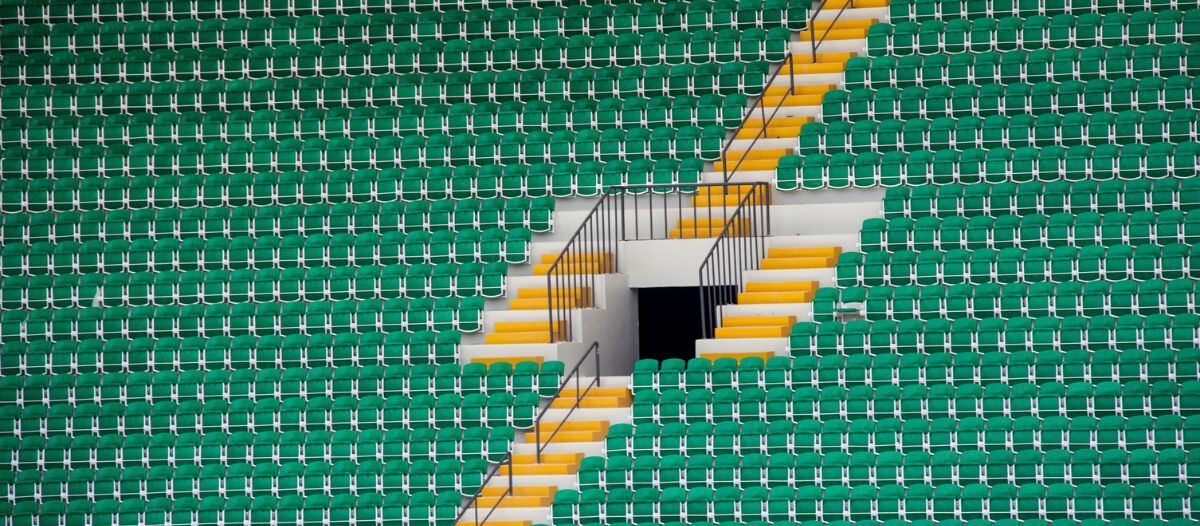
 Climbing to the upper deck of a stadium to watch a professional sports game is not an activity for the faint of heart. The stairs can be steep, the steps precarious and shuffling by other fans to get to your seat with no railing in front of you can be slightly terrifying when you realize how high you are.
Joseph Frank, assistant chief of public safety at Caesar’s Superdome and Smoothie King Center in New Orleans, Louisiana, USA, is familiar with this feeling. He and his team are responsible for the safety and security of fans in one of the largest stadiums in the United States, and the steepness of the upper deck of the stadium that can host more than 70,000 people on Saints game day can be a bit unnerving. The Superdome level 7 terrace — the highest in the stadium — is 145 feet above the stadium’s floor.
“The angle of those stairs that you have to go up and down — the ingress and egress — if you’re not careful, you could slip and fall and have serious bodily injury,” Frank says. “So, we spend a considerable amount of time and resources working on those stairs.”
From posts to unrest & how to curb spectator misconduct
At the Superdome, commissioned security officers do rigorous physical training to be prepared for the challenges of their job. On the Wednesday before an NFL game, for example, officers will do a one-mile run, push-ups, sit-ups and stretching to build and maintain their fitness. This routine is especially important for being able to move up and down the stairs in the Superdome, which has seats pitched at a 30-degree angle.
Training includes how to respond to a fight in an upper tier of the stadium, as well as how to maintain your balance during that response. This involves keeping a six-foot reactionary gap between yourself and the fan you are interacting with, keeping your phone out of sight, avoiding crossing your feet over one another to prevent self-tripping, and creating a firm base with your legs so it is more difficult to be knocked over.
Officers rehearse how to move up the stairs to de-escalate a tense situation between fans or physically escort a fan down the stairs to a less-precarious position if that patron needs to be ejected or arrested. They also practice safe weapons handling in these situations, since officers carry service weapons when on duty.
“I can’t tell you how many times that I’ve been on those steps in the lower terrace or upper terrace and there’s beer spilled on the steps,” Frank adds. “You think you’ve got good footing, and you grab the handrail to go up, and you still slip. But you’ve got to go through that, maybe 10 flights up to the upper decks, to try to arrest or detain someone.”
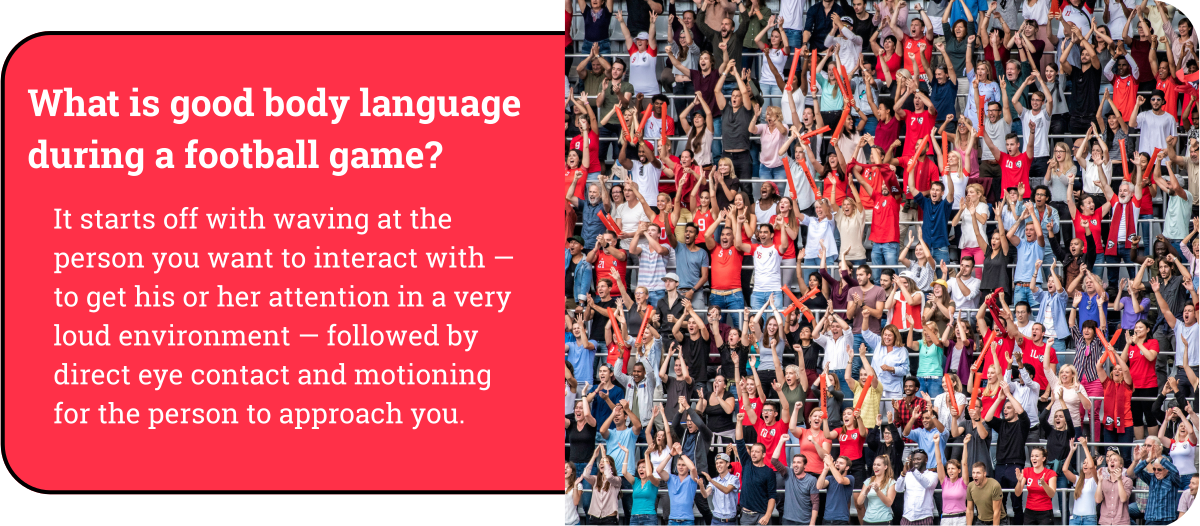
During some of these trials, Frank says they turn on music and crowd noise to simulate the environment in the stadium during a game, which gives officers an opportunity to put their training into practice. With the sound system volume turned high, the officers must use clear and loud verbal commands, accompanied by good body language, to practice safe interactions with fans.
What is good body language during a football game? Frank says it starts off with waving at the person you want to interact with — to get his or her attention in a very loud environment — followed by direct eye contact and motioning for the person to approach you.
“Just loud verbal commands are not going to work,” he adds. But when fans see a uniformed officer, with their badge and gun belt, focused with their phone put away, they are more likely to comply with an instruction.
Security officers also go over the floorplan of the stadium regularly to learn about areas they can escort fans to — like a conference room or storage area — that is not as steep and is quieter for follow-up interactions. Frank refers to this as “knowing your neighborhood,” and adds that it is very important for responding to fans having a medical emergency in the stands.
“If someone passes out and you’ve got to grab them, can you do mouth-to-mouth or CPR at a 45-degree angle in those seats? Maybe not,” Frank says. “But if you know the area, then you can move that person 20 feet up to an area that’s level and flat and safe.”
While medical emergencies or fights are unusual during games, security officers often have to respond to reports of a fan becoming intoxicated and unruly in the stadium. One common occurrence is a fan drinking alcohol before entering the stadium, having a few more drinks during the game, then getting verbally chippy with a rival fan. Typically, this dynamic calms down if a security officer goes up to the area and uses their body language to make themselves visible to the fans involved.
Frank also encourages partnership agencies that support the Superdome to visit the stadium and train on the stairs. The SWAT teams have been out, as well as the bomb squads, to work through how to navigate up to the top terrace should they need to respond to a threat.
“Is your explosives team used to sweeping an area that has a traverse and 500 steps to get up to the suspected device?” Frank says. “Or is the SWAT team member ready and prepared to go down those types of steps at a 45-degree angle and deal with a threat?”
For fans
While security officers run the risk of falling while responding to an emergency, steep stadium environments also pose risks for fans. They can topple over into a row — or several rows — in a steep upper deck. If this happens to several fans at once, it can create a crowd crush.
Keith Still, director of Crowd Risk Analysis Ltd. and a visiting professor of crowd science at the University of Suffolk, has conducted analysis for the Premier League about the risks of fans standing at soccer games. He has used simulations based off features from real stadiums to create an incident where a fan falls forward into the rows in front, causing other people to fall, creating a cascade.
Many Premier League stadiums are designed to have large capacities while keeping fans as close to the field as possible. Achieving this means that stadiums are steep and can have seats at an angle of 35 degrees to the field — the steepest allowed by U.K. regulators.
“We’ve collected data from sites around the world, looking at the width of the seat, the barrier layer, and all are calculable if that person will fall and if the fall will be stopped by that layer,” Still says. “On slopes (steeper and higher portions of stadiums), it’s just much more dangerous because you’re falling with gravity.”
Crowd crush incidents have been more prominent at soccer matches than other sporting events throughout history. One of the most infamous is the Hillsborough Disaster of 1989 involving Liverpool fans attending their club’s FA Cup semifinal against Nottingham Forest.
Before the match, a large crowd built up outside of an entry turnstile into the stadium, an exit gate was opened to relieve the pressure, and 2,000 fans entered a tunnel onto an already packed terrace (space where fans could watch a game while standing), creating a severe crush that killed 97 people and injured hundreds more.
 The tragedy led to U.K. regulations that required soccer grounds in England, Ireland and Wales to become all-seated (removing standing-room-only terraces) to improve crowd safety and prevent crush incidents. But many fans still wanted the ability to stand while watching a game — especially as other countries adopted safe standing practices.
Safe standing uses features like independent barriers in front of a stadium seat that allow fans to stand in front of their seat but prevent them from moving into the row in front of them. The practice was used elsewhere in Europe — especially in Germany’s Bundesliga stadiums.
So, in 2021, the U.K. government decided to initiate a trial testing period for safe standing during the 2021-2022 season with Cardiff City, Chelsea, Manchester City, Manchester United and Tottenham Hotspur.
The British clubs installed barriers or rails in some areas of the stadiums where fans would likely want to stand to view the game, enhanced their use of video surveillance, and improved steward and fan training to raise awareness of the concept of “one person, one space.”
The trials were a success, with an interim report from the Sports Grounds Safety Authority (SGSA) in April 2022 finding that score celebrations were more orderly because of reduced risk of forward and backward movement of fans, which prevented falls. The barriers also provided additional stability for people moving down aisles; allowed stadium personnel to identify and address areas of overcrowding; and enabled late fans to access their seats more easily because the people around them were already standing.
“Barriers along every row are effective at preventing fans falling forward, and so the primary benefit is a reduced risk of injury during goal celebrations,” said Jo Welford, senior research manager for CFE Research, about the report’s findings. “But there are other benefits, too: fans in those areas have something to hold onto for stability, and it is harder for people to move around in sections.
“We surveyed fans in those areas, and the vast majority reported feeling safe and well protected by the barriers; and being able to stand and watch football without being asked to sit down has improved the match day experience, too.”
Based on the findings, the U.K. government now allows Premier League and Championship clubs that want to have safe standing areas to do so if they meet certain requirements and apply for a license with the SGSA after using safe standing seats for two years. The Liverpool FC wrote to families of those affected by the Hillsborough Disaster in 2021, explaining that it planned to trial safe standing seats at its Anfield Stadium.
“The safety of our supporters when they come to Anfield is our absolute priority, and we are fully committed to working with the SGSA on the trial of these new seats at Anfield,” said Andy Hughes, managing director of Liverpool, in a statement about the communication.
Liverpool’s trial was successful, and it received a license to deploy safe standing for 14,000 seats in 2023. One year later, it added safe standing for its entire Kop section — 12,000 seats.
Outside of Europe, several Major League Soccer (MLS) stadiums in the United States also use safe standing. It is unclear if the 2026 World Cup — hosted in Canada, Mexico and the United States — will feature safe standing in stadiums. FIFA does not specifically recommend incorporating standing areas into new stadium designs, but in its technical guidelines it references the SGSA’s approach and suggests using rail seat options — “tip-up seats fixed to a dividing barrier between the rows, or standalone seats with independent barriers” — if included in a stadium.
FIFA does, however, mandate a minimum clearway of 400mm (15.7 inches) between rows of seats for safe egress and emergency evacuation to allow fans to safely pass one another to access seats or exits.
“This is particularly important in steeper tiers such as the upper tiers in larger stadiums, where a safe clearway is required to mitigate any risk of significant falls by spectators,” according to FIFA.
While soccer stadiums have paved the way for safe standing fans, other sports venues are beginning to take an interest in the practice. Several rugby stadiums in the U.K. and Australia have adopted safe standing, along with a National Hockey League (NHL) stadium and an NCAA baseball venue.
UBS Arena, home of the New York Islanders National Hockey League team, has created a safe standing section for its Blue and Orange Army — a fan group dedicated to supporting the team. And The University of Tennessee installed a safe standing section for students at its Lindsey Nelson Stadium in 2025. The section allows fans to stand during baseball games to create a tough right field dynamic for visiting teams.
Will the trend catch on in other sports leagues? Maybe. Regardless, proactive security practitioners will be preparing to respond to threats by training on the steep stairs.

Megan Gates is editor-in-chief of Security Technology.
References
Images via Getty Images.
Read more on Occupancy & Human Factors and Risk Management or related topics Occupant Safety , Risk Management , Training and Best Practices
Explore All FMJ Topics