
 Membership
 Network
 Regional Sites & Affiliates


 Events
 Participate
 Resources

 Training
 Credentials
 Government


 Content Channels
 Tools
Tools


 Business Overview





Green Leasing 2.0
Bridging the owner-occupier divide in data centers to deliver shared ESG value

The global built environment faces a definitive deadline: halving greenhouse gas (GHG) emissions by 2030. Within this sector, the data center industry occupies a unique and critical position. As the digital backbone of the global economy, data centers are among the fastest-growing consumers of energy. While strides have been made in procuring renewable energy, a significant structural barrier remains in optimizing the efficiency of the physical assets themselves: the adversarial nature of the traditional commercial lease.
To meet 2030 targets, the industry requires a paradigm shift from Green Leasing 1.0 — often characterized by vague aspirations and nonbinding clauses — to Green Leasing 2.0. This advanced framework bridges the split incentive gap between owners and occupiers, leveraging data transparency, shared financial models and a holistic focus on environmental, social and governance (ESG) criteria.
The imperative for structural change
 Data centers are energy-intensive facilities, with cooling and IT loads consuming vast amounts of electricity. The World Green Building Council and other global bodies have highlighted that operational carbon — emissions from the ongoing operation of buildings — must be drastically reduced.
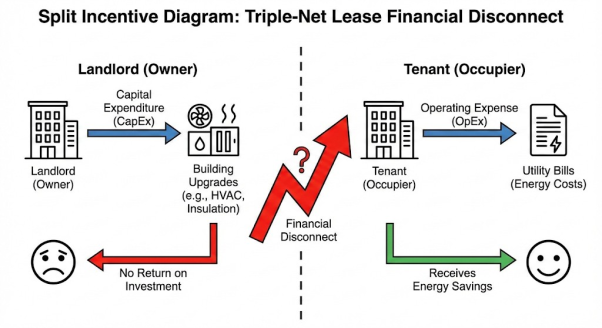
However, the traditional triple-net lease structure hinders this progress. In a standard triple-net lease, the tenant/occupier pays for all operating expenses, including electricity, while the owner is responsible for capital improvements to the building shell and core infrastructure. This creates the classic split incentive:
-
The owner’s disincentive: Owners lack the financial motivation to invest capital in energy-efficiency upgrades (such as advanced chillers or liquid cooling readiness) because the resulting energy savings accrue solely to the tenant who pays the utility bills.
-
The occupier’s disincentive: Occupiers are hesitant to invest in retrofitting a leased asset they do not own, as the long-term value of those improvements reverts to the owner upon lease expiration.
The result is a stagnation of efficiency. Green Leasing 2.0 dismantles this barrier by fundamentally restructuring the relationship from a transaction of space to a partnership in performance.
Defining Green Leasing 2.0: From compliance to performance
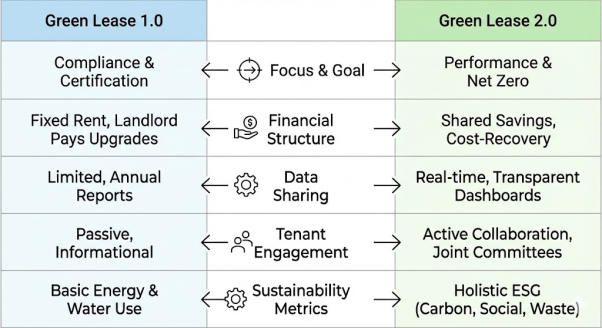 Green Leasing 1.0 was a necessary first step, introducing concepts like cooperation and basic recycling mandates. However, these were frequently treated as light green or soft clauses — legally unenforceable and often ignored after lease signing.
Green Leasing 2.0 represents a rigorous, dark green evolution. It is not merely a legal addendum but an operational management system.
Comparison of frameworks:
-
Objective: Where 1.0 focused on obtaining building certifications (e.g., LEED or BREEAM) at a point in time, 2.0 focuses on continuous, real-time decarbonization and operational performance.
-
Data strategy: 1.0 relied on annual or ad-hoc data sharing. 2.0 mandates automated, API-driven data exchange regarding energy, water and waste, often at 15-minute intervals.
-
Financial structure: 1.0 placed costs on the initiating party. 2.0 utilizes amortization and cost-sharing models wherein investments are recovered through generated savings.
-
Enforceability: 1.0 used best efforts language. 2.0 incorporates specific remedies, performance buffers and potentially liquidated damages for failure to meet agreed-upon metrics like power usage effectiveness (PUE).
The 3 enablers of transformation
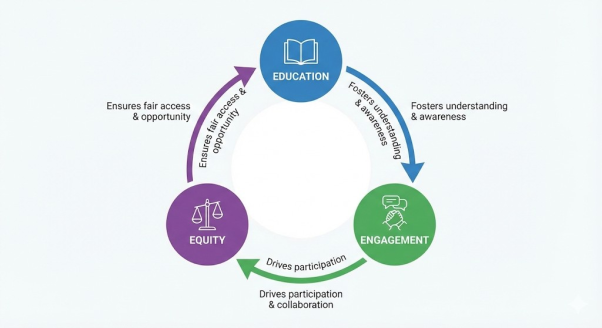 Transitioning to this model requires more than new contract language; it requires a change management strategy powered by three vital enablers: education, engagement and equity.
1. Education: Dismantling information asymmetry
A primary obstacle to green lease adoption is the knowledge gap between stakeholders. Engineering teams, legal counsels and leasing brokers often operate in silos.
Instructional strategy: Before drafting the lease, stakeholders should institute a technical exchange workshop. This forum brings together the owner’s facility managers and the occupier’s IT infrastructure teams.
-
Objective: To map the facility’s technical capabilities against the occupier’s roadmap (e.g., transition to high-density racks).
-
Outcome: A shared efficiency roadmap that becomes an exhibit in the lease. This document defines technical terms clearly — ensuring both parties agree on how PUE is calculated (e.g., at the uninterruptible power supply (UPS) output or power distribution unit (PDU) level) — eliminating ambiguity that leads to disputes.
2. Engagement: Fostering collaborative action
Green Leasing 2.0 transforms the landlord-tenant relationship from adversarial to collaborative. The lease must establish governance structures that force regular interaction on sustainability, distinct from standard property management meetings.
Instructional strategy: The lease should mandate the formation of a green management committee.
-
Composition: The GMC must include representatives from engineering, sustainability and finance from both the owner and occupier sides.
-
Cadence: Monthly or quarterly meetings are required, with minutes and action items formally recorded.
-
Agenda: The focus is strictly on ESG metrics. If the PUE deviates from the target, the conversation shifts from blame to joint root-cause analysis. For instance, determining if the variance was caused by the owner’s cooling inefficiency or the tenant's poor airflow containment in the server aisles.
3. Equity: Ensuring fair distribution of costs
The equity enabler addresses the financial mechanics of the split incentive. It ensures that the party investing capital sees a return, and the party benefiting from savings contributes a fair share.
Instructional strategy: To implement this strategy, leases should include a green capital expenditure (CapEx) amortization clause.
-
Mechanism: The owner invests in an efficiency upgrade (e.g., upgrading to magnetic bearing chillers). The cost of this project is amortized over its useful life.
-
Pass-through: The owner is permitted to pass this amortized cost through to the tenant as an operating expense.
-
The guardrail: A savings guarantee is often included. The additional operating expense charge must be projected to be less than or equal to the cost savings the tenant realizes on their energy bill. This ensures the tenant is cash-flow neutral or positive, removing their objection to the landlord's capital spend.
Operationalizing the shift: Teams & tactics
Success in Green Leasing 2.0 hinges on starting with the right team composition and avoiding a rigid, plug-and-play approach.
The role of sustainability experts
Legal teams are essential for drafting, but they cannot define the technical parameters of a performance-based lease. Sustainability experts must be integrated into the lease negotiation team early.
-
The pre-lease audit: Experts conduct a pre-lease due diligence assessment to verify if the building’s infrastructure can theoretically support the occupier’s net-zero targets.
-
The green manager: Green Leasing 2.0 often necessitates a specific role — the green manager. This individual serves as the bridge between the facility’s physical plant and the tenant’s sustainability goals, responsible for verifying data accuracy and managing renewable energy credits (RECs) or guarantees of origin (GOs).
Flexibility in application
The approach must adapt to the tenant type.
-
Hyperscalers: For large occupiers taking entire buildings, the focus is on shell-and-core efficiency and renewable energy procurement. The lease might structure a joint procurement vehicle for green power to leverage economies of scale.
-
Colocation/multitenant: For retail collocation, where multiple tenants share infrastructure, the owner holds more control. Here, the lease focuses on house rules regarding rack inlet temperatures and containment strategies. A green discount model can be applied, in which tenants who adhere to strict efficiency protocols receive a rebate on their service charges.
Beyond carbon: Expanding to social value
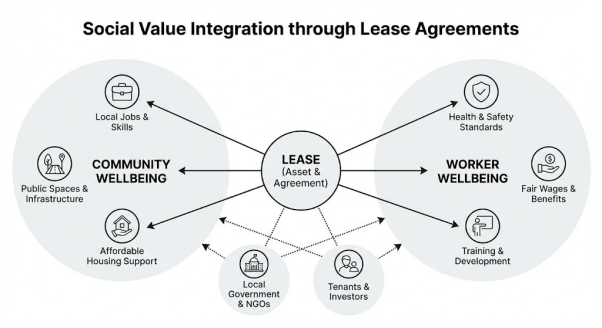
While carbon reduction is the driver, Green Leasing 2.0 extends its scope to the “S” in ESG: Social Value. In a global context, data centers are often scrutinized for their resource consumption (water and power) relative to the low number of jobs they create locally.
Evolving leases to be responsible
Leases can incorporate clauses that mandate shared value creation for the local community.
-
Local procurement: Clauses requiring best efforts to source maintenance services (security, landscaping, cleaning) from local, diverse-owned businesses.
-
Community investment: A community fund structure, wherein a small percentage of the rent or a matched contribution from both owner and occupier is directed toward local digital literacy programs or urban greening projects.
-
Worker well-being: Inside the facility, the lease should govern indoor environmental quality (IEQ). While servers prefer specific temperatures, the lease must ensure that areas occupied by security and technical staff meet high standards for air quality, thermal comfort and lighting, aligning with standards like the WELL Building Standard.
Data-driven insights & management
Implementing Green Leasing 2.0 requires robust data infrastructure. Without accurate measurement, performance clauses are unenforceable.
The metering hierarchy
A best-practice lease specifies the metering hierarchy:
-
Utility level: The main incomer meter from the grid.
-
Sub-system level: Separate metering for the cooling plant, lighting and house power.
-
IT load level: Metering at the UPS output or PDU.
Actionable insight:
Data analysis should focus on the delta between the IT load and the total facility load. This gap represents the overhead (cooling and losses). A Green Lease 2.0 sets a target for this overhead. For example, if the PUE target is 1.4, the overhead must not exceed 40 percent of the IT load. Automated alerts should be triggered when this ratio is breached for more than a set period (e.g., 24 hours), initiating a mandatory review by the green management committee.
Case study analysis: The power of alignmentConsider a theoretical comparison between two facilities to illustrate the impact. Facility A (Traditional lease):
Facility B (Green Lease 2.0):
|
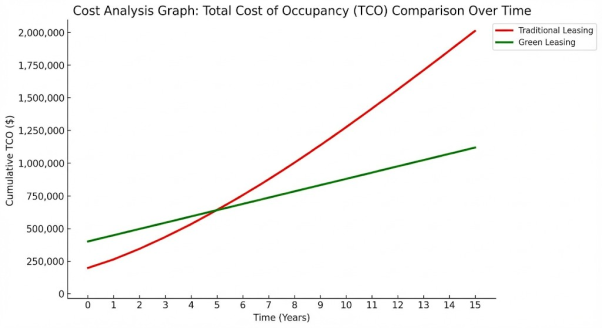
The penetration of Green Leasing 2.0 into the data center segment is essential for the built environment to meet its 2030 obligations. It requires a departure from the set-and-forget mentality of traditional real estate transactions.
By focusing on the three enablers — education to align understanding, engagement to drive daily collaboration and equity to solve financial blockages — owners and occupiers can transform their relationship. This shift moves the industry beyond simple compliance, turning lease agreements into powerful tools for delivering shared ESG value. The result is a more resilient, efficient and responsible digital infrastructure capable of supporting future growth without compromising the planet.

Siddhant Aggarwal is senior manager at LL REMS. Across the real estate life cycle, Aggarwal has carried out the roles of an aggregator, integrator, administrator and coordinator, spanning from design, leasing, fit-outs and operating spaces, whether viewed from the purview of a developer, occupier or tenant. His body of knowledge and exposure that has been earned through PMP, USGBC LEED and engineering in a gamut of varying business environments have catalysed the process of continual improvement, enhancing his overall pedigree.

Dr. Pulak Bhaumik is the CEO, Data Centres – India at Listenlights. In this role, he spearheads all aspects of the organization's data centre vertical in India, driving growth and innovation. An industry stalwart with over 25 years of diverse leadership experience, Dr. Bhaumik is recognized for his thoroughness, attention to detail,and a unique blend of professional rigor with a spiritual perspective — making him an invaluable addition to the Listenlights leadership team. He has successfully led organizations through transformation, operational scale-up, profitability enhancement and high-performing team building, consistently delivering value to stakeholders. Trusted by boards, investors and teams alike, he has been at the forefront of the data centre, corporate real estate and global real estate sectors.

Parvez Kazi serves as the Chief Executive Officer of LL R.E.M.S (Real Estate Management Services), the Integrated Facilities Management and Real Estate Services arm of the LL Group. With more than 26 years of leadership experience in facilities management, business operations, and service transformation, he is responsible for steering the company’s strategic vision, growth agenda, and operational excellence across India. With a leadership philosophy rooted in agility, collaboration, and accountability, Kazi is committed to redefining real estate and facility management as strategic enablers of business productivity, workplace experience and sustainable infrastructure.
References
Read more on Sustainability and Standards or related topics Sustainable Facility and Standards
Explore All FMJ TopicsRelated articles
-

Smart Building Control Systems
The foundation for a grid-interactive buildingBy Andre Marino09.25.2024 -

Smart Building Innovation
Cutting costs & carbon footprints without compromiseBy Andrew Butterworth09.12.2024 -

Chart the Path
Building sustainable cities & a sustainable futureBy Izzat Ali Khan & Aykean Forde12.16.2024