
 Membership
 Network
 Regional Sites & Affiliates


 Events
 Participate
 Resources

 Training
 Credentials
 Government


 Content Channels
 Tools
Tools


 Business Overview





Happier, Healthier FMs
Minimize these 4 environmental stressors for a better workforce

 Facility management work can be inherently stressful. There are countless tasks to juggle, jobs to complete, last-minute tenant requests and emergencies. The work is high-profile, often influencing the comfort and safety of hundreds, if not thousands, of people. All this puts a lot of pressure on FM workers.
To minimize employee burnout in an industry plagued by high turnover, FM leaders must mitigate environmental stressors that impact mental health, job satisfaction and service quality by focusing on four aspects that affect an FM team’s physical and psychological well-being: facility cleanliness, air quality and scent, noise and culture.
Tidy house, tidy mind
When people enter a facility, they absorb everything it contains. Whether it is a small building, an expansive office or an event venue, if it is cluttered and messy, workers and other occupants will likely feel stressed and have difficulty concentrating. There is also the “yuck factor” that happens when touching a sticky or dirty elevator button, piece of equipment or countertop. It not only repels people, but it can also make them feel uncomfortable in the facility, sometimes to the point of avoiding certain areas.
One study found that in workplaces where employees thought cleanliness was lacking, nearly half (46 percent) took longer lunch breaks and spent less time in the office, and a quarter took sick leave because their surroundings were depressing. Overall, 72 percent said their surroundings made them less productive.
A clean and organized environment can be challenging to maintain because every time someone enters a building, they bring dirt, air particles and other possible contaminants. However, when a facility is well-maintained, it minimizes distractions and contributes to a sense of calm, control and well-being. This is why frequent and proactive cleaning and dusting are a must.
Custodial teams that use professional-grade disinfectants on high-touch areas for health purposes should also be mindful that these substances can leave residue that feels strange to the touch. To avoid this, follow those disinfectants with another kind that smooths out the surface and feels clean.
 Air quality should be non-negotiable
Air quality affects cognitive ability and health. A Harvard University study that exposed office workers to three different air quality levels is telling. Participants in a green environment had cognitive function scores 61 percent higher than those in the typical building environment. Scores for participants in the study’s enhanced green environment were 101 percent higher.
Proper maintenance of HVAC equipment, usage of MERV 13 (at minimum) filters and scheduling frequent fresh air exchanges are recommended to help ensure the highest air quality. All of this contributes to keeping the environment smelling fresh without the need for fragrances.
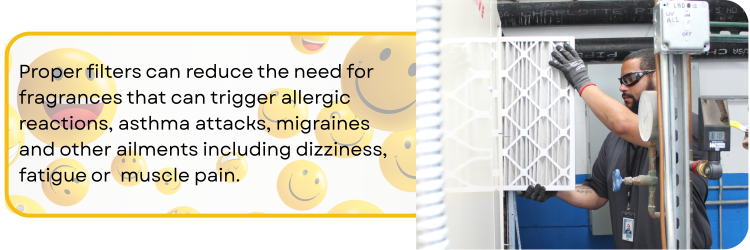 Sometimes, foul odors escape from custodial closets and linger in hallways, particularly if used supplies and buckets of dirty water are not disposed of. In older buildings, sewer smells can also rise through custodial closets and other rooms. Steps such as adding water back into the sewer traps and ensuring appropriate air filtration systems are in place can help contain and eliminate these odors.
 Quiet sounds perfect
Sounds affect people in many ways. Noises and distractions can distract one person’s attention, while quiet background music may not bother another. A study conducted by Radius found that low-level noises negatively impacted 69 percent of employees' concentration levels, productivity and creativity.
Beyond distraction, persistent noise contributes to fatigue, irritability and elevated stress levels, all of which can increase mistakes and slow response times for FM teams. Over time, these stressors can affect morale and job satisfaction, making noise control not just a safety issue, but a workforce well-being priority.
Loud noise can also damage workers’ hearing. Prolonged or repeated exposure to sounds at or above 85 decibels (dBA) can cause hearing loss. To minimize noise-induced hearing loss (NIHL), organizations should aim to keep sounds at or below 70 A-weighted dBA.
Implementing these best practices can help reduce noise pollution, along with the stress and physical ailments that come with it:
-
Keep on top of preventive maintenance and lubricate gears to ensure ceiling air vents do not rattle, equipment does not clang and vacuums do not hum.
-
Reduce the time FM workers spend in noisy areas at one stretch by rotating their tasks and providing quiet break areas.
-
Use barriers, enclosures and sound-absorbing materials to reduce noise at the source.
-
Encourage FM staff to wear hearing protection such as earmuffs or earplugs when other controls are not enough.
 Supportive cultures make a difference
People want to feel heard and appreciated in life, including when they are on the job. When work is inherently stressful, people are more apt to be curt and dismissive with one another. This is why FMs should strive to create a team environment that is supportive, empowering and communicative.
-
Create an atmosphere of psychological safety. People of all backgrounds should feel safe to take risks and be vulnerable in front of each other without fear of retribution. This starts at the top, with managers fostering an environment of trust and open communication.
Leaders can help instill this in their teams by demonstrating empathy, reminding employees that much of what their colleagues are carrying is invisible. A coworker may be juggling caregiving responsibilities, financial pressures or other personal challenges that shape how they show up at work. Extending patience and assuming positive intent toward fellow employees can significantly improve day-to-day interactions and reduce unnecessary tension.
Managers can illustrate this through a simple active listening exercise during a team meeting. Pair employees up and have one person describe a recent work challenge for one minute, while the other listens without interrupting. The listener then summarizes what they heard and how they think the speaker felt. This exercise can quickly highlight how easy it is to misinterpret information — and how much clarity and trust improve when people listen carefully and seek understanding before reacting.
-
Show respect: In one survey, 38 percent of people who feel disrespected intentionally decreased their work quality; and in another, 25 percent admitted to taking their frustrations out on customers. This emphasizes why managers must model respect. For instance, leaders should acknowledge others’ efforts and say thank you both privately and publicly. In interactions with team members and customers, show how it is possible to disagree without being rude or judgmental. Also, explain why staff should take particular actions instead of simply telling them to do so. Even if they do not like the answer, they will appreciate that leadership respected them enough to provide the reason behind the request.
-
Model integrity. Integrity carries real weight in FM because teams must trust and rely on one another to keep buildings safe, functional and responsive to daily demands. Leaders demonstrate integrity most clearly through transparency and follow-through. When supervisors commit to addressing staffing gaps, updating equipment or revisiting a policy concern, timely action reinforces trust. Even when circumstances change and a promise cannot be fulfilled as planned, communicating openly about delays or trade-offs shows respect for the team and helps prevent frustration from building behind the scenes.
Honest feedback also strengthens credibility. For instance, explaining the reasoning behind scheduling decisions, budget priorities or service-level changes helps convey that choices are being made thoughtfully, not arbitrarily. Constructive feedback should be direct, specific and focused on improvement rather than blame — especially in high-pressure environments where mistakes can happen. When errors occur, leaders who acknowledge them and take responsibility set a powerful example. Correcting issues when possible and clearly outlining lessons learned when they are not reinforces a culture in which accountability is shared and integrity is consistently reflected in action, not just intention.
-
Empower employees. FM supervisors often fall into micromanagement out of a desire to maintain high standards. Yet experienced employees are most effective when they are trusted to take ownership of their work. Research shows that 70 percent of employees consider being empowered to take action when issues or opportunities arise to be essential to staying engaged in their jobs.
One way to reduce the urge to micromanage is to ensure every team member has the training they need as well as a clear job description that outlines responsibilities and expected outcomes. Once this foundation is in place, leaders should give employees room to operate. Acknowledge good judgment and positive outcomes, while recognizing that mistakes are inevitable. When errors are treated as opportunities to learn rather than failures to avoid, teams are more resilient.

CJ Mello is a safety specialist with UG2 who conducts safety audits across customer sites while collaborating with facility engineers to address safety issues and maintain safe working environments for all employees. He joined UG2 as an intern in spring of 2024 and transitioned to full-time employment shortly after graduating from Massachusetts Maritime Academy with a Bachelor's degree in Emergency Management that same year. Mello's role combines fieldwork at client locations with engineering collaboration to identify hazards and implement safety improvements, leveraging his emergency management background and growing safety professional experience to support UG2's environmental health and safety goals.
References
Top image by Getty Images.
Filter image courtesy of UG2.
Read more on Leadership & Strategy , Communication and Occupancy & Human Factors or related topics Communication Skills , Relationship and Conflict Management and Wellness and Well-being
Explore All FMJ TopicsRelated articles
-

Artificial Intelligence in FM
The stakeholder’s perspectiveBy Dr. Jake Smithwick & Dr. Kenneth Sullivan & Nneka Ubi05.01.2024 -

Mastering Change in Hybrid Environments
Insights from global operational leadersBy Meg Swanson09.02.2024 -

Plugged In
Solving the data disconnect in real estate and FMBy Amanda Muzzarelli & James Waddell07.01.2024