 Membership
 Network
 Regional Sites & Affiliates


 Events
 Participate
 Resources
 Training
 Credentials
 Government


 Content Channels
 Tools
Tools


 Business Overview





Higher IEQ
Enhancing indoor quality with smart technologies

Indoor environmental quality (IEQ) has emerged as a critical factor in modern building design and facility management, directly influencing occupant health, comfort, productivity and overall well-being. As urbanization continues to accelerate and individuals spend nearly 90 percent of their time indoors whether in offices, homes, educational institutions, health care facilities or commercial complexes, ensuring optimal indoor environments has become a global priority.
Studies by the World Health Organization and the U.S. Environmental Protection Agency indicate that indoor pollutant levels can be two to five times higher than outdoor concentrations, highlighting the significance of effective IEQ management. IEQ encompasses a broad range of environmental parameters, including indoor air quality (IAQ), thermal comfort, visual comfort and acoustic performance, all of which play a vital role in determining occupant satisfaction and building performance.
Poor IEQ has been associated with health issues such as respiratory illnesses, allergies, fatigue, headaches and Sick Building Syndrome, as well as reduced cognitive performance and increased absenteeism.
In the context of sustainability and regulatory compliance, IEQ is a fundamental component of international green building standards and certifications, including LEED, WELL, BREEAM and ASHRAE guidelines. These frameworks emphasize the integration of energy efficiency, occupant health and environmental stewardship in building operations. The rapid advancement of smart technologies such as the Internet of Things (IoT), artificial intelligence (AI), building automation systems (BAS), building information modeling (BIM) and digital twins transformed traditional buildings into intelligent, responsive and sustainable environments. These technologies enable continuous monitoring of environmental parameters such as temperature, humidity, carbon dioxide, particulate matter, lighting levels and noise through interconnected sensors and data platforms. By leveraging predictive analytics, cloud computing and machine learning, smart systems facilitate real-time monitoring, data-driven decision-making and automated control of building operations. This not only enhances IEQ but also optimizes resource utilization, reduces energy consumption and lowers greenhouse gas emissions.
Smart IEQ solutions support demand-controlled ventilation, adaptive thermal regulation, circadian lighting systems and intelligent acoustic management, thereby creating healthier and more comfortable indoor environments. Such innovations contribute to improved operational efficiency and align with global sustainability initiatives, including the United Nations Sustainable Development Goals and national development strategies such as Saudi Arabia’s Vision 2030. Consequently, the integration of smart technologies into IEQ management represents a transformative approach to modern FM, enabling organizations to achieve enhanced occupant satisfaction, environmental sustainability and long-term economic value.
Health, comfort & satisfaction
 IAQ is a fundamental component of IEQ and significantly impacts human health and well-being. Poor air quality, often caused by pollutants such as carbon dioxide (CO2), particulate matter (PM2.5 and PM10), volatile organic compounds (VOCs) and biological contaminants, can lead to respiratory illnesses, fatigue and Sick Building Syndrome. Smart technologies address these challenges by deploying IoT-enabled sensors that continuously monitor air quality and provide real-time data. These sensors detect contaminants and trigger automated responses, such as adjusting ventilation systems to maintain optimal air purity. Demand-controlled ventilation systems, supported by AI algorithms, regulate airflow based on occupancy levels and pollutant concentrations, ensuring a healthier indoor environment while minimizing energy consumption.
 Thermal comfort is another essential dimension of IEQ, influencing occupant satisfaction and productivity. It is determined by factors such as temperature, humidity, air velocity and radiant heat. Traditional HVAC systems often rely on static settings, leading to inefficiencies and discomfort. Smart HVAC systems equipped with IoT sensors and AI-driven analytics provide dynamic climate control by adapting to environmental changes and occupancy patterns. These systems maintain optimal temperature and humidity levels in accordance with international standards such as ASHRAE Standard 55. By optimizing energy use and ensuring occupant comfort, smart HVAC technologies contribute to sustainable and energy-efficient building operations.
 Visual comfort plays a crucial role in enhancing productivity, reducing eye strain and supporting occupants’ circadian rhythms. Smart lighting systems utilize energy-efficient LED technologies, daylight harvesting and occupancy sensors to optimize illumination levels. These systems automatically adjust lighting intensity based on natural daylight availability and user requirements, thereby reducing energy consumption while maintaining visual comfort. Human-centric lighting solutions further enhance well-being by mimicking natural daylight patterns, promoting alertness during working hours and supporting restful sleep cycles. Such innovations are particularly valuable in offices, health care facilities and educational institutions where lighting conditions significantly influence performance and health.
 Acoustic comfort is equally important in ensuring a conducive indoor environment. Excessive noise can impair concentration, increase stress levels and reduce productivity. Smart acoustic systems employ advanced sensors and sound-masking technologies to monitor and control noise levels within buildings. These systems are widely used in open-plan offices, hospitals and educational facilities to enhance communication and minimize distractions. By integrating acoustic monitoring with building automation systems, FMs can create quieter and more productive indoor environments.
The technology factor
 IoT devices serve as the backbone of smart building technologies, enabling interconnected devices to collect, transmit and analyze environmental data in real time. IoT-enabled smart sensors provide continuous insights into indoor conditions, allowing FMs to monitor IEQ parameters remotely. These systems facilitate proactive maintenance, enhance operational efficiency and support data-driven decision-making. By integrating IoT platforms with cloud computing, organizations can optimize building performance while ensuring sustainability and cost-effectiveness.
 AI and machine learning further enhance IEQ by analyzing vast datasets collected from smart sensors. AI-driven systems predict environmental trends, identify anomalies and optimize building operations. For instance, predictive maintenance powered by AI detects potential equipment failures before they occur, reducing downtime and maintenance costs. AI-based occupancy analytics also enable buildings to adjust lighting, ventilation and temperature according to user behavior, ensuring both comfort and energy efficiency. Such intelligent automation represents a paradigm shift from reactive FM to proactive, predictive building operations.
 BAS integrates various building services, including HVAC, lighting, security and fire safety, into a centralized control platform. BAS enables seamless communication between different systems, ensuring efficient monitoring and control of environmental parameters. By automating routine operations, BAS reduces human intervention, minimizes errors and enhances operational efficiency. These systems also contribute to sustainability by optimizing energy consumption and supporting green building certifications such as LEED, WELL and BREEAM.
 Digital twin technology has emerged as a transformative innovation in smart building management. A digital twin is a virtual representation of a physical building that uses real-time data to simulate performance and predict outcomes. By replicating building operations in a digital environment, FMs can evaluate environmental conditions, optimize system performance and enhance IEQ. Digital twins enable predictive maintenance, reduce operational risks and support informed decision-making throughout the building life cycle. This technology is particularly beneficial in large-scale infrastructure projects, airports and smart cities, where efficient management of indoor environments is essential.
 BIM further complements smart technologies by providing a comprehensive digital framework for designing, constructing and managing buildings. BIM facilitates the simulation of airflow, lighting and thermal performance during the design phase, enabling architects and engineers to optimize IEQ from the outset. When integrated with IoT and AI, BIM supports life cycle management and enhances collaboration among stakeholders, resulting in more efficient, sustainable buildings.
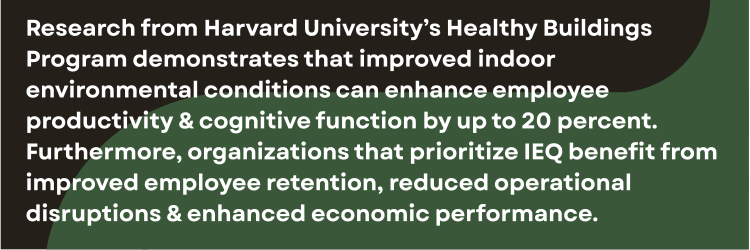
The adoption of smart technologies for IEQ enhancement offers numerous benefits. Improved indoor conditions contribute to better occupant health, reduced absenteeism and increased productivity. Research indicates that optimized IEQ can enhance employee performance and cognitive function, making smart buildings a valuable investment for organizations. Furthermore, smart systems promote energy efficiency by optimizing resource utilization, reducing greenhouse gas emissions and lowering operational costs. These advantages align with global sustainability initiatives and environmental standards, supporting the transition toward greener and more resilient built environments.
Better buildings, better outcomes
Despite their numerous benefits, the implementation of smart technologies presents certain challenges. High initial investment costs can pose barriers for organizations, particularly in developing regions. Additionally, integrating smart systems with legacy infrastructure requires careful planning and technical expertise. Data privacy and cybersecurity concerns also arise due to the extensive use of interconnected devices and cloud-based platforms. Ensuring robust security measures and compliance with data protection regulations is essential to mitigate these risks. The successful adoption of smart technologies depends on skilled professionals capable of managing and maintaining advanced systems.
The future of IEQ management lies in the continued advancement of intelligent and occupant-centric technologies. Emerging innovations such as edge computing, 5G connectivity and blockchain are expected to enhance the efficiency, reliability and security of smart building systems. Occupant-centric designs will enable personalized environmental settings, allowing individuals to customize lighting, temperature and ventilation according to their preferences.
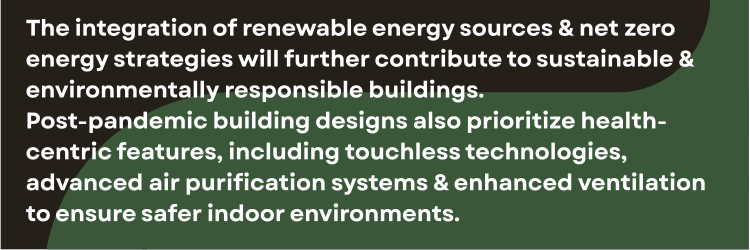 Enhancing IEQ through smart technologies represents a transformative approach to modern building management. The integration of facility technologies is revolutionizing the way indoor environments are monitored, controlled and optimized. These innovations ensure healthier, more comfortable, energy-efficient spaces while supporting sustainability and operational excellence. Although challenges such as high implementation costs and cybersecurity risks remain, the long-term benefits of smart technologies outweigh their limitations. As advancements continue to reshape the built environment, smart solutions will play an indispensable role in creating intelligent, resilient and sustainable buildings that prioritize occupant well-being and environmental responsibility.


Izzat Ali Khan, SFP, FMP, is the general manager at EFSiM Facilities Services. A seasoned FM professional, he is passionate about creating a positive impact in business through sustainability. He focuses on integrating sustainability and innovation in businesses to build the FM industry and make the world a better place to live.
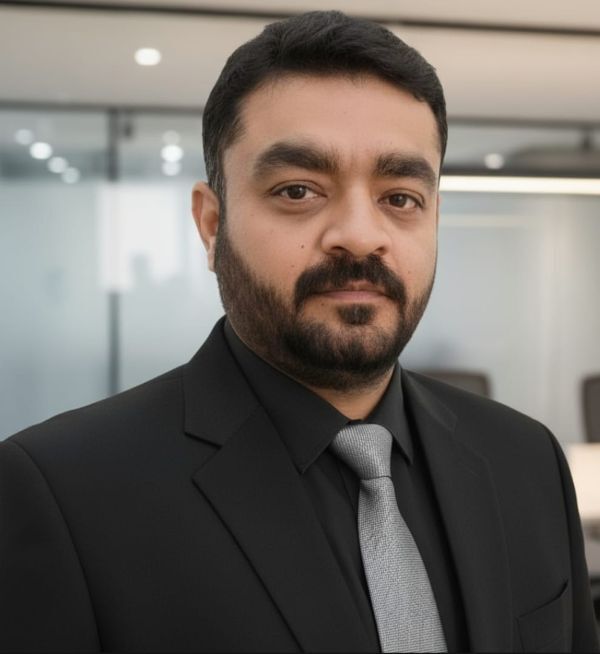
Dr. Shahrukh Nawaz Khan is an environmentalist with specialized expertise in water pollution control and circular economy practices. He holds a Ph.D. in environmental sciences, with a strong focus on sustainable resource management. His work centers on reducing environmental impacts through efficient waste and water management solutions, signalling his commitment to promoting environmentally responsible practices that support long-term sustainability.
References
Top image via Getty Images.
Read more on Workplace and Occupancy & Human Factors or related topics Workplace Utilization , Occupant Health and Wellness and Well-being
Explore All FMJ Topics