
 Membership
 Network
 Regional Sites & Affiliates


 Events
 Participate
 Resources

 Training
 Credentials
 Government


 Content Channels
 Tools
Tools


 Business Overview




Integrating Corporate Governance with ISO-aligned FM
A 5-level documentation practice

Across industries, building types and assets, FM is no longer a simple maintenance function. It is a management discipline connecting corporate governance, risk control, service delivery, engineering reliability, customer experience, cost efficiency, compliance and long-term asset value.
In practice, many organizations face a common problem: governance documents and operational documents are not connected. Corporate management may issue high-level policies, while departments separately prepare procedures and site forms. Without a clear relationship between levels, staff may not understand which policy governs which procedure, which department owns the process, which records prove execution, or how evidence should be reviewed. This gap becomes more serious during ISO alignment, operational readiness, internal audits or client reviews.
Why ISO alignment matters in FM
ISO standards provide a useful management language for FM organizations.
-
ISO 41001 emphasizes alignment between organizational objectives, facility management demand, service delivery, performance evaluation and continual improvement.
-
ISO 9001 strengthens quality management and process control.
-
ISO 14001 and ISO 45001 support environmental, health and safety management.
-
ISO 55001 supports asset management, while ISO 19650 supports structured information management for BIM and digital asset data.
However, ISO should not be treated only as a certification exercise. Its real value is to help an FM company build a disciplined management system.
 For a project operation, ISO-aligned thinking helps translate strategy into procedures, procedures into actions, and actions into records. It also supports PDCA logic: plan the system, do the work, check performance and act based on evidence. Therefore, combining corporate governance documents with ISO management principles is a practical way to create a more mature FM operating model.
5-Level documentation framework
The core practice is to establish a five-level documentation framework to create a clear line from corporate governance to site execution. Each level has a different purpose and should not be confused with another level. A corporate policy should not contain excessive operational details, and a checklist should not become a management procedure. The value of the hierarchy is that every document has its own position, scope, owner and output.
|
Level |
Name |
Code |
Typical Document Examples |
Core ISO 41001 Clauses |
Definition & Role |
|
L1 |
General Principles |
G |
FM General Principles, Policy Statement... |
Clauses 4, 5, 6 (Context, Leadership, Planning) |
Strategic Layer: Establishes vision, mission, legal commitments and scope. |
|
L2 |
Departmental Manual |
M |
Hard Service Dept. Manual 1 |
Clauses 5.3, 7.1 (Roles & Authorities, Resources) |
Functional Layer: Clarifies interfaces, resource allocation and core responsibilities between departments. |
|
L3 |
Management Procedures |
P |
Energy Management procedure |
Clause 8.1 (Operational Planning & Control) |
Tactical Layer: Who manages what and when. |
|
L4 |
Work Instructions (WI) |
WI |
Energy Metering Guidance |
Clauses 7.2, 8.1 (Competence, Operational Criteria) |
Operational Layer: How to perform specific actions. |
|
L5 |
Operational Records/ Forms/ Reports |
R |
Metering records, Energy Reports |
Clauses 7.5, 9.1 (Documented Info, Monitoring & Measurement) |
Evidence Layer: Traces left by system operation. Used for traceability, auditing analysis and improvement. |
L1 corporate governance documents
L1 documents provide the highest governance source and are not limited to a single policy. This helps lower-level manuals and procedures avoid becoming isolated departmental documents.
-
The Articles of Association, the core governance foundation, clarifies the legal and governance foundation.
-
The organizational governance policy clarifies decision-making principles.
-
The process management policy defines how systems and workflows should be controlled.
-
The internal control and compliance policy supports risk-based management.
-
The ISO management system application policy provides a unified method for adopting ISO-related requirements.
-
The continuous improvement policy connects daily operations with management review, corrective actions and long-term improvement.
-
Market Development Policy focuses on the development of the company.
This L1 layer is essential because it gives authority to the lower-level FM system. When a department prepares a manual, it clearly explains which corporate principles it is implementing. This improves credibility, reduces subjective interpretation and helps managers understand that departmental procedures are part of a corporate system rather than personal working habits.
L2 departmental manuals
L2 manuals translate company governance into departmental management language. They are not detailed work instructions. Instead, they define the management principles, scope, responsibilities, terminology, management content, reference documents and downstream outputs of each business line.
For example, a cost management manual may reference internal control, process management, ISO application and continuous improvement principles. A QEHS manual may connect quality, safety, environment, health, audit, reporting and improvement mechanisms.
A good L2 manual should show both upstream and downstream relationships. Upstream means which L1 documents are the source of requirements. Downstream means which L3 procedures are produced for execution procedures.
It also helps staff understand that a departmental manual is not a standalone opinion, but an operational translation of corporate governance requirements.
L3 to L5 execution logic
L3 procedures are the core execution bridge. They define how work is managed in or across departments and documents procedures. Example procedures include asset handover, work order, preventive maintenance, vendor management, QA/QC, emergency response and cost control. A procedure should explain the process flow, responsible parties, inputs, outputs, approval requirements, escalation conditions and records required.
L4 work instructions explain how specific work is performed. This level is especially important for technical or risk-sensitive tasks, such as chiller inspection, fire pump testing, permit to work, lockout/tagout, emergency drills, defect closure and operational-readiness inspection.
L5 records prove that work has been executed. They include forms, checklists, registers, logs, reports, dashboards, and records documenting training, nonconformance, corrective and preventive action tracking records, and inspection evidence. If the L3 procedure is already detailed enough, an L4 document may be simplified or omitted, but L5 evidence should still be maintained.
Departmental roles
The FM governance structure involves multiple departments.
-
Corporate management (COR) approves corporate governance documents, strategic direction, authority frameworks and major decisions.
-
Center of Excellence (COE) acts as the system owner for standardization, ISO alignment, templates, document control, cross-functional coordination and management review support.
-
The hard services team (HSD), including engineering management, executed MEP operations, asset takeover, operational readiness, QA/QC, EHS implementation and technical records.
-
The soft services team (PED) manages cleaning, security, landscaping, waste, pest control and customer-facing service quality.
-
Finance (FIN) owns budgeting, cost control, CapEx and OpEx tracking, and financial compliance.
-
Procurement owns sourcing, vendor evaluation, tendering, contract coordination and supplier-performance support.
-
HR and administration (HR, Admin) own recruitment, onboarding, training records, competency management and administrative support.
-
Legal and compliance (L&C) reviews contract obligations, liability boundaries, regulatory risks, disputes and governance-control requirements.
This division of responsibility avoids the common problem in which every department participates, but no department is accountable.
Document coding rules
Introducing a document coding rule supports control and retrieval. Typical codes can be structured as:
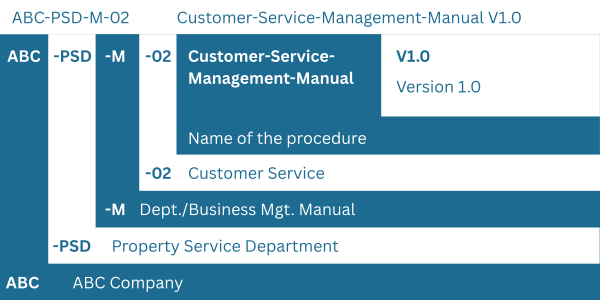
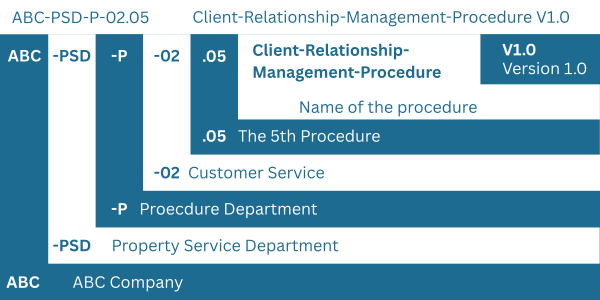
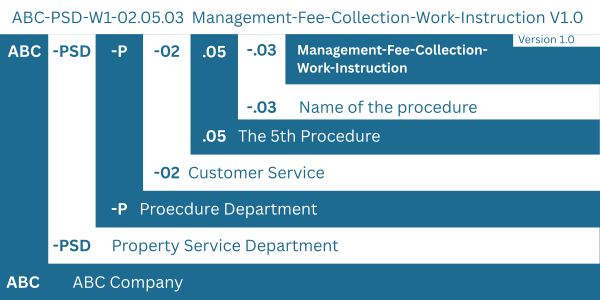
This coding rule helps users quickly identify the company, department, function, document type and sequence. It also supports version control, document registers, audit preparation and cross-departmental coordination.
RACI-based governance
A single management system often involves multiple departments. The RACI model distinguishes who is responsible, accountable, consulted and informed.
-
For L1 governance approval, COR is normally Accountable, while COE is Consulted.
-
For L2 manual development, COE may be Accountable, while the department is Responsible.
-
For L3 procedures and L4 work instructions, the operating department is normally Responsible, while COE provides methodology, template and review support.
-
For L5 execution, the site team generates records, and department management reviews quality.
This model is practical because it separates ownership from participation. The RACI matrix improves discipline, reduces misunderstanding and supports faster decision-making. Each department’s documents have its own RACI matrix. For example, a hard service L3 procedure from COE L2 (i.e., QC) could be shown in the following table.
|
Activity |
COR |
COE |
Hard Services |
Soft Services |
Finance/ |
Legal/ |
|
L1 governance approval |
A |
C |
I |
I |
I |
C |
|
L2 manual development |
A |
R |
I |
I |
C |
C |
|
L3 procedure development |
I |
A |
R |
C |
C |
C |
|
L4 work instruction preparation |
I |
A |
R |
C |
I |
C |
|
L5 form and record execution |
I |
C |
A/R |
I |
I |
I |
|
Audit and compliance review |
C |
A |
R |
R |
C |
C |
|
Management review and improvement |
C |
A |
R |
C |
C |
C |
Practical implementation approach
Implementation should start with a simple inventory of existing documents, followed by gap analysis, classification, coding, ownership confirmation and approval planning.
The priority is to solve the question of whether required documents exist. Optimization can then follow through review, audit, training and lessons learned. In this practice, shared tracking files are useful because each department can update document status, responsible persons and completion progress. This makes system construction visible to management and helps avoid repeated drafting.
The approach also allows the organization to balance speed and quality: build the baseline framework first, then improve the depth and maturity of each procedure through actual operation.
Practical outputs
The main outputs of this practice include a document tree, L1-to-L2 mapping, departmental manuals, procedure lists, work-instruction lists, form registers, RACI matrices, document coding rules and tracking dashboards. These outputs allow management to verify not only whether documents exist, but also whether they are connected, executable and traceable.
The document tree is particularly important as it illustrates the relationship between corporate policies, departmental manuals, operational procedures, work instructions and records. It helps identify duplicated documents, missing procedures, unclear ownership and unnecessary files.
The framework also supports operational readiness. During takeover inspection, technical standards must be evidence-based, traceable and linked to accountability. Critical systems such as district cooling, electrical distribution, fire protection, BMS, elevators and emergency power require inspection criteria, test records, photographs, checklists and defect-closure evidence. This demonstrates that documentation is not paperwork; it protects future operations and clarifies responsibility when failures occur.
Conclusion
The integration of corporate governance with ISO-aligned FM systems is not simply a documentation exercise, but a practical method for strengthening organizational capability. For large project operations, the five-level documentation framework helps clarify governance logic, define responsibilities, standardize execution, support audits and improve operational traceability. It also supports operational readiness, asset life cycle management, QEHS implementation, cost control, vendor governance and continual improvement.
The most important lesson is that documents should not exist only for filing purposes; they must support real operations. An effective FM system should clearly demonstrate the source of requirements, process ownership, execution methods, operational evidence and improvement mechanisms. When governance, ISO principles, procedures and site records are effectively connected, FM can evolve from reactive maintenance into a strategic contributor to asset value, risk control, service quality and sustainable operations.

Xingya Yong, CFM, FMP, is a senior facility management professional with over 20 years of experience in technical operations, hard services management, project transition and integrated FM system development. He has led and contributed to major FM tendering, takeover inspection, technical proposal development and performance management initiatives across China and the Middle East, with strong expertise in ISO 41001, QHSE, SLA/KPI management, CMMS, maintenance strategy, vendor coordination and operational readiness. Yong has extensive FM experience across industrial manufacturing facilities, laboratories, R&D environments, corporate offices, commercial complexes, international airport terminals, CBD city-operation projects, critical environments, multi-site portfolios and large-scale hard services operations. He combines practical engineering knowledge with strategic FM management capability, positioning him as an experienced FM practitioner in international hard services and operational management.
References
Top image via Getty Images.
Read more on Leadership & Strategy , Sustainability and Standards or related topics Standards , ISO , Sustainable Facility and Operational Technology
Explore All FMJ TopicsRelated articles
-

Artificial Intelligence in FM
The stakeholder’s perspectiveBy Dr. Jake Smithwick & Dr. Kenneth Sullivan & Nneka Ubi05.01.2024 -

Mastering Change in Hybrid Environments
Insights from global operational leadersBy Meg Swanson09.02.2024 -

Plugged In
Solving the data disconnect in real estate and FMBy Amanda Muzzarelli & James Waddell07.01.2024