
 Membership
 Network
 Regional Sites & Affiliates


 Events
 Participate
 Resources
 Training
 Credentials
 Government


 Content Channels
 Tools
Tools


 Business Overview




Leading in a Crisis
Creating safer, healthier facilities
Leadership during a crisis is one of the most valuable contributions the facility management community provides. Organizations need a steady hand to navigate the challenges posed by any emergency threatening the safety, security, and health of its stakeholders.
During any crisis, the most prepared organizations are more likely to recover faster, more completely, and with fewer adverse health, safety and economic impacts. If the magnitude of the crisis is significant and prior experience with the crisis is limited, the general knowledge of the recovery process is diminished, and recovery will be far more difficult, even under the best of circumstances.
In early 2020, facilities worldwide were and are challenged by COVID-19. On one hand, the rapid departure from office buildings, public and recreation facilities, restaurants and community gathering places led to large vacancies. FMs were faced with how to prepare buildings for minimal operation. On the other hand, emergency and healthcare facilities were required to escalate health and safety requirements to brace for maximum occupancy under significant additional health threats and limited resources. As areas move toward a recovery phase, organizations must determine the conditions under which they will be operating their facilities in the near- and long-term.
The challenge of both re-occupation and continuous operation under new environmental conditions poses an even greater threat as information on health, safety, cleaning and operational risks changed (and continues to change) on an almost daily basis. This environment demands a planning process that remains flexible as new health information, operational practices, technology and equipment continue to evolve.
Given that little is known about the specific challenges presented in this crisis, how does an organization best respond to keeping its staff, visitors and the public safe in the built environment when the health and safety risks are unknown? The answer lies in being prepared and having the right process to manage unknown risks.
FMs can start by acknowledging that they may not have a complete understanding of the challenges, circumstances will continue to change, and time is needed to develop the best approach for providing a safe environment. In an unprecedented situation such as with COVID-19, pre-determined procedures in response to emergencies may not provide the proper solution, may be wrong and may not apply to you’re a specific organization or types of facilities.
FMs already possess the knowledge, skills, abilities, and competencies needed to develop and implement a plan for dealing with the unknowns related to the built environment in a crisis. When information on the impact of a new crisis is unknown, the FM’s most valuable assets are threefold:
1. Institutional knowledge allows the FM to align plans and strategies with the mission of the demand organization and make the business case for health, safety and productivity in facilities. It also allows the FM to appropriate the right resources and serve as the advisor to the organization about exposure to risk if the appropriate resources are not provided.
2. Competency in FM covers a broad range of knowledge and technical skills (e.g., leadership, business, finance, communication, technology). It aids in facilitating alignment with the demand organization. Employing their knowledge and skills in the formulation of strategies for risk management, emergency preparedness and response, and facility and business resilience have been recognized as part of the FM’s role for many years.
3. Connections to the right resources through networking with peers, access to publications and research, organizational involvement, benchmarking, and sharing of practices provide the FM with channels that expand the knowledge base of potential answers to strategic and tactical challenges.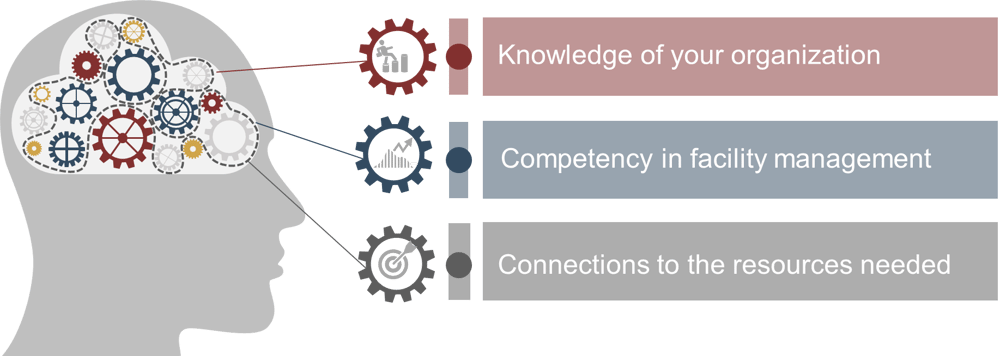
The FM’s core purpose is in managing the integration of People, Place, and Process. When immediate answers are unknown, and new information (and often misinformation) continues to evolve, a systematic approach that allows for frequent updates and modification is needed.
Facility management: “the organizational function which integrates people, place and process within the built environment with the purpose of improving the quality of life of people and the productivity of the core business” (ISO 41011)
IFMA responded to the COVID-19 challenge by formulating a Rapid Response Task Force to develop a planning framework to respond to facility re-occupation. Utilizing the Plan-Do-Check-Act (PDCA) planning model and integrating the model with FM’s core purpose of maintaining People-Process-Place, the task force mapped a process that extends well beyond facility re-occupancy in a COVID-19 environment.
The well-known practice of continuous improvement through the PDCA cycle provides a robust framework to develop a crisis response plan, an operational or tactical plan, or a long-range facility strategic plan. This is especially important in an evolving crisis. The decades-old history and utility of the PDCA cycle provide a powerful model when linked with the facility manager’s core purpose. Regardless of the challenge, following the PDCA cycle with People-Process-Place in mind offers a repeatable, reliable process for continuous improvement. As with any FM plan, the objective is to provide safe, healthy, productive and more resilient facilities and organizations. Having a plan in place that also considers the economic impact on the demand organization creates an environment that links the outcome to what is economically feasible (i.e., cost-effective).
The figure below is a schematic representation of the integration of People-Place-Process with the PDCA cycle. It represents “what question are we answering?” in the facilities environment. Using this schematic outline, we can formulate a response plan that is flexible and adaptable to changing conditions and can be tested, measured and improved. Click on the image to expand in a new window.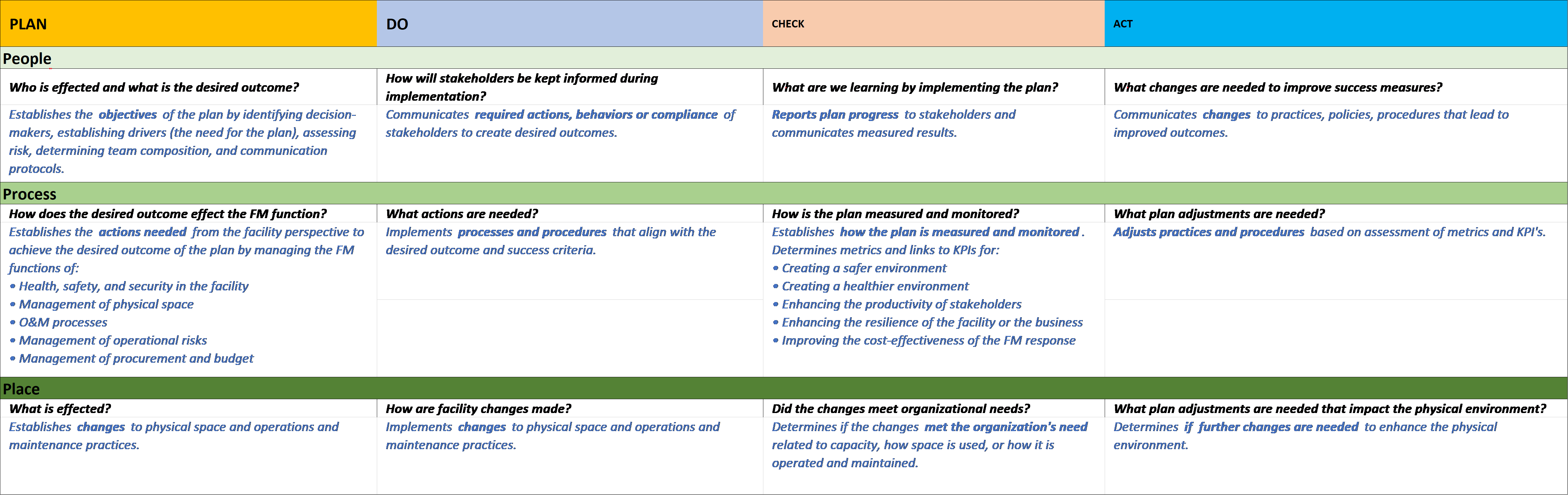
An essential component of leadership is the ability to think critically, consider different perspectives, formulate a plan, measure progress, and modify the plan to adapt to changed conditions. Using the PDCA model provides the ability to reason through the process to assure that the desired results are achieved. In FM’s case, the ability to create safer, healthier facilities that provide as productive an environment as feasible within the resource constraints is the desired outcome.
The most frequently missed steps in the PDCA cycle are the Check and Act phase. This happens because once a plan is implemented, there is a natural bias to move on to the next issue and let the plan play out. It is also often difficult to determine appropriate metrics and measurements during the first stages of developing and implementing a plan. It may take several iterations to settle on the appropriate measures for plan success. The issue of changing information and shifts in understanding of the impacts of a crisis also makes measurement and monitoring difficult.
However, the Check and Act phases provide an opportunity for FMs to demonstrate true leadership and bring value to their organizations. Plan success should contribute to greater resilience in the built environment, reduced organizational risk, and more cost-effective responses to the challenge or crisis. When success measures are tied to the demand organization’s needs for safe, healthy and productive facilities, the FM function will take a strong lead in safeguarding the organization’s most valuable asset – People.
There may be many measures in the Check phase. But there are few KPIs. KPIs are more strategic in nature and should focus on and align the most important outcomes to the organization. In practice, they help answer fundamental questions such as:
-
Has our facility been made safer?
-
Is the building healthier?
-
Is it more productive to occupants?
-
Is the facility been made more resilient?
-
Has the implementation of the plan reduced risk?
-
Has the implementation of the plan led to a more cost-effective facility, or has the plan helped with cost-avoidance?
These are all important outcomes that align with the core purpose of FM in integrating People-Place-Process. These are not always easy outcomes to measure and require the FM’s leadership and critical thinking skills to walk through the PDCA process and create the necessary links between the plan and the expected outcome.
For the last step, the check phase will allow for adjustments to be made in the Act phase. Lessons learned can be incorporated, the plan updated, new measures put in place, and implementation continued. This is where plan elements are evaluated, and some are made to “stick,” while others are abandoned.
Although this process may seem laborious to some, it is at the core of FM leadership in to recognize that they are the stewards of the built environment on behalf of their organizations. It is beneficial to keep the charge of FMs top-of-mind: “improving the of life of people and the productivity of the core business.” This focuses our actions when faced with a crisis that threatens the health and safety of our stakeholders. Max DePree sums it up well with this passage from Leadership is an Art –
“Leadership is the concept of owing certain things to the institution… [It] is a way of thinking about stewardship as a contrast to ownership”
FMs demonstrate leadership every day as they are on the front lines of the built environment, keeping it safe and creating a healthier, more resilient environment, often with limited resources, limited information, and (often) very little time to react. By bringing strategy and planning competencies to bear, FM is able to set plans in place in preparation or a wide range of challenges, some of which they will know little about. With a plan in place before a crisis hits, FM will be able to maintain safer, healthier environments our organizations need to serve their purpose. It is understanding and linking actions to that purpose that brings true value to the organizations they serve.

Chris Hodges, P.E., CFM, FMP, LEED AP, IFMA Fellow is Chairman and Co-founder of Facility Engineering Associates. He currently serves as Chair of IFMA’s Certificate Commission and has contributed to IFMA for over 25 years. He is co-author of the book, “Sustainable Facility Management, the Facility Manager’s Guide to Optimizing Building Performance.”
Read more on Risk Management , Occupancy & Human Factors and Standards or related topics Risk Management , Occupant Health , Standards and ISO
Explore All FMJ TopicsRelated articles
-

A New Approach
Improving business continuity with alarm managementBy Brad Freeman09.09.2024 -

Beware of Growing Cyberthreats
Why it’s time for stronger facility cybersecurityBy Andrew Harris & Eric Headington10.30.2024 -

Going Up?
Keeping elevators safe & compliantBy Dave Myers & Doug Taylor11.06.2024