 Membership
 Network
 Regional Sites & Affiliates


 Events
 Participate
 Resources

 Training
 Credentials
 Government


 Content Channels
 Tools
Tools


 Business Overview





Lost in Transmission
The frontline data black hole

In the relentless pursuit of operational excellence, the buildings industry has become obsessed with the voice of the machine. A multi-trillion-dollar spending spree on digital transformation is underway, instrumenting facilities with a dizzying array of sensors, connecting assets to the Internet of Things (IoT) and deploying sophisticated artificial intelligence (AI) to analyze the endless streams of data they produce. The global facility management market is rocketing toward US$2.28 trillion, and executives are betting their careers on the promise of the "smart factory," with 86 percent believing it will be their primary competitive driver. Yet, in this gold rush for machine-centric data, a profound and costly paradox has emerged.
.svg) While petabytes of data on machine vibration and temperature are meticulously captured, every maintenance request, safety observation, quality control check and informal suggestion spoken into a traditional two-way radio is a piece of unstructured data that vanishes the moment it is said. This creates a massive data black hole at the heart of operations – a strategic blind spot that costs organizations millions in lost productivity, missed opportunities and preventable failures.
While petabytes of data on machine vibration and temperature are meticulously captured, every maintenance request, safety observation, quality control check and informal suggestion spoken into a traditional two-way radio is a piece of unstructured data that vanishes the moment it is said. This creates a massive data black hole at the heart of operations – a strategic blind spot that costs organizations millions in lost productivity, missed opportunities and preventable failures.
The broken foundation of communication
This data black hole is not a theoretical concept; it is a daily, quantifiable crisis rooted in a fundamentally broken communication foundation. Before an organization can dream of capturing frontline intelligence, it must first be able to guarantee that a simple conversation can happen reliably. New research from Relay reveals a startling reality: for a vast number of organizations, this basic requirement is not being met.
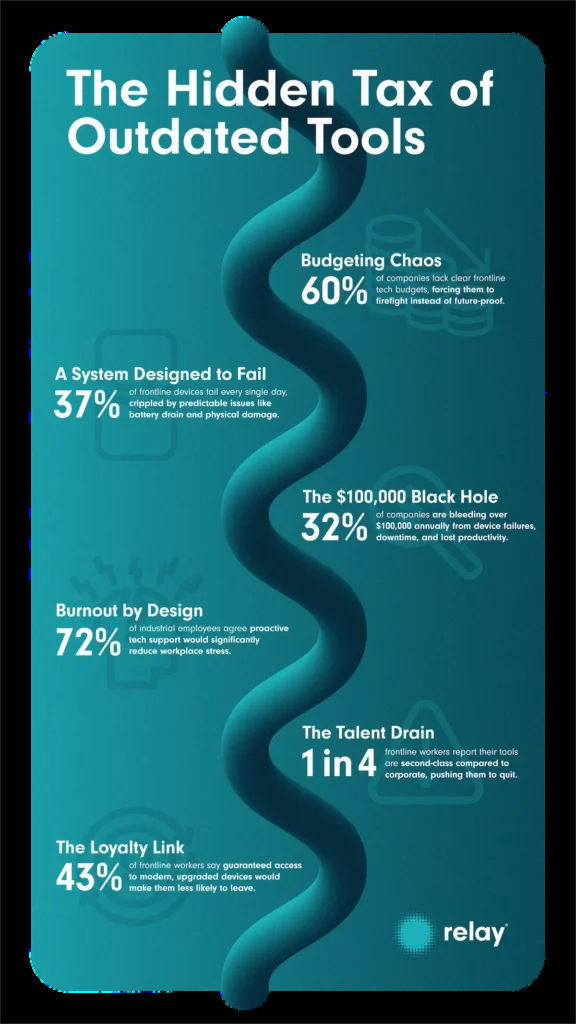
The daily experience for many frontline teams is one of constant technological failures. This survey found that more than a third of frontline teams (36.8 percent) experience a communication device failure every single day. These are not complex software glitches; the primary culprits are depressingly basic hardware issues. Battery problems (48.4 percent) and physical damage (46.8 percent) are the top causes of failure, a clear indictment of tools that are fundamentally mismatched for the rugged, fast-paced environments in which they are deployed.
Daily unreliability is not a minor inconvenience; it is a massive operational tax. The same research shows that one in four organizations (25 percent) loses more than an entire day of productivity every single month just dealing with the fallout of broken communication technology. But the true cost extends far beyond lost hours. This broken foundation acts as a direct anchor on strategic progress. The survey uncovered a critical connection: nearly half of all industrial companies (48.2 percent) have been forced to delay or cancel operational improvement projects because their communication technology was too unreliable to support them.
This creates a vicious cycle of distrust. When a worker’s radio dies mid-task, they learn not to rely on company-provided tech. When leadership later tries to deploy a new smart system, they are met with a workforce conditioned by experience to believe that "the tech doesn't work here." The failure of the foundational communication layer actively sabotages the success of every other technological investment.
 The strategic domino effect: How lost data cripples business
The failure to capture this operational dark data is an active force that unravels core business objectives. It creates a ripple effect, diminishing the ROI of technology, disempowering the workforce and exposing the organization to significant, unnecessary risk.
1. It cripples predictive maintenance
The promise of predictive maintenance is to fix assets before they fail, but companies cannot predict what they cannot hear. A Deloitte report highlights that predictive maintenance can reduce breakdowns by as much as 70 percent and lower maintenance costs by 25 percent. However, these powerful AI algorithms are only as good as the data they are fed. While a sensor can report that a machine is vibrating outside of normal parameters, it often cannot explain why. The technician who says, "I've heard that sound before, right before the main bearing goes," provides the essential human context that turns raw data into predictive insight.
Without a system to capture and analyze that verbal observation, a critical early warning is lost forever in the data black hole. A predictable failure becomes another costly, reactive emergency. The financial impact is catastrophic. Unplanned downtime costs manufacturers an estimated US$50 billion annually, with the cost in some sectors, like automotive, exceeding US$2 million per hour. The failure to capture a single technician's verbal warning can directly trigger these multimillion-dollar events, completely consuming the ROI of smart technology investments.
2. Innovation is stifled & talent walks out the door
Frontline workers are the greatest source of innovation. They see the daily inefficiencies and opportunities that are invisible from a dashboard. But when their insights are confined to ephemeral radio chatter, a culture of continuous improvement is impossible. Their best suggestions for improvement are never captured, shared or acted upon.
This directly disenfranchises the workforce and fuels the talent crisis. The connection between tools and turnover is undeniable: 43 percent of workers state they would be less likely to quit if they were guaranteed access to modern, reliable technology. By failing to provide tools that capture their spoken ideas, companies signal that their expertise is not valued. The data black hole does not just lose ideas; it drains human capital and creates a recurring financial liability through increased employee turnover.
3. Critical safety risks remain undocumented
A proactive safety culture relies on identifying and mitigating risks before they cause harm. Many of the most important leading indicators are verbal: a casual report of a wet spot, a mention of a malfunctioning guard, a concern about a new procedure. When these verbal warnings are not captured, patterns that could prevent a major incident remain invisible.
This creates a massive, undocumented liability. In the event of an incident, the lack of a verifiable, time-stamped record of verbal safety warnings becomes a serious legal vulnerability, making it difficult to defend against an OSHA willful violation, which can carry a penalty of more than US$165,000. More importantly, the average cost of a single medically consulted work injury is US$43,000, while a fatality costs a staggering US$1.46 million. The failure to capture a simple verbal safety observation directly exposes a company to these immense financial and human costs.
From talk to text: Building a frontline intelligence layer
The solution is not to generate more paper reports or hold more meetings. The solution is to transform frontline communication systems from a simple utility into an intelligent data-gathering platform. By implementing a modern, cloud-connected communication tool that automatically transcribes voice to text, it is possible to finally close the data black hole.
When talk is converted to text, it becomes structured, searchable and analyzable, creating a permanent, time-stamped system of record for the ground truth of operations. This is not just about documentation; it is about unlocking the ability to perform analytics on a dataset that was previously inaccessible.
Imagine the possibilities this creates for an FM team:
-
A maintenance technician speaks a work order into their device: "The HVAC unit on the roof of Building B needs a new compressor filter." The request is instantly transcribed, logged in the CMMS and tagged with relevant keywords like "HVAC" and "Building B," all without manual data entry.
-
All communications related to a specific asset or area are automatically aggregated. It is possible to now search for every mention of "Pump 3B" over the last six months to identify recurring issues that scheduled preventive maintenance might be missing.
-
AI-powered tools can scan transcriptions in real-time for keywords related to safety ("spill," "leak," "unsafe") or quality control, automatically flagging them for supervisor review and creating an immediate alert.
-
When training a new technician, users can search the communication history for a specific piece of equipment to review all past issues, repairs and informal observations made by veteran employees, creating a powerful knowledge base.
This is not a futuristic vision; it is what is possible today. By capturing and structuring this data, it creates a powerful intelligence layer that provides unprecedented visibility into operations, allowing FMs to spot trends and opportunities that were previously hidden in the noise.
A strategic blueprint for the data-driven FM
Building this intelligence layer requires a strategic shift. It begins with recognizing that the team's voice is one of the most underutilized data assets and ensuring there is a reliable foundation to capture it.
Before solving the problem, it is important to understand its scope. Ask: What are the most valuable conversations happening on the facility floor that are not being captured? Where are the near-misses, the maintenance warnings and the brilliant suggestions getting lost? Spend time shadowing teams and cataloging the types of verbal information exchanged. Identifying these blind spots is the first step toward understanding the true cost of the data black hole and building a business case for solving it.
A team's voice is a strategic asset
The future of facility management will be defined by the ability to harness data for strategic advantage. For years, the focus has been on data from machines and sensors. But this is only half the picture. The rich, contextual and often predictive insights locked away in the verbal communications of frontline teams represent a massive, untapped resource.
By closing the frontline data black hole, it does more than just improve communication. It builds a true operational intelligence engine, empowers teams by showing their insights are valued, enhances safety by creating a verifiable record of potential risks, and unlocks the full potential of predictive maintenance and smart building strategies. It is time to stop letting the most valuable data vanish into thin air and start turning a team's talk into the most powerful tool for action.

Read more on Communication and Facility Technology & Data Management or related topics Communication Management and Collaboration
Explore All FMJ Topics