
 Membership
 Network
 Regional Sites & Affiliates


 Events
 Participate
 Resources

 Training
 Credentials
 Government


 Content Channels
 Tools
Tools


 Business Overview





May the Force be With You
BIM data gives FMs a new hope in O&M

Those words are universally known for wishing people good will as they head on to a great quest. Managing large buildings or a portfolio of buildings is no different in the need to wish people well. The sheer volume of information, regulatory requirements, IoT information, green certifications, BIM level compliance requirements, reversing climate change, and much more require the field to rethink the life cycle of data. The end game for data is to turn it into information to make better decisions more reliably. For this, the Force is needed to work with and interpret data at ever-increasing volumes.
Drivers forcing changing
The figurative Force is the ability to use and manipulate data in such a way that it supports operations, maintenance, and planning operations for a building in a manner that improves safety, lowers usage costs, and extends the lifetime of the building and equipment it houses. During the pandemic, the pressure has increased dramatically for flexibility and safe usage.
The decisions made to adjust to the changing circumstances are all based on the data collected and generated as part of the life cycle of a building. Something as seemingly simple as adjusting to COVID-19 protocols can force reconfiguration of airflow patterns, which in turn is based on data derived from a building model. The challenges arise as organizations are not always equipped to handle the volumes and technicalities of data, which leaves a greater risk of imperfect decisions. The underpinning challenges are:
-
An ever-increasing volume of data
-
The complexity of building information modeling (BIM) data
-
The environmental impact
An ever-increasing volume of data
Data grows at unprecedented rates. What is often less clear is how this translates. Many data specialists split data into two major categories, the first one being the structured kind, such as databases for a facility management system, ERP systems, HR, etc. The second one being unstructured data such as email, BIM models, drawings, certificates, contracts, video, IoT devices, social media and much more. As an interesting statistic, the prediction is that by 2025, 80 percent of worldwide data will be unstructured. While structured data can be analyzed relatively easily and used for decision making, unstructured data is much more complex due to its sheer volume and variety of formats.
Going back to the sample of the airflow reconfiguration for an office building, the data collected during that process is a good combination of BIM, airflow simulations, inspection reports, certificates, and much more. Not having good control over that data can be a real legal risk if and when an outbreak of COVID-19 happens. If an organization is struggling to manage unstructured data, with the above prediction, things will be getting worse over the next few years, and it would be wise to act upon it.
The complexity of BIM data
BIM data is one of the great evolutions for the AEC space. The use of BIM technologies has driven innovations and efficiencies during all life cycle stages of a building. From initial design, planning, construction and operations. A major challenge is each of the life cycles has a different need for a BIM model. Where design and planning will focus on technical aspects and questions like constructability, for an operations BIM model, questions arise around asset management, maintenance records, BIM-IoT integration and others. From recent research into 590 publications, it became clear that interoperability across the models is a hot topic among practitioners.
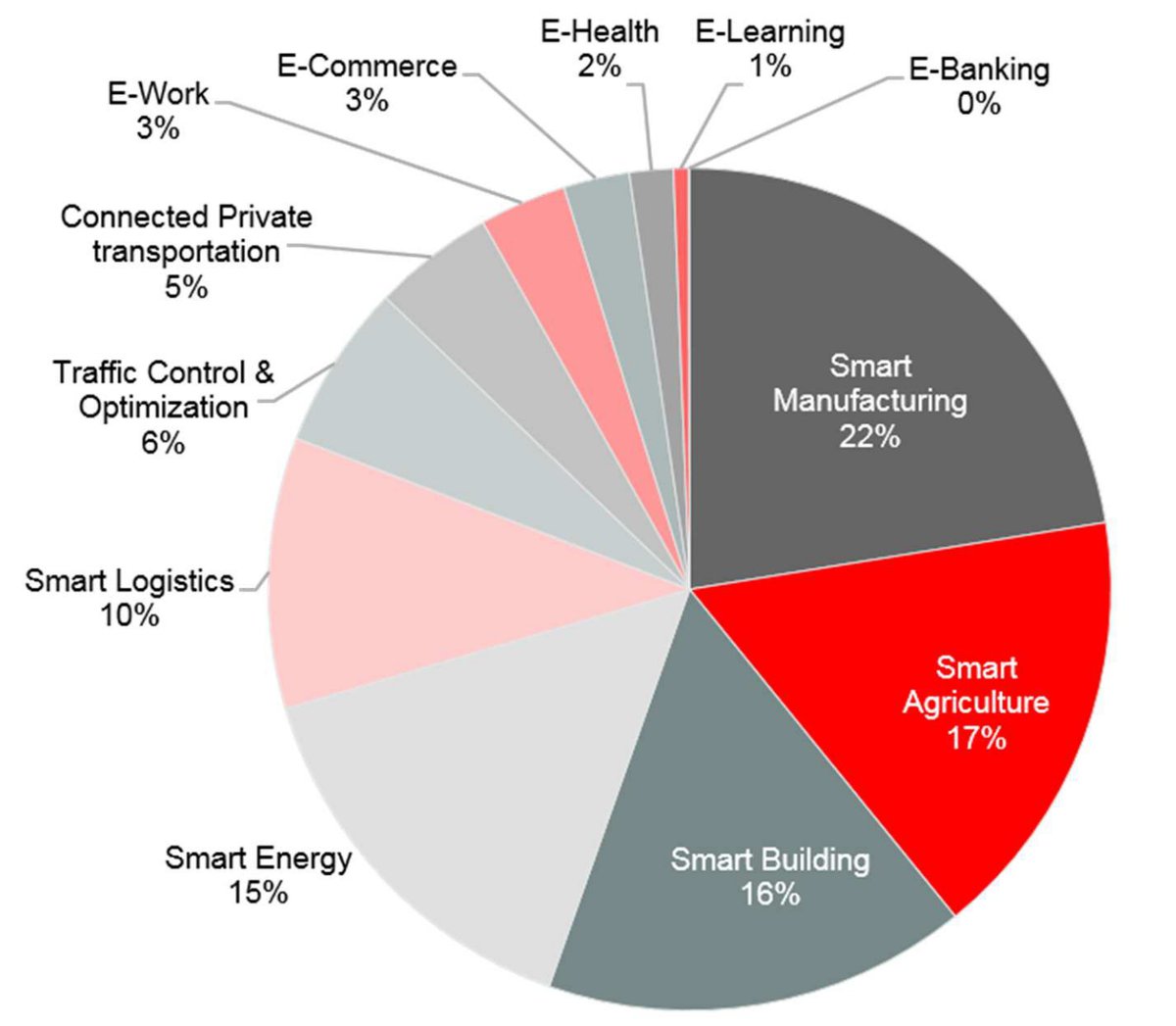 Figure 1
The environmental impact
Multiple studies have shown that the building sector is a large global energy consumer and contributor to global emissions. The numbers are a staggering 40 and 33 percent for a country like Germany who, along with the U.K. and U.S. are among the largest contributors. The good news is there is a very large potential for improvement, and smart building technology such as smart sensors can contribute up to 16 percent in CO2e abatement by 2030, as seen in Figure 1.
The side effect of these technologies is a large influx of data and the need to manage it. Many large corporations — such as Cushman and Wakefield — have pledged their alignment with the U.N. sustainability goals. As a result, they focused on lowering greenhouse gases across their buildings by looking very closely at energy usage patterns using smart monitoring and sophisticated software at scale.
Cushman and Wakefield are not the only ones. Even the big corporations in the energy capital of the world have all pledged towards carbon-neutral programs.
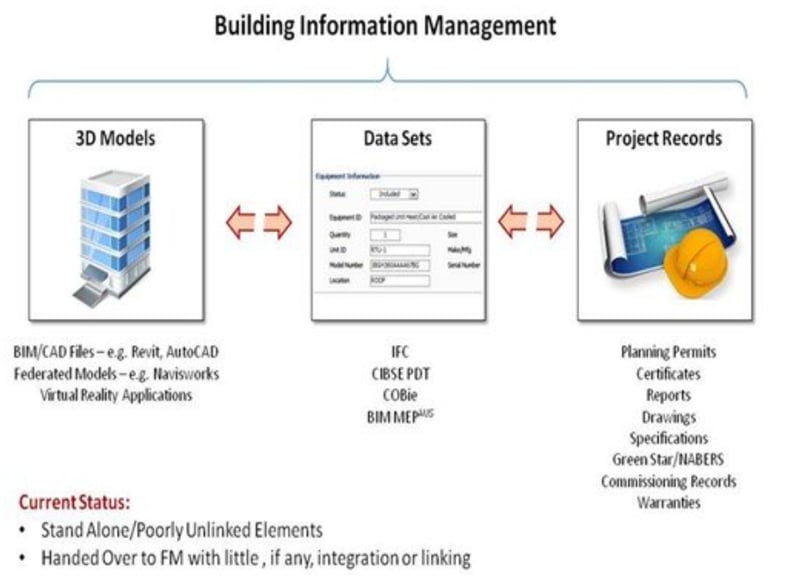 Figure 2
What data is managed for a building?
When one thinks about the different life cycles of a building, such as design, planning, construction and operations, a very large amount of data will arise. As a building flows through these different stages, the data created and used is somewhat unique for that step in the life cycle. One of the bigger problems contributing to the interoperability of data is that BIM models are designed around the specifics of the life cycle and do not take into consideration what the owner wants to do with the data. When a building is being commissioned, the owner typically receives a mixture of information that describes the building, as shown in Figure 2.
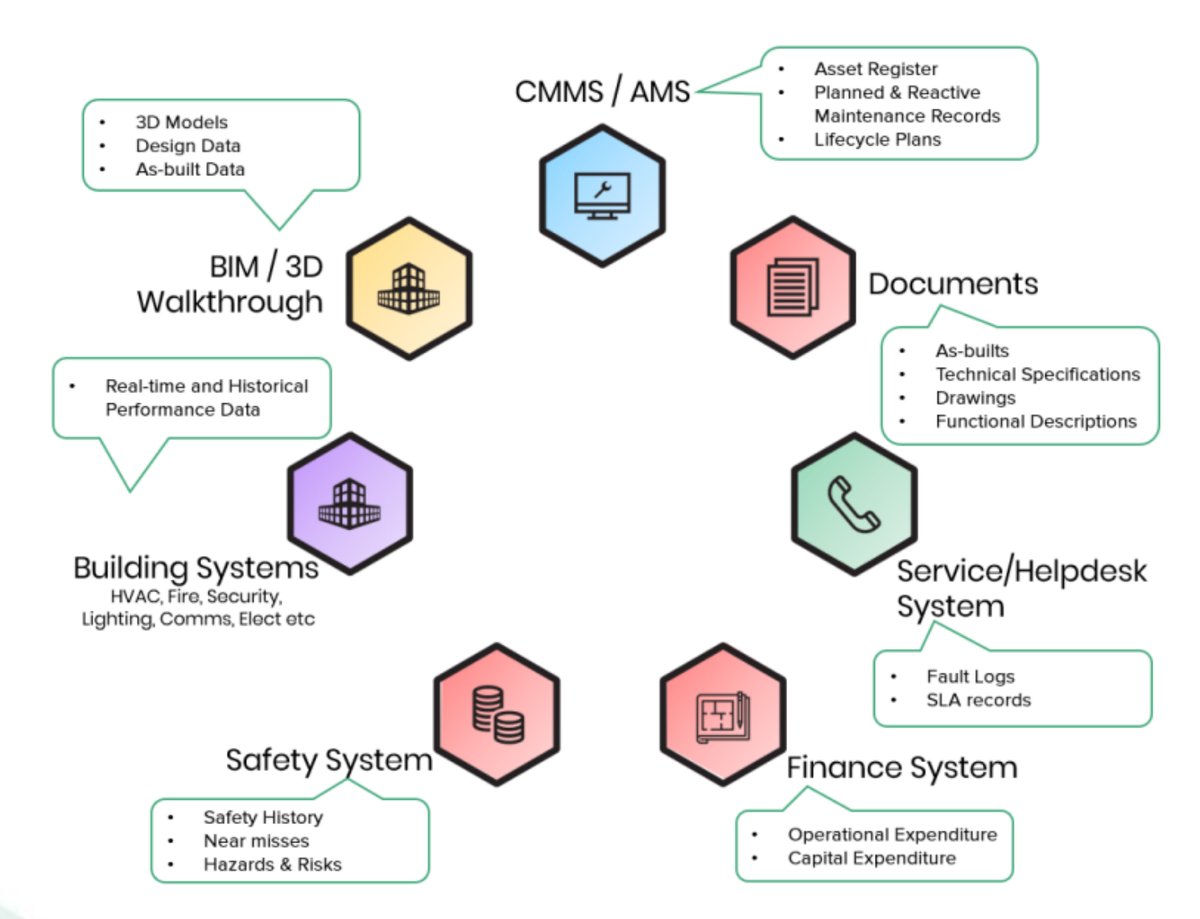
This is a shame as the greatest value for a well-constructed BIM model comes post-construction as renovations and asset maintenance take place. With a focus on the operational phase of the building, Figure 2 shows the different types of information that are managed and all influence decision making.
Based on the details in Figure 2, it is easy to envision that the lack of management around these structured and unstructured sources can be the cause of frequent hair pulling to address issues as they arise, or decisions are made based on the wrong data. To address this challenge, virtual building information systems (VBIS) is a classification schema designed to connect data in different locations. The classification was designed with the end-state in mind to address questions like:
-
How to embed in a BIM object property a code that can be passed through to federated models and function in the FM phase?
-
How to standardize the naming of assets on project drawings, schematics, commissioning documentation and labeling in the field
-
As the world moves to SaaS systems, how to standardize inter-system communication?
-
As the world moves to predictive maintenance, what is required to analyze FM databases of assets and service history records?
-
How to accommodate the Internet of Things and potentially relate thousands of sensors to asset databases?
-
How do to categorize assets in the built environment?
-
How do to categorize documents associated with the built environment?
The idea behind VBIS is that useful object codes for FM are embedded early in the model and allow for easy use of the model for FM purposes. The challenge, as with many of these standards, is that they need to be backed by the industry and ideally enforced by government entities, such as the case when BS1192 was enforced for projects in the U.K. many years ago.
The need for end-to-end data integration
When buildings are created or renovated, the on-set data silos must be avoided at all costs, agreement on data standards, applications, usage of standards and what the end goal of the data is are all critical components for the project data to be FM enabled. This term is introduced in the research performed by Pishdad-Bozorgi and is described as:
That definition is easier said than done. The research describes in detail the different challenges that had to be addressed on technology as well as an organizational level for a project to be FM-enabled upon completion of the building. As an important conclusion, researchers describe how the virtual world and the physical world need to be aligned and follow the same life cycle stages as the physical building, as can be seen in Figure 4. As the physical elements progress, the digital assets must follow along to provide a usable model at the end of the project. Next to technical aspects, another observation was the requirement for breaking down contractual silos and ideally organize the project in the form of an IDP (integrated delivery project) contract.
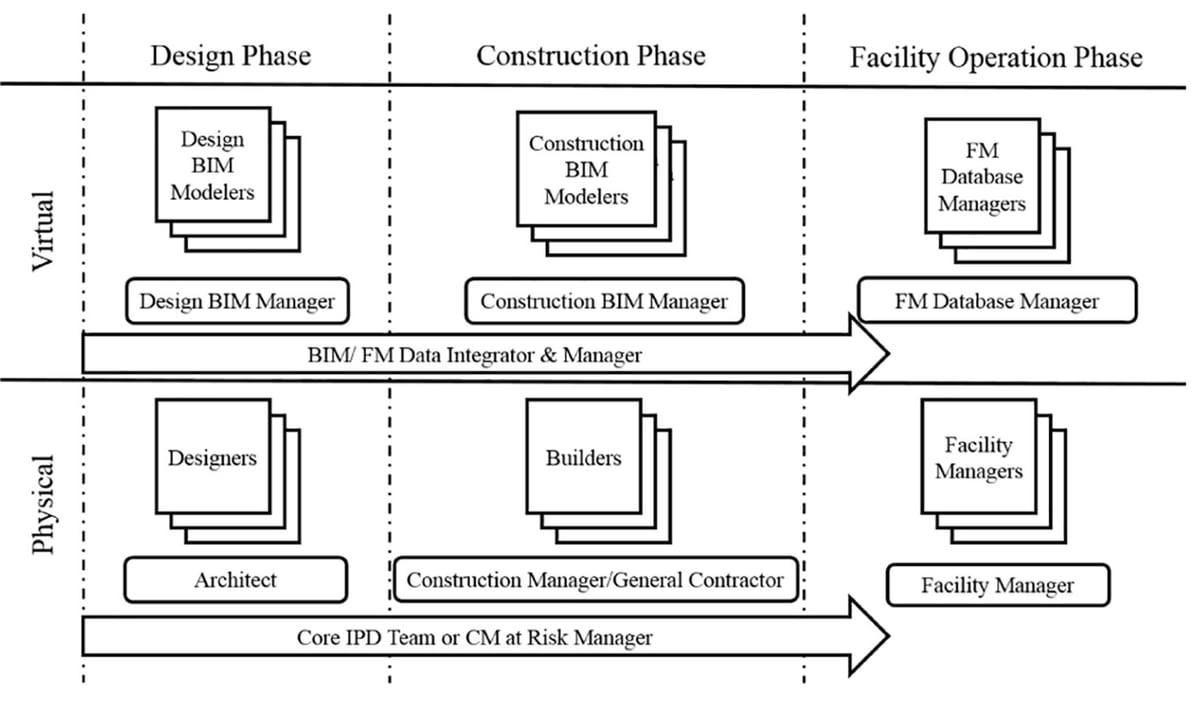
The force is with you
Utilizing BIM information for O&M is not hindered by the technology and standards available. A lot of good work has been done to support FM goals, but technology misalignment, owner readiness as well as organizational project structures can severely hinder the output of the digital building. A digital version of the building should not be an afterthought but design and communicate the needs upfront to ensure that the organization is ready to embrace the information as the project is delivered.
Edwin Elmendorp, information architect at Kinsmen Group. Elmendorp has almost 20 years of consulting experience in engineering information management. After initially graduating as an electrical instrumentation engineer, he moved on, added a computer science degree, and recently graduated cum laude with a master’s in business process management and IT. Aside from a solid academic background, Elmendorp has worked with many owner-operators to digitally transform how companies manage their information assets spanning many different software solutions.
References
King, “80 Percent of Your Data Will Be Unstructured in Five Years,” 2019. solutionsreview.com/data-management/80- percent-of-your-data-will-be-unstructured-in-fi ve-years/ (accessed Feb. 03, 2021).
A. S. of C. Engineers, “Construction Research Congress 2020: Computer Applications,” no. 2008, p. 1384p, 2020, Online. Available: trid.trb.org/view/1760497.
Global e-Sustainability Initiative, “#SMARTer2030-ICT Solutions for 21st Century Challenges,” 2015. Online. smarter2030.gesi.org.
“Sustainable Development Goals,” Sustainable Development Goals, 2015. sustainabledevelopment.un.org/sdgs (accessed Sep. 25, 2019).
E. N. Rudakova, D. A. Pashentsev, R. M. Myrzalimov, Y. M. Alpatov, and V. A. Baranov, “Corporate social responsibility,” Espacios, vol. 40, no. 22, 2019.
T. Axelrod, “Shell unveils plans for emissions cuts,” The Hill, 2021. thehill.com/policy/energy-environment/538392-shellunveils- plans-for-emissions-cuts (accessed Feb. 03, 2021).
VBIS, “VBIS - Bridging Construction and FM,” 2020. vbis.com. au/practise-notes/vbis-for-vdas%0A vbis.com.au/practisenotes/ 2020/12/9/vbis-amp-standards-the-vbis-relationship-to- standards%0A (accessed Feb. 03, 2021).
P. Pishdad-Bozorgi, X. Gao, C. Eastman, and A. P. Self, “Planning and developing facility management-enabled building information model (FM-enabled BIM),” Autom. Constr., vol. 87, no. December 2017, pp.
Read more on Leadership & Strategy and Facility Technology & Data Management or related topics Facility Technology , Data strategy and information management and Measure and Monitor
Explore All FMJ TopicsRelated articles
-

Artificial Intelligence in FM
The stakeholder’s perspectiveBy Dr. Jake Smithwick & Dr. Kenneth Sullivan & Nneka Ubi05.01.2024 -

Mastering Change in Hybrid Environments
Insights from global operational leadersBy Meg Swanson09.02.2024 -

Plugged In
Solving the data disconnect in real estate and FMBy Amanda Muzzarelli & James Waddell07.01.2024
