 Membership
 Network
 Regional Sites & Affiliates


 Events
 Participate
 Resources

 Training
 Credentials
 Government


 Content Channels
 Tools
Tools


 Business Overview





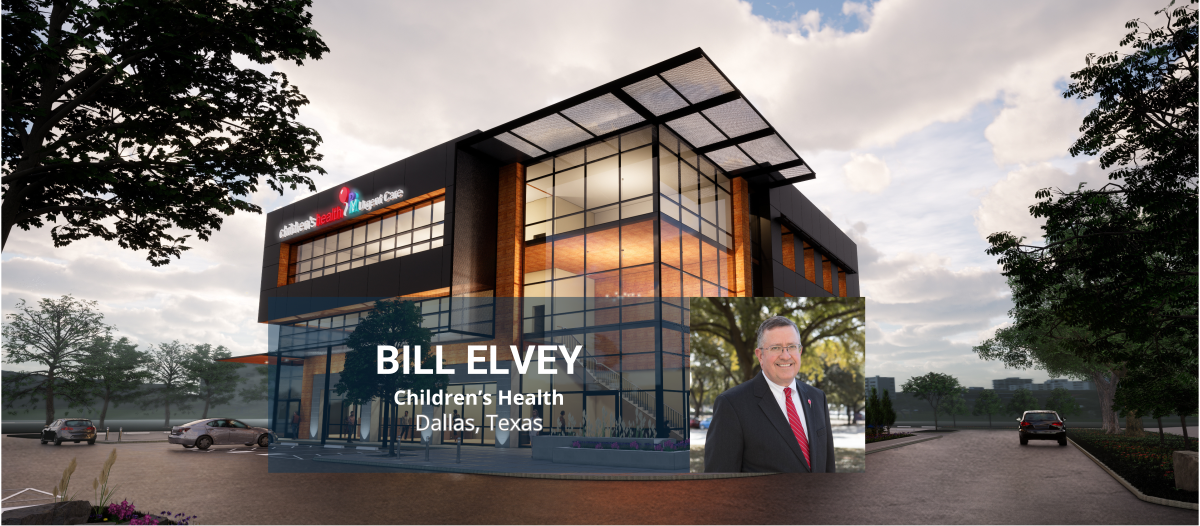
Managing 4.4 million sq. ft. of space across 16 owned buildings and 35 leased facilities is no easy task. From COVID-19 protocols to pediatric care and visitor comfort, IFMA member Bill Elvey and his team of 500 FM staff at Children's Health in North Texas face daily challenges head on.
Tell us about yourself and how you got into FM.
I started in the facility management profession when I served in the U.S. Navy. For 20 years. I served as a Navy Civil Engineer Corps Officer and worked in various areas of FM including public works, Seabees (the Navy’s construction battalion), construction project management, planning, programming, budget and finance.
After serving in the Navy, I spent the next 19 years working in FM at higher education facilities including Virginia Tech, the University of Texas at Dallas, and the University of Wisconsin-Madison.
After working in higher education, I knew I wanted a new experience and was eventually hired in 2016 as the senior vice president of facilities and real estate at Children’s Health, one of the largest and most prestigious pediatric health care providers in the U.S. I am still in this role today.
What is day-to-day life like at Children’s Health?
There is no such thing as a typical workday at Children’s Health, and I wouldn’t want it any other way. I love the variety that comes with working in FM. We are always on the clock, and that is especially true when working in a health care setting. To be prepared for any situation we may encounter, our facilities must always be maintained at the highest possible level. Our team is completely focused on providing the highest quality experience for our patients, their families and our team members. It is not uncommon for me or other members of my team to work 12- to 14-hour days to ensure we continuously serve on our mission to make life better for children.
What are some of the challenges you and your team face at Children’s Health?
Not many FM professionals work in the health care industry, so my role at Children’s Health is especially unique. Each challenge we are presented with is an opportunity to learn and try something new.
Children’s Health has a wide variety of facilities that include various types, ages and building conditions, which always keeps things interesting. For example, we have three hospitals of varying sizes, specialties and locations. We are also responsible for corporate leased space, clinical transport facilities (fixed wing and helicopter), distribution warehouses, data centers, clinical research space, specialty clinics and primary care buildings. Our portfolio is constantly changing and growing. I have been heavily involved in the 140-bed expansion at our Plano campus, our emergency department renovation at our Dallas campus and a large undertaking developing our new medical office building in Prosper. Most recently, I have been hard at work helping to ensure electrical work, painting, fireproofing and more is installed seamlessly at our new Prosper development. I will be working on that project to make sure the building is adequately suited for patient care once the project reaches its final stages. There is seemingly always a facilities project in the works to keep Children’s Health top-of-the-line for patient care.
One of the reasons I sought to transition to health care from higher education was to apply my FM expertise in a different environment. While it might also be unique to do this at an executive level, it has been a match made in heaven for me. I have learned about a variety of work these past five years working at Children’s Health, but the basic FM principles remain the same. Safety is our top priority. However, health care differs in that there is more of an emphasis on cybersecurity. We ensure all patient and research information remains classified and confidential. There is also naturally an incredibly large emphasis on infection prevention and control when conducting our work and projects. Areas under construction at our hospitals must be properly sectioned off to not interfere with patient health or care.
How do you adjust to provide the needs for an area to be warm and accommodating with space used for life-saving procedures literally just steps away?
Our facilities at Children’s Health consist of 4.4 million square feet, 601 licensed beds, 198 acres of land, 16 owned buildings, 35 leased facilities and 1.6 million square feet of parking garages.
Space comfort and clinical needs do not have to be in conflict. By developing a robust, comprehensive ventilation management plan both needs are met, and the space remains code compliant. The environment is governed by codes which lay out the specific criteria for each space. For example, waiting and exam rooms have parameters for comfort and protecting patients. Treatment and procedure spaces have more comprehensive requirements to ensure the safety of the patients and clinical teams. The HVAC systems are managed by a building automation system (BAS) that is programmed with these criteria in mind and make constant adjustments to meet them, while also sending alarms to support teams when criteria are not being met. The combination of a ventilation management plan and the BAS ensures that patients are treated in an environment that is comfortable, safe and compliant.
Tell us about your FM team.
I work with upwards of 500 incredible FM team members that are all highly trained, experienced and engaged. Our team at Children’s Health is divided into five functional areas: real estate; planning, design and construction; engineering; environment services and security. I can count on them to do the right thing in any given situation. My job is to provide them with the training and resources they need to be successful. I believe in delegating duties and empowering my team to feel they can own their work and make great decisions. They understand that no matter their role or what is happening at the time, I have their best interests at heart, and they are all part of a larger team of Children’s Health professionals dedicated to making life better for children. I love them, period!
What is the biggest FM challenge you have faced and how did you find a solution?
As an FM team, we are in the business of risk management. The safety of our team members and the operations they oversee is always a priority. No matter how much of the latest tools, equipment, and technology our health system has available, we are as only good as our team members. As a result, I spend as much time as possible recruiting, hiring, training and retaining the best possible people I can for our team. If you have a great team, success will surely follow. Every day presents a variety of challenges, and some are bigger than others. It’s not the challenge that matters, it’s how you react to it and rise to the occasion.
One special situation I encountered while serving as the Resident Officer-in-Charge of Construction (ROICC) was to help decommission Clark Air Base in the Philippines after the simultaneous eruption of Mt. Pinatubo while dealing with a typhoon on June 15, 1991. I was also the Chief Facilities Officer at Virginia Tech on April 16, 2007, the day of the mass shooting on campus that resulted in 33 deaths. Nothing in my prior FM experience could have prepared me for the events of that day, nor the recovery efforts that were required afterward.
How has COVID-19 changed the way you and your team are able to operate your facility?
Children’s Health is committed to responding to COVID-19 in a safe, strategic, and sustainable way that allows us to fulfill our mission to make life better for children. The FM team adapted its working conditions as needed to continue to be successful. All our operational teams worked their shifts as they did before, but with added constraints and protocols imposed during the pandemic. Children’s Health has a great team of clinical and administrative professionals that have carefully and meticulously guided the entire organization through this situation.
Our team was critical in helping establish the emergency operation center working with the system COVID-19 Command Center team. We also managed the shift in signage around all our facilities to help team members and patient families remain apprised of all of the latest PPE, social distancing, visitor and safety guidelines throughout the many changes that are still taking place amid the pandemic.
What are some FM challenges you face at your venue that are common across the FM industry?
There is no experience in my time as an FM leader that I can say has gone to waste. I continually apply everything I have learned in the past 45 years every single day that I come to work. Everything we do at Children’s Health is important and urgent. When you love your job, are completely aligned with the mission of the organization, love the people you work with and aspire to be a servant leader, then work no longer feels like work!
What do you like best about what you do?
I love the people I have the privilege of working with. They are all heroes in my mind. My job is just to make their jobs easier and spread as much joy in the workplace as I can while doing it.
References
Photos Courtesy of Children's Health
Read more on My Facility
Explore All FMJ Topics