 Membership
 Network
 Regional Sites & Affiliates


 Events
 Participate
 Resources

 Training
 Credentials
 Government


 Content Channels
 Tools
Tools


 Business Overview





My Facility: Claire Wait
Georgetown University in Qatar
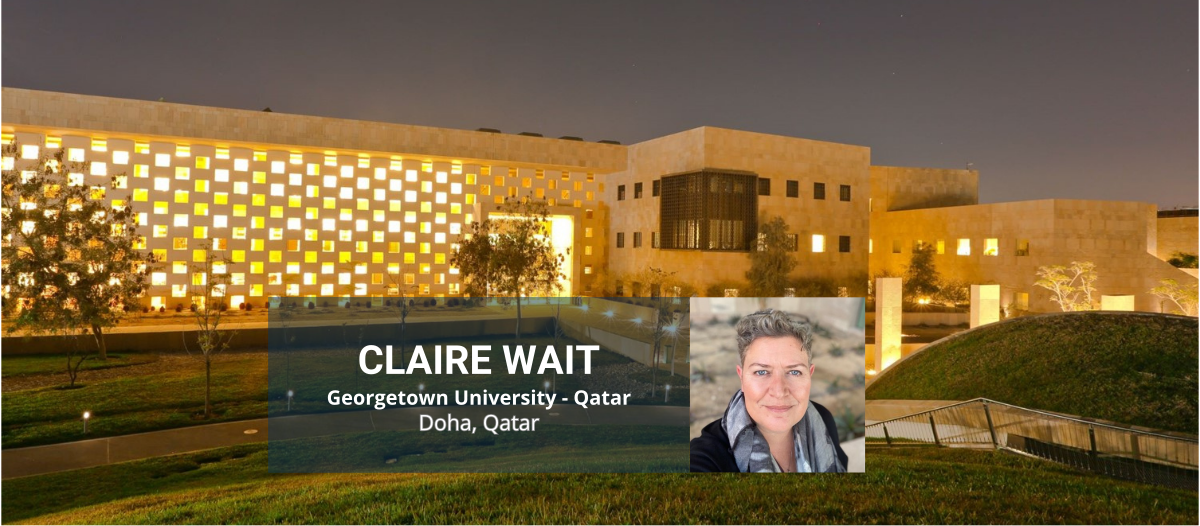
IFMA member Clare Wait’s career has taken her in and out of the public and private sectors in all kinds of facilities. As chief facilities management officer for Georgetown University in Qatar, she oversees a high-performing building that must meet the needs of a vast number of diverse occupants in a hot desert climate.
What is day-to-day life like at Georgetown University in Qatar?
FM here has a broad remit covering the standard cleaning and maintenance, but also catering, transportation, events, bookstore, security, mail services and employee housing, so there is never a dull moment. Our FM team represents 30 nationalities, including 25 directly employed staff and contractors and 95 Qatar Foundation (QF)-provided contractors for maintenance, cleaning and catering. This can be challenging when trying to build a cohesive environment, so we have paid particular attention to team building activities and rewards to build that sense of belonging in line with the GU values.
Why is GU-Q unique and what kind of challenges do you face managing the campus?
We are lucky to have been able to start fresh in a brand-new facility built just for GU-Q, but it also came with the lengthy standard punch list to address during the building handover process.
GU-Q is based in a building provided by QF, the Humanitarium Building. I was hired three weeks before the Georgetown community began the transition into the newly designed building in September 2010. We were fully operational by the start of January 2011.
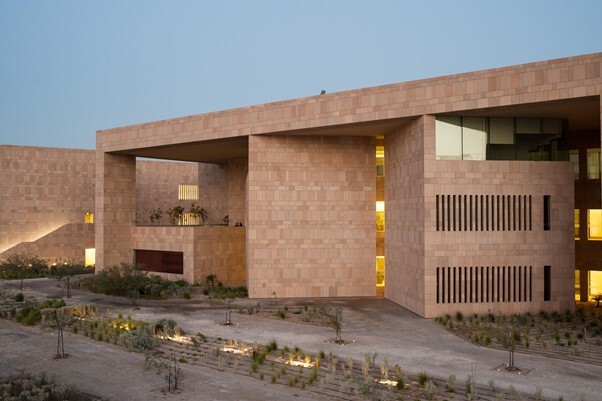
The design of the building reflects design elements from both the Georgetown University campus in Washington, D.C., and from buildings in the Gulf Region.
The Georgetown Building was officially renamed the Humanitarium Building by QF in 2017. The new name, a combination of the words humanities and atrium, which is a central feature in the building’s design, honors the Georgetown community’s role in the study of the humanities.
The Humanitarium hosts up to 700 people. We have around 400 students and when they attend in-person classes, there are about 16 students in each classroom. We host upwards of 700 events a year hosted by students, faculty and staff, including public lectures, panel discussions, academic and student conferences, as well as academic ceremonies.
Designed to be a major gathering place for faculty, students and staff, as well as visitors, the Atrium is three stories high with skylights that allow natural light into the space. An area with dining tables and chairs sits adjacent to the dining services and is separated from the other casual seating area with a distinct architectural water feature. The space is often converted for special events and can accommodate a banquet with seating capacity for 250. The flags representing the different nationalities of the students enrolled at GU-Q are prominently displayed along one perimeter of the atrium. In addition, metal lightning bolt sculptures drop down below each skylight making light dance across the space. This level of architectural and decorative detail can be a challenge to maintain when we have an operation that spans the full year and doesn't really break for the summer, which would be the traditional time for periodic maintenance.
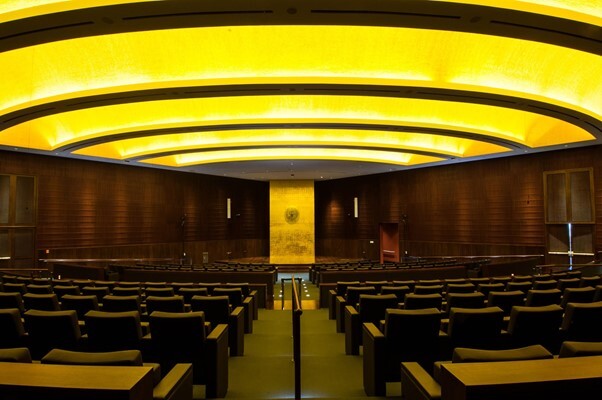
 The Auditorium is the preferred venue for larger events, including but not limited to lectures, panel discussions and artistic performances, with seating capacity for 350 people. Other spaces include The Centre for International and Regional Studies (CIRS), which is designed to host international conferences and meetings with various local and foreign delegations. CIRS is in an open courtyard within the academic wing. It contains a conference with custom designed tables that form a circle to accommodate up to 40 participants. The classrooms, seminar rooms, lecture room and distance learning rooms form one of the major design features of the building. These rooms contain the latest A/V equipment to be used for instructional purposes. The distance learning room is equipped with “telepresence” technology to allow for distance learning between the Washington, D.C., and Qatar campuses, as well as the rest of the world.
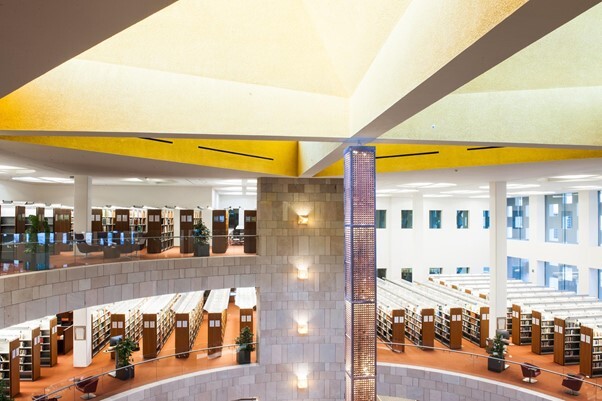
The library offers flexible spaces that encourage individual or collaborative reading, studying and research, allows for the provision of research assistance, and skills training and support, and houses an extensive collection of books and materials, as well as a variety of assistive technologies.
The design architect’s integration of open courtyards and spaces allows natural light to penetrate the building’s interior. This feature ensures that there are hardly any
spaces without natural light, including offices and teaching spaces. The use of water features both in the interior and exterior of the building contributes to the aesthetics and character of the building. Having invested in such an iconic building, QF is keen to maintain the integrity of the design so there are limitations to the changes or alterations we can make.
How does the Qatar climate affect your FM strategies?
The climate in Qatar brings other challenges with the building management system and air conditioning, particularly adjusting for changes in humidity throughout the year. Occasional heavy rainfall can cause flooding and there was an incident in recent years when we had to respond rapidly to water ingress. Nevertheless, I am proud that the teamwork we cultivated carefully paid off, because we were able to respond quickly to mitigate the flood and prevent major damage.
What is the biggest FM challenge you have faced and how did you find a solution?
 In 2009, I led the response to the floods at my previous in which we rescued 200 households from the rising water after unexpectedly high rainfall. Just like during floods at GUQ, teamwork, critical decision making and creative solutions helped us overcome this challenge.
When we moved into the GU-Q building one floor was left incomplete for our future expansion, and QF decided to use the space to host another university on a temporary basis. In 2011, the University College of London in Qatar moved in and we jointly oversaw a one-year fit out of that space while maintaining our operations and minimizing disruption.
Another challenge was supply chain disruption due to the blockade. In 2017, Qatar experienced breakdown in relations with neighboring countries, and the borders closed, significantly affecting our supply chains.
What are some FM challenges you face at GU-Q that are common across the FM industry?
As with every other FM team in the world, right now our biggest challenge is providing a safe environment for our community to continue to operate during the pandemic. Members of the FM team were deemed critical for building operations and were among the few people placed on a pre-approved list authorizing entry and work from the premises to continue operations through the lockdown.
What do you like best about what you do?
I love the people I work with and the variety of the activities we work on, because however proactive you are, you never know what the day will bring.
Read more on My Facility
Explore All FMJ Topics