 Membership
 Network
 Regional Sites & Affiliates


 Events
 Participate
 Resources

 Training
 Credentials
 Government


 Content Channels
 Tools
Tools


 Business Overview






A happy employee is a productive employee. One recent study found that happy employees are up to 20 percent more productive than unhappy employees. When it comes to salespeople, happiness has an even greater impact, raising sales by 37 percent. How can a company impact an employee’s happiness? It is not overly complicated. Since employees spend more of their waking hours at the office than they do at home, a comfortable, healthy and motivating workspace is a critical step to inspiring happiness.
Trends in workplace design are always changing. New research continues to emerge about the best ways to facilitate productivity and collaboration, improve employee satisfaction and reduce stress. Everything about your workspace - the color of your office, the use of greenery, the openness of the space - can have a direct impact on your workers’ satisfaction and productivity. While open offices may continue to dominate many workplace designs, this year’s Staples Workplace Survey finds that an open layout is not always the best solution to meet all employees’ needs. Instead, workplaces need to tap into the full design toolkit to build flexible, inspiring spaces that minimize distractions and enable employee choice when it comes to the environments that energize them.
When thinking about a new office space, engage an architect early in the process to help translate the company’s wants and employees’ needs into the most effective space. The best design is rarely a full open office approach. Instead, it is typically a hybrid that introduces activity-based working areas to meet the spectrum of needs. A highly touted Harvard Study supports this concept, “Our studies show that the most successful work environments provide a range of spaces — an ecosystem — that allows people to choose where and how they get their jobs done.”
Open office
In the U.S., open office design plans are used in about 70 percent of offices, according to IFMA. Open office layouts can save companies up to 50 percent per employee on office space costs, so the financial rationale often drives design in that direction. There are benefits and challenges of an open office design to identify the reasons and the extent to incorporate it.
Open offices offer a variety of benefits including:
-
Increased collaboration – open plan environments encourage employees to work together more.
-
Creative thinking and innovation – easy input from others without having to schedule a meeting can lead to better ideas.
-
Lower build and fit-out cost – the amount of space needed and the costs of constructing a space with an open office design can be as much as 50 percent lower.
-
Energy savings – open plans reduce heating, cooling and electricity expenses thanks to improved flow of air and light.
-
Reduced office equipment expenses – enable easier sharing of printers, copiers and other office supplies.
-
Easier layout changes - can accommodate increases in head count, or rearrangements of groups due to changes in company structure.
Along with the benefits come some challenges:
-
Noise and distractions – make focus more difficult and can lead to a decrease in productivity, especially for work that requires concentration or privacy.
-
Lack of privacy – computer screens are easily visible and sensitive telephone conversations can be overheard. Depending on worker background, they may respond negatively to an open environment perceiving they are being watched.
-
Implied lower status – when all employees don’t have the same workspace scenario, any difference can be interpreted as a ranking in perceived value to the company.
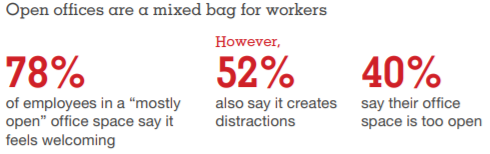
2019 Staples Workplace Survey
Addressing noise in the open plan is a key area to address to ensure success, regardless of how open or closed the overall office design may be. When noise distractions are reduced, 75 percent of employees are more productive, 57 percent have increased motivation and 49 percent are happier at work overall. An acoustically balanced environment is as easy as A-B-C: Absorb, Block, Cover.
1. Absorb
Minimize noise by absorbing sound. High ceilings create reverberant acoustics that blur voices in the distance to allow clear face-to-face conversations. However, conversations more than a few feet away can be problematic. An acoustical ceiling can absorb up to 50 percent of sound, so explore using hanging baffles, suspended ceiling tiles or sprayed acoustic foam. Consider soft carpets to dampen noise, especially foot-fall sounds. Wrapping walls with acoustical panels, incorporating curved walls and reducing the number of parallel walls will reduce reverberation of sound. Explore furnishings such as free-standing interior elements, surfaces, fabric and draperies to attenuate sound without compromising design.
2. Block
Blocking helps manage noise via sound avoidance. While many initially think of blocking as a physical solution, it is often more effective to establish office protocols, which encourage etiquette and a positive culture to maintain comfortable sound levels. Initial, proper workspace planning and strategy are also valuable. For example, avoid noise disturbances by placing front-facing teams that spend large time periods on the phone away from those with focused work. Also, it is beneficial to divide staff into smaller groups of employees. Instead of putting all 100 employees in the same open space, consider two to three smaller groups separated by meeting rooms. Another critical factor to address in office layout is loud and constant noise generators. Isolating copiers, shredders and other disruptive noise generators will help minimize noise disruptions.
3. Cover
Cover is how you mask noise with sound-generation equipment. Background sounds prevent small noises from producing out-of-proportion disturbances. Pink noise, which is smoother and more calming across all frequencies is preferred over white noise. Investment in high-quality headsets with directional microphones is well worth the cost for individual workstations.
Noise mitigation design should include the following key considerations:
-
-
Functional and activity-based space planning
-
Workstation layout as sound barriers
-
Interior materials selections and application
-
Sound-absorbing materials for ceilings, floors and walls
-
Electronic sound masking – Privacy index
-
Isolation of noise-generating equipment, devices and systems
-
HVAC system design (duct routing, silencers, materials, geometry, vibration isolation)
-
Activity-based working (ABW)
While open office design has become a standard, many companies are now reaping the benefits of incorporating activity-based working areas. Office design trends in some regions and industries (especially in the tech industry) are moving toward ABW environments, which provide a combination of open office design spaces with other task-oriented, private spaces. When an ABW office design is combined with a non-assigned seating model (also known as “agile” or “flexible” working), many of the problems associated with open plan spaces are eliminated.
For example, someone who needs to make confidential phone calls can choose a private “phone booth.” Likewise, an employee from a branch office location (or a guest) can use a “hotel” workspace. Team brainstorming sessions can take place in a comfortable lounge or whiteboard room that encourages creative thinking. Meanwhile, someone auditing financials or reviewing legal documents can choose a small, quiet space for thinking and concentration.
Designing the right environment
So how does a company go about designing the right environment for their workers and their bottom line? The planning process starts with a thorough inventory to help you understand how your current space is being utilized. The planning team will gather data about each building, floor, conference room and desk, and track who is using what.
Workplace management technology systems have recently become available and help by implementing space utilization tracking technology, such as sensors and network tracking, to determine exactly when and how often spaces are used. That data can help determine the right mix of spaces and ratio of people to desks.
The only right answer when evaluating open space, doored or activity-based working plans is the one that is the best suited to your company and your employees’ needs. Investing in a relationship with an experienced architect can ensure success, regardless of which type of office design you choose; it will be money well spent that keeps your employees happy and productive.

Steve Kimball is a principal at emersion DESIGN and leads the science and technology practice. emersion DESIGN, located in Cincinnati, Ohio, USA, is a collaborative architecture, interior design, planning, structural engineering and sustainable design firm driven by a passion for exceptional designs that advance clients and society.
References
Top image via Getty Images.
University of Warwick Study
http://www.smf.co.uk/wp-content/uploads/2015/10/Social-Market-Foundation-Publication-Briefing-CAGE-4-Are-happy-workers-more-productive-281015.pdf#page=9
2019 Staples Workplace Survey
https://marketingassets.staples.com/m/2f87908f7831655d/original/2019-Staples-Workplace-Survey.pdf
Wall Street Journal
https://www.wsj.com/articles/open-offices-are-losing-some-of-their-openness-1475460662
Harvard Business Review
https://hbr.org/2014/10/balancing-we-and-me-the-best-collaborative-spaces-also-support-solitude
2018 Workplace Distraction Report, Udemy for Business
https://research.udemy.com/research_report/udemy-depth-2018-workplace-distraction-report/
Knoll, Noise at Work, Addressing noise in the open plan
https://www.knoll.com/knollnewsdetail/noise-at-work
Serraview workplace management technology
https://serraview.com/solutions-5/
Read more on Workplace or related topics Space design and planning and Space Management
Explore All FMJ Topics