
 Membership
 Network
 Regional Sites & Affiliates


 Events
 Participate
 Resources

 Training
 Credentials
 Government


 Content Channels
 Tools
Tools


 Business Overview





On Equal Footing
5 ways FM leaders become trusted partners in decision-making

It is a familiar scene: an asset fails, a capital request lands on the wrong side of a budget cycle or the change in seasons exposes a backlog of unfulfilled maintenance across the portfolio.
The facility manager is called into a meeting with the CFO or COO. In that room, two things are being evaluated simultaneously: the problem itself and the person presenting it.
The FM who arrives with a quote and an apology confirms the preconception that facilities are a cost center – reactive by nature and always seem to cost money.
Thorough documentation and a prioritized response plan can be the key to changing executive opinion. Do it well and in the eyes of an executive, FMs go from first responder to trusted partner.
Here are five ways that shift happens in practice.
 The most fundamental change an FM team can make is to stop relying on memory and start documenting comparable records of asset conditions over time.
This matters for reasons that go beyond operational efficiency. In most large portfolios, the condition of any given asset at any given point in time is held loosely, be it in the memory of a technician who visited six months ago, a spreadsheet that was last updated before a handover or a contractor's verbal assurance that things were fine.
This knowledge is fragile. It evaporates when a technician changes roles. It degrades across a 50- or 75-property portfolio to the point where nobody has a reliable view of the whole picture. And it collapses entirely when someone new inherits a region mid-cycle with no baseline from which to work.
The practical consequences surface constantly. Consider a scenario that plays out across portfolios every year: an FM suspects that a contractor's vehicles caused significant curb damage during winter operations. Without before-and-after documentation, that conversation is a dispute.
With that evidence, it is a straightforward recovery. At US$20-30 per linear foot across hundreds of feet of curbing, the difference between having documentation and lacking it can represent tens of thousands of dollars on a single property in a single season.
Multiply that across a portfolio and the need becomes structural. The FM who can arrive at an executive review with timestamped, comparable condition records across every property in their portfolio is not only better prepared for individual disputes; they are operating with a fundamentally different level of credibility than the one who is working from memory and best estimates.
There is also a workforce resilience aspect that resonates at board level. FM teams whose condition knowledge lives in a system rather than in individuals are more resilient to staff turnover, more scalable as a portfolio grows and more transferable when responsibilities shift.
Five people with access to consistent, longitudinal data that can be read in real-time can perform the work that previously required eight or nine. That is an operational efficiency and risk management argument all blended into one.
 The structural challenge facing most FMs in budget conversations is straightforward: reactive spend has a visible, urgent imperative that executives can trigger; proactive spend requires trust in a projection.
The CFO who approves emergency repairs has a clear justification. The CFO who approves a preventive intervention is, in effect, solving a problem that has not actually occurred yet.
This asymmetry is not going to disappear. But it can be addressed, and the FM leaders who navigate it most effectively do so by changing the terms of the conversation.
Rather than presenting a capital request as, "here is what this repair will cost," they should present it as, "here is what this costs today, here is what it will cost in 18 to 24 months if deferred, and here is the trajectory between those two points."
Cost calculators can help FMs accurately put a number on proactivity, not taking action before a seasonal transition or deferring action over different timelines.
Asset deterioration, particularly across pavements, roofing systems and building envelopes, follows reasonably predictable curves that are well-documented in civil engineering research.
FMs with access to longitudinal condition data can benchmark a portfolio against those curves and present credible projections – not speculation but evidence-based of what deferred maintenance actually produces financially.
A US$50,000 intervention today that prevents walking off a US$250,000 capital cliff in three years is a different kind of conversation than a repair request. It is astute risk management.
Equally important – yet often overlooked – is the ability to justify deferral when the data supports it. Knowing when an asset can wait is just as valuable as knowing when it cannot.
An FM who can tell a CFO, “Based on current condition data and deterioration modelling, this property does not need major pavement work for another two years – and here is the evidence for that," is not just engaging in spending advocacy, but providing genuine decision support.
That kind of intellectual honesty builds trust faster than almost anything else.
 Strategic planning advantage in FM is often simply a question of timing.
 The FM who begins that process reactively – after conditions have deteriorated, the contractor market has tightened or a C-suite conversation has already happened – is not.
The seasonal transition from winter to spring is one of the clearest illustrations of this principle, and it applies broadly across any operating environment where weather patterns, occupancy cycles or regulatory calendars create predictable operative markers.
In markets that experience significant seasonal weather, the first warm weeks of the year reveal deferred maintenance that accumulated under snow and ice such as pavement failures, drainage problems, roofing stress, façade damage and more.
Those issues existed before the season turned, but were they discovered proactively or reactively?
The teams that have done the work do not have to bring justification to their executive review in February. A data-backed capital plan, prioritized repair schedules and early contractor engagements are in a dramatically different position from those that arrive in April with reactive spend requests.
The practical advantages snowball. Contractors engaged early in a planning cycle, before the seasonal rush, are more likely to offer competitive pricing and demonstrate intimate understanding of the supply-demand dynamics of the maintenance contractor market. This represents real financial value gained.
Early planning also creates space for contingency reserves. A portfolio team that has locked in its planned CapEx eight weeks earlier than usual has room to absorb reactive spend mid-season, without compromising planned projects or having to return to the board to request emergency funds.
The same principle applies beyond changes in the seasons: FM leaders who build a habit of anticipating inflection points demonstrate the kind of strategic awareness that earns true influence at the executive table.
 Scale changes everything in FM. Managing five buildings well is largely a question of diligence. Managing 50 or 500 is a question of systems, consistency and the ability to make comparable judgements across properties that may have very different histories, conditions and advocacy networks.
The challenge at scale is that without standardized visibility, prioritization falls to those who make the most noise. Regional managers advocate for their properties. Tenured technicians argue for sites they know well. Tenants escalate directly to ownership.
Capital flows not toward where the objective need is greatest, but toward wherever the pressure is highest. This is not a planning failure but an information failure and is endemic to portfolios that rely on inconsistent inspection, mixed reporting formats and subjective assessments.
The FM leader who can walk into a capital allocation meeting with a standardized, comparable view of conditions across an entire portfolio is again coming from a position of strength. They are not asking leadership to trust their judgment about which properties matter most but showing the evidence that allows leadership to make informed decisions collaboratively.
This transparency has a secondary benefit that often goes unacknowledged: it resolves internal disputes efficiently, shifting conversations away from being unilateral and towards being pragmatic and rational.
The workforce dimension matters here, too. Organizations that invest in standardized, tech-driven visibility become quantifiably more resilient.
Coverage gaps created by staff turnover, sick leave or portfolio expansion can be absorbed more smoothly when condition knowledge lives in a system rather than in individuals. Incoming technicians create impact on their first day.
That resilience is a genuine operational advantage, and one that translates directly into reduced risk for the organization.
 There is a version of the FM-executive conversation that has become almost a cliché in large organizations. An FM team surfaces a significant, unexpected cost but frames it as unforeseen and requests emergency approval.
The CFO approves, not entirely convinced that it was truly unforeseen, and files the experience as further evidence that FM is unpredictable. The cycle repeats.
The FM leaders who break that cycle do not necessarily do so by eliminating surprises, but by changing the register in which they communicate with senior leadership.
There is also a psychological dimension to the reactive culture that is worth acknowledging directly. In many high-performing FM teams, firefighting has become genuinely addictive. There is an attraction to the visible urgency, the rapid resolution, the tangible sense of having fixed something.
That culture produces capable responders, but not necessarily trusted advisors.
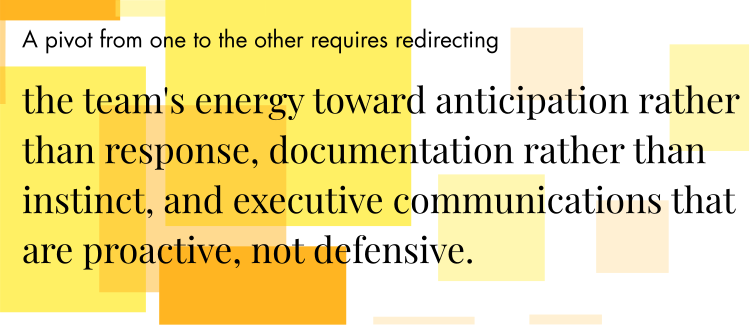 The generational shift currently under way in the FM workforce may accelerate this transition naturally. A cohort that has grown up with data-driven decision-making as a default expectation is likely to more readily recognize FM leadership is as much about information architecture and executive communication as it is about operational expertise.
From responder to go-to partner
Return to that opening scenario: the FM director in the meeting room, the executive across the table, the risk that has just surfaced.
What happens in that room – what the FM brings, how they frame it, what kind of conversation follows – is shaped by decisions made long before that moment.
While the five approaches outlined here are not a transformation program by any means, they are a series of incremental operational and communicative shifts that, from the executive's vantage point, position the FM as a qualitatively different kind of partner.
For the FM, behavioral and operative shifts take time, but can be reinforced by asking themselves these four simple questions before engaging a circumspect leadership:
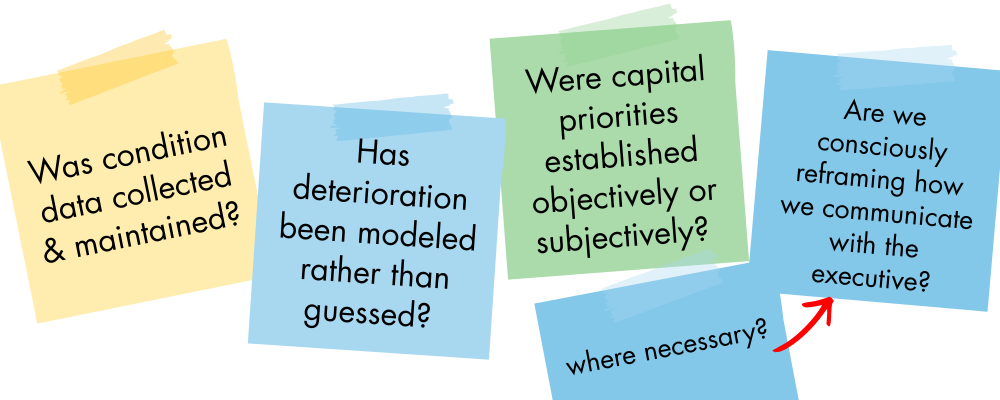 If the answer to any of these positions sounds reactive over proactive, it might be time to reframe it, and to make an emergency legible and the response proportionate.
And where FMs cannot realistically reframe the conversation if data or process does not exist, the team can begin building trust by explaining how they will be proactive moving forward.
The FMs that do will earn the trust to resolve crises with little intervention or oversight; and, over time, make them increasingly rare.
That is what trusted partnership looks like in practice. It begins the moment a risk surfaces, and the FM is the one person in the room who is not surprised.

Austin Rabine is the co-founder and CEO of SITE technologies. He drives innovation in property assessment technology and national facility maintenance. Before co-founding SITE Technologies, he held leadership roles in his family’s business, Rabine, within project management, operations, sales and strategy, gaining a deep understanding of the facilities/construction industry. Rabine is passionate about leveraging technology to help property owners assess, prioritize, and budget for their portfolios with greater efficiency. He also serves on the board of the Cheryl Rabine Foundation, Judson Universities World Leaders Forum, and is a member of the Young Presidents’ Organization.
References
Top image via Getty Images.
Read more on Leadership & Strategy and Communication or related topics Strategic Planning , Communication Skills , Influencing and Operational and Capital Budgeting
Explore All FMJ TopicsRelated articles
-

Artificial Intelligence in FM
The stakeholder’s perspectiveBy Dr. Jake Smithwick & Dr. Kenneth Sullivan & Nneka Ubi05.01.2024 -

Mastering Change in Hybrid Environments
Insights from global operational leadersBy Meg Swanson09.02.2024 -

Plugged In
Solving the data disconnect in real estate and FMBy Amanda Muzzarelli & James Waddell07.01.2024