
 Membership
 Network
 Regional Sites & Affiliates


 Events
 Participate
 Resources

 Training
 Credentials
 Government


 Content Channels
 Tools
Tools


 Business Overview





On the Rocks
Identifying & addressing indicators of trouble in FM supplier relationships

Facility management supplier relationships rarely collapse without warning. The failure that surfaces in a contract dispute or a service credit battle typically began months earlier — in a missed response time, a quietly reassigned account manager, or a governance meeting where no one asked the difficult questions. The challenge for FMs is not recognizing a broken relationship. It is recognizing one that is breaking.
Five early-warning scenarios drawn from common patterns in outsourced FM relationships organize the discussion. Each reflects a signal, not yet a crisis, and each carries a practical course correction before the damage compounds.
 An FM at a large corporate campus has observed inconsistencies in the way service complaints from building occupants are addressed. Some are resolved quickly. Others cycle through multiple contacts without resolution, eventually arriving at the FM’s desk days after the fact. The supplier's frontline team is responsive but issues that require cross-functional coordination or supplier-side decisions seem to stall.
Diagnosis: A single issue reaching the FM director's desk is not a signal, it may simply reflect the severity of that specific situation. The pattern to watch is frequency. When escalation becomes the default path rather than the exception, the resolution structure below it has stopped functioning.
Healthy supplier relationships depend on clearly defined resolution tiers: what gets handled at the operational level, what escalates to account management, and what requires executive attention. When that structure is unclear or untested, issues migrate upward by default, consuming senior time on problems that should resolve at the first tier and leaving occupants waiting.
Course correction: Map the current escalation path explicitly. If it exists only in the contract and has never been practiced, schedule a tabletop exercise with the supplier's account team to walk through realistic scenarios. Establish response time expectations at each tier and build a brief monthly review of escalation volume and resolution time into existing governance meetings. The goal is not bureaucracy; it is making the path visible before it is needed urgently.
 A regional FM lead notices that interactions with a key supplier have gradually narrowed. The monthly governance meeting happens reliably. Reports arrive on schedule. But day-to-day engagement — informal problem-solving, proactive updates, site walkovers — has largely disappeared. The supplier shows up when required and is otherwise absent.
Diagnosis: Reduced contact is not inherently a problem — a high-performing supplier in a stable contract may require less frequent touchpoints. The distinction is trajectory: engagement that has narrowed over time, particularly when combined with slower response to informal requests, points to drift rather than efficiency. This pattern, sometimes called relationship drift, is common in mature contracts where the initial implementation energy has dissipated. It is not necessarily a sign of poor intent. It may reflect supplier resource constraints, internal restructuring, or simply a relationship that has been allowed to become transactional. The risk is that by the time a real problem surfaces, the working relationship lacks the depth to address it quickly.
Course correction: Reintroduce structured informal touchpoints that exist outside the governance calendar. Joint site walks, quarterly relationship reviews that include voice-of-customer feedback from building occupants, and brief weekly check-ins with the account manager can rebuild working familiarity. FM teams should also consider whether the contract's engagement requirements reflect current expectations — if daily or weekly contact is operationally necessary, that expectation should be explicit.
 A facility team is managing a persistent issue with preventive maintenance completion rates. The supplier's reports show tasks completed. The client-side building data suggests otherwise. When the discrepancy is raised, the response is a sequence of partial explanations: the work order system did not sync correctly, the client team did not confirm access, the data pull was from the wrong reporting period. Nothing is wrong, exactly — and nothing is resolved.
Diagnosis: A single data discrepancy is a data problem. The signal is the response pattern. When every gap in performance produces a sequence of partial explanations with no single owner and no resolution, the relationship has normalized avoidance of accountability. This does not always indicate bad faith. Often it reflects ambiguity in the contract about who owns specific outcomes, or a lack of clear data standards that makes verification difficult. Left unaddressed, it normalizes a dynamic where problems are explained rather than owned.
Course correction: Return to the contract and clarify ownership for the specific performance area in dispute. If the language is genuinely ambiguous, negotiate an addendum rather than operating on informal understandings. Establish a shared data standard for the metric in question — both parties should draw from the same source. Consider adding a joint monthly data reconciliation step until confidence is restored. The objective is not to assign blame retroactively, but to make accountability structural rather than conversational.
 An FM working with a long-term integrated services supplier realizes that over the past year, the account manager has changed twice, two senior technicians with deep building knowledge have departed, and onboarding new supplier staff has become a recurring drain on the client team's time. Each change is explained individually — a promotion, a resignation, a restructure. Collectively, they represent something more significant.
Diagnosis: One staff transition, even a senior one, is operational noise. The signal is pattern and pace: multiple departures across different roles within a compressed timeframe, particularly when institutional knowledge walks out with each one, indicates something systemic rather than coincidental. Supplier-side staff turnover is one of the most underrated early warning signals in FM relationships. Institutional knowledge of a building's systems, its occupant quirks, its undocumented maintenance history lives in people. When it walks out the door repeatedly, service quality typically degrades behind the scenes before it degrades visibly. High turnover can also signal internal conditions at the supplier that will eventually affect the client relationship: low morale, management instability, or difficulty retaining talent at the compensation levels the contract supports.
Course Correction: Raise the pattern directly with supplier leadership — not to threaten, but to understand. Ask whether the contract's staffing model is viable given current labor market conditions. Review whether key person provisions exist in the contract and whether they carry meaningful consequences. Consider building a knowledge transfer requirement into the contract: before a named account resource transitions off, a documented handover period should be mandatory.
 At contract signing, a supplier committed to a suite of technology-driven improvements: a new integrated workplace management system (IWMS) module, predictive maintenance analytics, and quarterly innovation reviews. Eighteen months in, the IWMS module is partially deployed. The analytics capability has been discussed in three governance meetings with no implementation timeline. Innovation reviews were held twice and then quietly dropped from the agenda.
Diagnosis: A delayed implementation milestone is not unusual in complex technology deployments. The distinction is whether the delay has a visible owner, an active timeline, and genuine momentum or whether it has become a topic that appears on governance agendas without ever advancing. The innovation gap is not always a supplier failure. Sometimes the client organization was not ready to absorb the changes. Sometimes the contract's commercial structure did not create sufficient incentive for the supplier to invest. Sometimes commitments made during the sales process were not translated into binding contract language. Whatever the cause, an unfulfilled innovation agenda erodes trust and wastes the strategic potential of what may otherwise be a functional relationship.
Course correction: Conduct a structured review of all innovation commitments made at contract inception. For each, establish status, identify the barrier to progress, and agree on a realistic revised timeline or a formal acknowledgment that the commitment is being retired. Future innovation commitments should be written into the contract with specific milestones, resource requirements, and consequences for non-delivery.
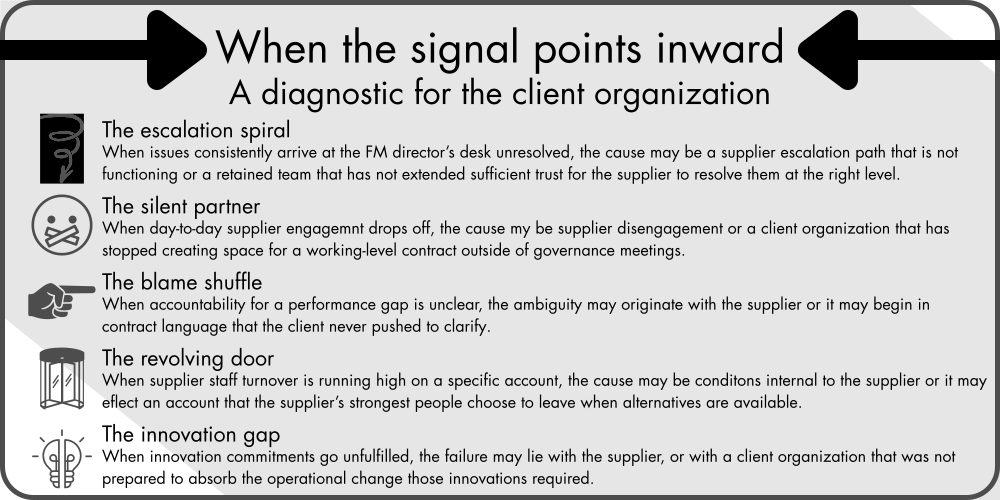 Who owns the relationship?
Early warning signals often go unaddressed not because they are unseen, but because responsibility for acting on them is unclear. In many organizations, supplier relationships sit at the intersection FM, procurement and sometimes a dedicated vendor or third-party management function. Each group has legitimate involvement, and each may assume another is watching the relationship closely. The result is that accountability for relationship health falls into the same gap it is meant to prevent.
FMs are often best positioned to detect the operational signals — escalation failures, the effects of turnover, and innovation gaps show up in practice before they show up in reports. That proximity carries a responsibility: regardless of where contract ownership formally sits, the FM team should maintain an active, documented view of relationship health and raise concerns through whatever governance structure exists. Procurement and third-party management functions bring contractual leverage and commercial perspective that FM teams may lack. The most effective approach treats these as complementary roles rather than competing ones, with clear agreement upfront about who monitors what and who initiates a conversation when a signal appears.
 What these signals have in common
Each of the five scenarios shares a structural characteristic: the problem is visible before it becomes a crisis, but only to someone looking at the right data with the right frequency. Escalation path failures show up in resolution time trends. Relationship drift shows up in contact frequency logs. Accountability gaps show up in data reconciliation discrepancies. Turnover shows up in staffing records. Innovation gaps show up in meeting agendas.
Strong governance is often discussed as the mechanism for addressing problems. Its more valuable function is earlier: catching the signal while a course correction is still relatively painless. A governance structure that meets quarterly and reviews aggregate performance data will miss most of these signals entirely. One that maintains regular working-level contact, tracks leading indicators alongside lagging ones, and creates space for honest conversation between governance meetings will catch them early.
 Keeping the relationship healthy
FM supplier relationships are long-term commitments operating in environments that change constantly: occupancy shifts, budget pressures, labor markets, technology evolution. No contract written at signing perfectly anticipates what the relationship will need at year three or year five. The organizations that maintain strong supplier relationships over time are not the ones with the most legally precise contracts. They are the ones that treat the contract as a foundation and the relationship as something that requires ongoing attention.
The five early signals are starting points, not an exhaustive diagnostic. Each FM organization will develop its own pattern recognition over time, the specific indicators that, in their environment, reliably predict a relationship heading toward difficulty. The practice of looking for those signals, naming them clearly when found, and addressing them as course corrections rather than confrontations is what keeps partnerships productive across the full arc of a contract life cycle.

Amanda Muzzarelli is a global real estate and facility management executive whose career spans both enterprise leadership and independent consulting. In consulting roles, she has advised multinational enterprises on supplier transition strategy, integrated FM procurement, and operating model modernization. Her perspective on FM supplier relationships draws from both sides of the table: as a senior leader managing complex outsourced ecosystems, and as an advisor helping organizations design the governance structures that determine whether those ecosystems perform. Muzzarelli serves as President of the Central Illinois Chapter of IFMA and is a member of IFMA's Workplace Evolutionaries community.
References
Top image via Getty Images.
Read more on Leadership & Strategy , Communication and Facility Operations or related topics Supplier or Vendor Management , Communication Management and Operations and Maintenance Planning
Explore All FMJ TopicsRelated articles
-

Artificial Intelligence in FM
The stakeholder’s perspectiveBy Dr. Jake Smithwick & Dr. Kenneth Sullivan & Nneka Ubi05.01.2024 -

Mastering Change in Hybrid Environments
Insights from global operational leadersBy Meg Swanson09.02.2024 -

Plugged In
Solving the data disconnect in real estate and FMBy Amanda Muzzarelli & James Waddell07.01.2024