
 Membership
 Network
 Regional Sites & Affiliates


 Events
 Participate
 Resources
 Training
 Credentials
 Government


 Content Channels
 Tools
Tools


 Business Overview





Operational Entropy
Why high-performance buildings drift after certification
Every building begins as an idea.
Long before the first foundation is excavated, hundreds of people imagine what the building could become. Architects, engineers, owners, manufacturers, contractors and sustainability professionals spend years translating vision into reality, line by line, wall by wall, system by system. A building is shaped through an investment of creativity, resources and human effort. Natural materials are extracted, transformed, transported and assembled into places designed to serve people for decades. This effort is guided by ambitious environmental goals: reducing carbon, conserving water, improving indoor environmental quality (IEQ), minimizing waste and creating healthier places to live and work.
By the time a high-performance building is completed, countless decisions have balanced performance, durability, cost, constructability and occupant well-being. Manufacturers have invested in cleaner production, designers have optimized systems, and contractors have coordinated complex installations. Certification recognizes the success of a herculean collective effort, captured at a specific moment in time.
Yet that moment is not the end of the story.
Defining operational entropy
Buildings are not static objects. They are living environments inhabited by people whose needs, expectations and behaviors continually evolve. Spaces are reconfigured, and equipment is replaced. Occupants adjust thermostats, request brighter lighting, install personal appliances and reorganize workspaces. Facility management teams respond to service calls, procurement staff navigate supply chain disruptions, and contractors substitute products. Organizations experience new leadership, staff turnover and shift priorities.
None of these actions are inherently wrong. Most are thoughtful responses to immediate operational needs. Individually, they improve comfort, reduce downtime, control costs or keep a building functioning effectively. Collectively, however, they reshape how that building performs and, in essence, what the building is.
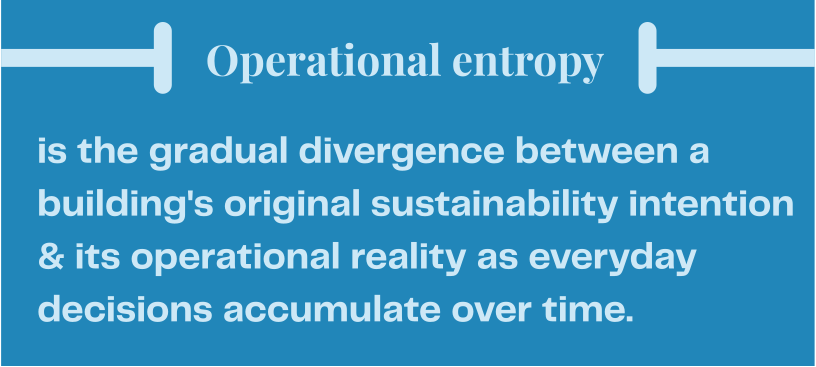
Unlike mechanical failure, operational entropy is rarely dramatic. It emerges quietly, through thousands of reasonable choices made over years of operation. A temporary override becomes permanent. A flooring specification changes mid-renovation. A green-certified floor cleaner is replaced. Documentation disappears during staff turnover. An occupancy sensor is disabled after repeated comfort complaints. Each decision solves today's problem, but each also moves the building away from the performance it was originally designed to achieve.
The true measure of a high-performance building is therefore not the day it graduates to a “sustainable building.” It is how faithfully that original “knowledge” is preserved as the building adapts to the people, organizations and operational realities it was created to serve.
Every replacement is a design decision
Operational entropy does not emerge only through building systems. It is equally shaped by the quieter decisions surrounding the materials that enter, leave and evolve throughout a building's life. Certifications, for example, momentarily portray the materials installed on day one. FM governs every material decision made afterward.
Consider a water leak that damages a section of carpet. The original product may have been selected for its low embodied carbon, low-emitting emissions, manufacturer take-back program and fair labor practices. Yet when it comes time to replace it, sustainability is often only one of several competing priorities: the space must reopen quickly, occupants need to return, budgets are constrained, and the original product may no longer be available. A readily available carpet with petroleum-based backing becomes the practical choice.
The decision is understandable. It restores operations. However, it may increase embodied carbon, introduce different material chemistries, eliminate future recycling opportunities and alter (IEQ). None of those outcomes were intentional. They simply became secondary to getting the space back in service.
The same pattern repeats throughout the building's life. Ceiling tiles are discarded during lighting upgrades because no process exists to evaluate reuse. Furniture is replaced during workplace reconfigurations instead of being refurbished or redistributed. Cleaning products change when procurement contracts are renewed. Paints, adhesives, sealants and flooring are substituted because they are available sooner or cost less. Individually, these decisions seem insignificant. Collectively, they redefine the environmental performance of the building.
Finding value in reuse
Within this cycle of replacement, there are often overlooked opportunities to retain value already embedded in the building. Doors are a compelling example. During renovations, they are frequently removed to accommodate new layouts. Conventional practice often assumes replacement. Yet many doors can be carefully dismantled, resized, refinished or rehung elsewhere in the building. Reusing a single door can avoid approximately 300 kilograms of embodied carbon while reducing replacement costs by roughly 30 percent. Across dozens or even hundreds of doors, the environmental and financial benefits become substantial. More importantly, reuse preserves value that already exists instead of creating demand for new materials.
Raised access flooring presents a similar opportunity. Technology upgrades, tenant reconfigurations and infrastructure improvements frequently require floor panels to be lifted. Too often, reusable panels are treated as demolition debris instead of valuable building assets. Cataloging, storing and redeploying those panels transform waste into inventory while preserving both embodied carbon and financial value. The same mindset can apply to ceiling systems, partitions, lighting components and many other elements designed for disassembly.
These examples reveal an often-overlooked reality. Embodied carbon is not managed only during design and construction. It is managed throughout the operational life of a building.
Operational stewardship begins when material replacement is no longer viewed as routine maintenance, but as an opportunity to extend the life, value and environmental performance of the resources already entrusted to the building.
Change is the natural life cycle
Buildings are not pieces of art preserved behind sealed glass.
They crack. Roofs leak. Mechanical systems reach the end of their service life. Flooring wears. Sealants fail. Finishes become dated. Technology evolves faster than the buildings that house it. Renovations, repairs, replacements and reconfigurations are not exceptions. They are the natural life cycle of every building.
High-performance buildings are no different.
In many ways, their greatest strength is their ability to adapt. As the people and organizations within it evolve, so must the spaces themselves. New ways of working reshape floor plans, advancing technologies drive system upgrades, and changing expectations around comfort, flexibility and wellness influence how spaces are used. Buildings are expected to respond continuously to these shifting demands.
Every adaptation requires a decision. Some are technical. Others are financial, operational or organizational. Most are made with incomplete information and under real constraints: limited budgets, compressed schedules, staffing shortages, supply chain disruptions or the need to restore operations quickly. Rarely are these decisions intended to reduce sustainability performance. Yet every one of them has the potential to reshape it.
Operational entropy is therefore not the result of negligence. It is the natural consequence of well-intentioned decisions made by people responding to immediate needs.
People are, in many ways, entropic beings. They personalize spaces, solve immediate problems and make decisions within the constraints of time, budget and availability. But those individuals are constantly changing — staff turns over, institutional knowledge fades and organizational priorities shift. Technologies evolve and eventually become obsolete. The building remains, but the system of people responsible for it is always in flux.
Where operational stewardship begins
The question is no longer how to prevent change. It is how to ensure that change continues to honor the environmental and wellness goals that shaped the building from the beginning.
This is where operational stewardship begins.
Operational stewardship recognizes that sustainability cannot be preserved through design alone. It depends on the continuity of decisions made years after occupancy, during maintenance, procurement, renovations, repairs and everyday operations. The goal is not to prevent evolution, but to guide it.
That guidance depends on decision continuity: the deliberate practice of carrying forward the principles behind the original design intent, even as materials are replaced, systems are upgraded, spaces are reconfigured and organizations evolve.
It shifts the question from, "What is the quickest solution?" to "How can this necessary decision meet today's operational needs without eroding the building's long-term optimal performance?"
Viewed through this lens, FMs do far more than operate buildings. They become stewards of sustainability and resilience.
The enduring measure of a building
Change is the only certainty. Every building will evolve.
Materials reach the end of their service life. Systems are upgraded. Organizations evolve. New technologies advance. Occupants need change. New operational challenges emerge. Change is not the enemy of sustainability. It is the inevitable condition of every building that remains useful over time.
The question is not whether high-performance buildings will evolve. The question is whether each decision made throughout that evolution continues to honor the vision that shaped the building from the beginning.
Operational entropy can never be eliminated. It should be acknowledged and embraced as the natural consequence of placing buildings in the hands of people, organizations and the realities of everyday operation. Its effects can be managed. Every procurement decision, renovation, repair, material replacement and operational adjustment presents an opportunity either to preserve or to erode long-term environmental performance.
This is the essence of operational stewardship. And facility managers hold the reins.
Through thousands of decisions, many routine, many urgent and often invisible to others, they determine whether sustainability remains embedded in the building or gradually gives way to operational entropy.
Perhaps the greatest measure of a high-performance building is not how it performs on the day it is certified, but how faithfully its purpose endures decades later.
The most enduring sustainability strategy is not found in a specification, technology or plaque. It is found in the people who preserve the building's intent long after construction is complete.

Katia Lucuy is a sustainability and materials technology expert with a focus on improving interior environments through innovative, bio-based materials. She has extensive experience in LEED, Fitwel, WELL projects and embodied carbon calculations, specializing in life cycle assessments for interior and building projects. Her work has led to significant reductions in embodied carbon, achieving 20-70 percent reductions in multiple sustainability projects. Lucuy collaborates closely with manufacturers to stay at the forefront of sustainable technologies, materials and their impacts on human health. Her expertise includes advising clients on integrating sustainable materials into design and construction, helping them meet their ESG goals. Lucuy's deep understanding of sustainable design practices and commitment to healthier, carbon-conscious interiors make her uniquely positioned to drive the implementation of bio-based materials for carbon-lean interiors.
References
Top image via Getty Images.
Read more on Sustainability , Real Estate and Leadership & Strategy or related topics Sustainable Facility , Strategic Planning and Real Estate Management
Explore All FMJ TopicsRelated articles
-
Smart Building Control Systems
The foundation for a grid-interactive buildingBy Andre Marino09.25.2024 -

Smart Building Innovation
Cutting costs & carbon footprints without compromiseBy Andrew Butterworth09.12.2024 -
Chart the Path
Building sustainable cities & a sustainable futureBy Izzat Ali Khan & Aykean Forde12.16.2024