Membership
 Network
 Regional Sites & Affiliates


 Events
 Participate
 Resources

 Training
 Credentials
 Government


 Content Channels
 Tools
Tools


 Business Overview





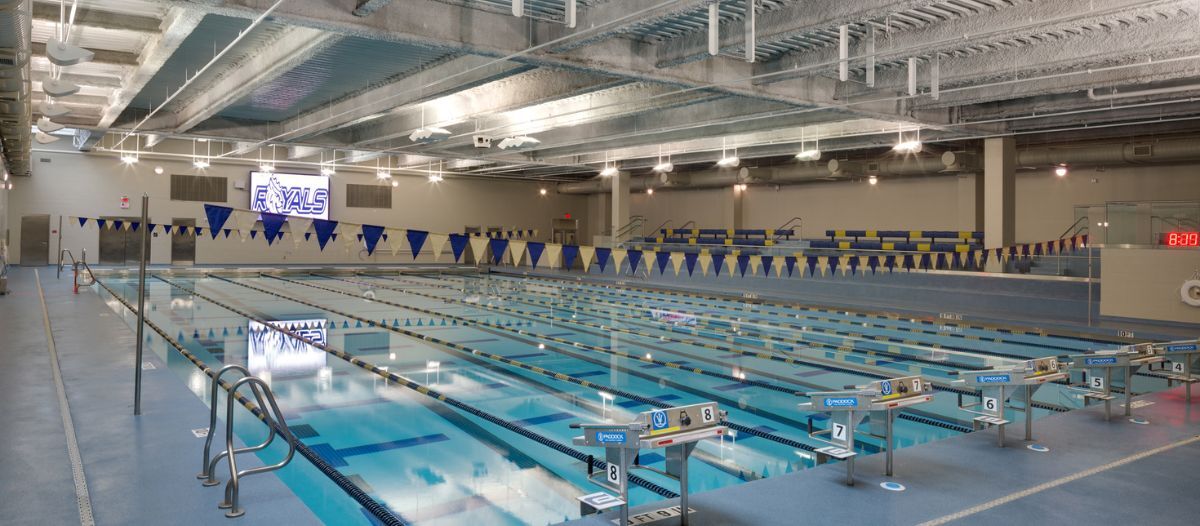
Indoor swimming pools are great methods of recreation, however when their indoor air quality is improperly designed or maintained, they can also adversely affect the human condition.
Like many commercial buildings, natatoriums can suffer from Sick Building Syndrome, a phenomenon IAQ experts blame on tight, energy-conserving construction techniques combined with subpar ventilation designs.
An Internet search can reveal a list of ailments caused by indoor pools. Lifeguard lung (granulomatous pneumonitis), for example, poses health risks for facility employees, who spend the majority of their work hours in natatoriums. However, asthma and other respiratory irritants can also be exacerbated by poor IAQ indoor pool environments.
Even swimmers with less exposure time than facility workers are not immune to poor IAQ. During the 2013 USA Winter Junior National Championships, future Olympic gold medalist Caeleb Dressel was transported to an emergency room with breathing difficulties from facility IAQ problems, according to a report by Swimming World Magazine. Competitive swimmers often pack inhalators with their swimming gear because it’s never known what airborne contaminants are at an indoor pool.
Indoor pools: A short history
Indoor pools built prior to 1975 typically didn’t suffer this degree of IAQ problems. Ventilation systems were supply and exhaust with little or no recirculation, therefore the entire space had a complete air change in a relatively short time. Unfortunately, all the heat generated from space and pool water heating was wastefully exhausted too, which made these facilities extremely expensive to operate.
The advent of the mechanical indoor pool dehumidifier in the late 1970s changed indoor pool design methodology. This technology also offered a solution complementing that era’s budding energy conservation goals while providing better control of the space temperature and relative humidity. Instead of exhausting all the air, dehumidifiers recirculated a majority of air while using refrigeration coils to condense moisture out for better relative humidity control and occupant air comfort. Like today’s models, the dehumidifiers could dehumidify, cool and heat the space more efficiently than preceding methods.
They also efficiently used refrigeration circuit compressor waste heat to provide free pool water heating. Later models energy-efficiently recovered heat from exhaust air to preheat increased amounts of incoming outdoor air recommended for commercial buildings by the American Society of Heating, Refrigerating and Air-Conditioning Engineers Standard 62.1 Ventilation for Acceptable Indoor Air Quality.
The main factor causing indoor pool breathing problems is chloramines. Chlorine sanitizes pool water, but when it chemically binds to body waste such as sweat and urine, it converts to a heavy gas called chloramines that stratify on the water’s surface in the swimmers’ breathing zones, according to The Centers for Disease Control and Prevention.
The CDC recommends an HVAC system to move fresh air across the water’s surface, exhaust chloramines and bring in more outdoor air. Many indoor pool ventilation designs or their mechanical dehumidifier maintenance routines fall short when chloramines stratify for extended periods.
Recruiting a winning swim team with IAQ
The U.S. Environmental Protection Agency and Occupational Safety and Health Administration are looking for answers to Lifeguard Lung and other indoor pool respiratory health issues. The lead counsel of the U.S. Senate Environment and Public Works Committee, Washington D.C., met last year with Jeff Dugdale, the men’s and women’s swim coach of Queens University, a small 2,300-student private college in Charlotte, North Carolina, USA. The committee, as well as the EPA and OSHA, have shown an interest in QU’s nine-year-old pool and why its IAQ is reportedly one of the nation’s best.
Dugdale helped spearhead the 7,500-square-foot pool’s design when QU built its US$30 million, 144,000-square-foot Levine Center for Wellness and Recreation. He uniquely uses the QU pool’s IAQ as a recruiting tool for one of the NCAA’s most successful swim programs.
IAQ is subjective, but Dugdale’s swim team record is factual. Although it’s a Division II school in the Blue Grass Mountain Conference, QU successfully uses IAQ to recruit Division I level swimmers from around the world. Visiting parents of recruit candidates from across the globe, especially those who regularly used inhalators at their high school swim meets, immediately notice QU’s superior IAQ and great water quality inside the pool area, according to Dugdale.
How QU created the ultimate IAQ
The 33-meter stretch pool’s IAQ was designed by Lea Burt, P.E., CEM, president of Mechanical Contractors Inc., of Charlotte, the design/build HVAC contractor for the entire Levine Center.
While many engineers may never design an indoor pool, Burt had previously designed several natatoriums. That experience was what Dugdale and Troy Luttman, AIA, campus architect and associate vice president of design and construction, needed to build what’s arguably one of the world’s best indoor pools today.
A successful natatorium environment with good indoor air quality is based on five principles:
-
proper building materials and building envelope design;
-
effective air distribution;
-
the right mechanical HVAC equipment,
-
source capture of chemical gasses at the water surface; and
-
pool water chemistry.
The latter discipline is more of a facility operations and maintenance issue than design concern. Good natatorium design is easily accomplished, according to Burt, if the design team follows the recommendations and precautions of Chapter 25 (“Mechanical Dehumidifiers and Related Equipment”) in ASHRAE’s Systems and Equipment Handbook.
Knowing the dangers of poor IAQ, the design team insisted during construction meetings that cutting costs on critical items was not optional. Anti-corrosive building materials, expanded supply and return air distribution coverage, source capture and state-of-the-art mechanical equipment would help create the ultimate IAQ. The team made several educational presentations during the project’s value engineering period to point out why certain building materials, designs and equipment were essential for project success and also used evidence of IAQ failures in other pool designs.
Building envelope & materials
Burt collaborated with the project architect on the choice of building materials and assured certain installation techniques were applied properly. For example, Burt lobbied against the use of glass in the design, which adds a nice aesthetic, but attracts condensation. Another architectural precaution is assuring the vapor barrier envelopes the entire building pool area to prevent moisture migration. The contractor must install it without tears or broken seams, which can allow moisture exposure to attack the building’s structural materials.
Air distribution
Air distribution is equally important, because conditioned air must be dispersed down to the breathing zone at deck level and pool surface level. Ideally, ductwork must be positioned approximately one foot away from exterior walls and windows to assure proper coverage that will prevent condensation. Return air is critical too. Burt recalls design committee value engineering conversations that would consolidate return air coverage, which can result in air stratification and short circuiting.
Source capture
Burt minimized chloramines accumulation at QU by specifying six volumetric air changes per hour of supply air and combining it with a source capture exhaust device that’s integrated into one side of the pool gutter system. The 4,500-CFM source capture exhaust system draws chloramines off the water surface and exhausts them through a heat reclaim system Burt custom designed. The system extracts energy from the source capture unit’s energy-rich exhaust airstream just prior to exhausting outdoors. The recovered energy is then used for pre-heating outdoor air. Because the heat reclaim system also uses a refrigeration coil to condense moisture, Burt recommends careful supervision of the mechanical room floor for proper slope and drainage. If a condensate drain line becomes blocked, an installed sensor/alarm system warns the maintenance department of the situation.
Outdoor air code requirements for acceptable indoor air quality usually follow ASHRAE Standard 62 guidelines, which have a baseline of 0.48-CFM per square foot for a conventional pool water surface area and the deck area. Pools with spectator seating, such as QU, should add 7.5-CFM per spectator during events. Swimmers aren’t considered spectators and they are covered by the baseline calculation. Increasing outdoor air beyond the minimum requirement will significantly raise energy costs and not necessarily improve the air quality. If the air distribution is designed well, the code-required outdoor air is ample for good IAQ. Adding more outdoor air can’t fix a poor ventilation design. Getting the air distribution right not only results in optimum IAQ, but it can also help minimize operating costs.
Exhaust air is equally as important. Natatoriums run at a slightly negative pressure of 0.05 to 0.15-w.g., so that humid, chemical-laden air isn’t pushed outside the natatorium into other portions of the building. Generally, exhaust air should be 10 percent CFM more than the incoming outdoor air CFM to maintain a negative pressure in the space. Source capture exhaust devices can also figure into the overall exhaust air in the form of direct exhaust or it can be channeled into the dehumidifier for heat recovery and energy-efficient pre-conditioning of the incoming outdoor air.
Equipment sizing
Any natatorium project needs proper sized HVAC equipment. Knowing the pool’s future activities was critical for Burt’s equipment sizing. Dugdale, who is also QU’s associate athletic director, head swim and aquatic director, requested 54 percent RH supplied by a dehumidifier. He also wanted a heat recovery dehumidifier with free pool water heating to 80 F, while also cooling or heating the space to 76 F. That four-degree differential is quite a deviation from ASHRAE’s recommended two-degree differential between water and space temperature to minimize evaporation rates. These unorthodox set points certainly work, but result in higher evaporation rates that must be planned for during the design phase to properly size the mechanical equipment and maintain a space that’s comfortable for both swimmers and spectators.
In QU’s case, it uses two 24-ton dehumidifiers that were purposely configured to be piggy-backed together for cramped mechanical rooms. This makes staging easier and energy efficient, whether there’s a swim meet with hundreds of people or just an off-hours practice with a few swimmers. Specifying two units also offers redundancy. Dugdale said his teams have never missed a practice due to a natatorium shutdown.
Pool water chemistry is typically a facility operations and maintenance issue, rather than a design consideration, but the consulting engineer should always monitor what water sanitization devices are implemented in the design. For example, UV water purification technology or other secondary water sanitation alternatives for reducing chlorine use and subsequently chloramines, could be suggested as part of the pool support equipment. Dugdale is so tuned into the IAQ, he instills a “culture of IAQ” which even emphasizes swimmer personal hygiene in and out of the pool, to help maintain a healthier IAQ. Showering before entering the pool not urinating in the pool all give the pool water chemistry a head start to work properly.
Another tip from Burt is keeping combustion equipment, such as back-up pool water boilers, separate from chlorine equipment. If there is free chlorine in the air that boilers use for combustion, premature corrosion can occur. Close attention should be paid to ventilation air in mechanical rooms and the elimination of chlorine-base product storage and chlorine equipment, according to Burt.
Finally, Burt recommends focusing on condensate management and chlorine corrosion in a natatorium’s design phase and paying close emphasis on every detail of those issues during construction and commissioning.
Designing a good pool environment is only half the task. Burt also specified a dehumidifier that incorporates internet access, remote monitoring and analyzation through web-based browsers. Therefore, factory service professionals can access the equipment for adjustments, recalibration or troubleshooting to keep the unit operating efficiently and maintain the natatorium air comfort via PCs or smartphones. Factory technicians through remote monitoring can also help Burt’s service technicians troubleshoot when service issues arise.
Properly designing and maintaining a natatorium is critical to presenting a healthy recreational facility environment.

Ralph Kittler, P.E., is vice president of sales at Dehumidified Air Solutions Montreal, Quebec. Kittler is the co-founder and former vice president of sales/marketing at Seresco Technologies, an Ottawa-based mechanical dehumidifier manufacturer brand of DAS. Kittler, is an ASHRAE Distinguished Lecturer and the reviser responsible for Chapter 25 (“Mechanical Dehumidifiers and Related Equipment”) for ASHRAE’s 2012 Systems and Equipment Handbook. Kittler recently created a video that qualifies as a Professional Design Hour (PDH) continuing education credit for HVAC engineers, facility managers and contractors.
References
Top image courtesy of DAS-Montreal.
Read more on Facility Operations or related topics Operations and Maintenance Planning and Occupant Health
Explore All FMJ Topics