
 Membership
 Network
 Regional Sites & Affiliates


 Events
 Participate
 Resources

 Training
 Credentials
 Government


 Content Channels
 Tools
Tools


 Business Overview





Property Resilience Assessments
A business imperative
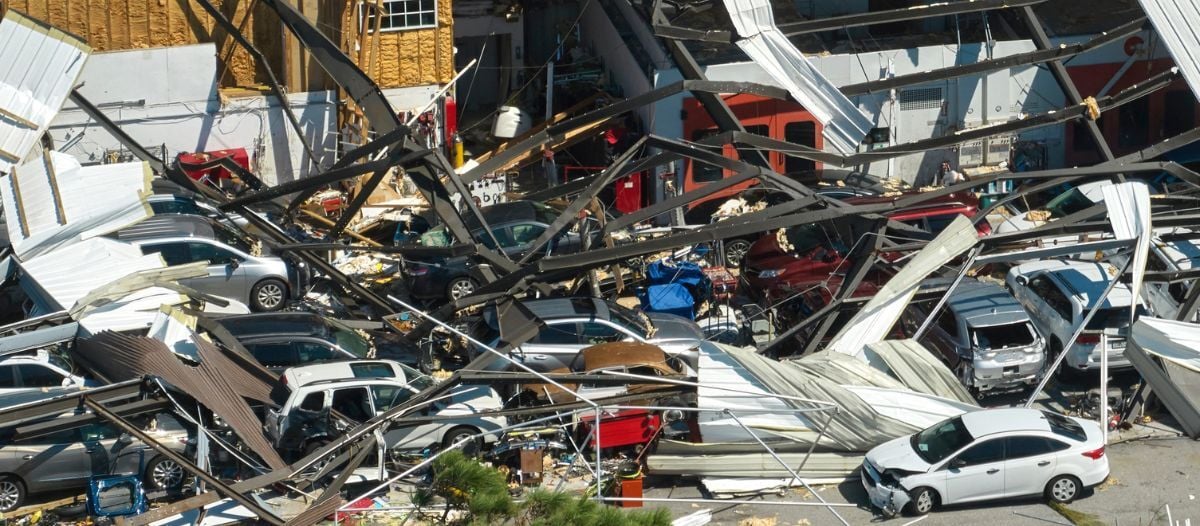
For decades, disaster planning focused on one question: How quickly can an organization get back up and running after a disruption? Today, the question is different: How can a property withstand disruption in the first place?
What is behind that shift – extreme natural disasters – is driving demand for property resilience assessments. PRAs evaluate how vulnerable a building or site may be to physical risks including flooding, wildfire, extreme heat, severe storms, drought, sea level rise, seismic activity and others, and identify practical steps owners can take to reduce those risks before a disaster occurs.

The World Economic Forum reports extreme weather remains one of the most significant long-term global risks facing businesses and communities. At the same time, global insured losses from natural catastrophes are rising, putting pressure on insurers, reinsurers and ultimately, property owners.
Insurance markets are tightening. Lenders are paying closer attention to climate-related risks. Investors increasingly expect companies to understand and disclose how physical hazards could affect assets and operations. The leading motivator for property and site resilience has moved from regulatory mandates to financial pressures.
The insurance market bellwether
 Concerns about the financial impact of natural hazards have influenced insurance markets for decades. A 1985 FEMA study, updated in 2003, of six central U.S. cities vulnerable to the New Madrid Seismic Zone, modeled earthquake scenarios and was one of the first to quantify likely building damage, casualties, utility failures, transportation disruption, hospital impacts and economic consequences. The update reported:
“The original six cities study was an important report because it provided a quantitative assessment, for the first time, that a large earthquake could impact the New Madrid Seismic Zone with ‘widespread disruption, damage and casualties.’ Furthermore, the economic impact of a large earthquake would be staggering at the least.”
As a result of this study, one major insurer pulled out of the central U.S. for 10 years, did not write new policies and cancelled earthquake insurance. There was so much risk they could not find enough re-insurers to cover potential losses.
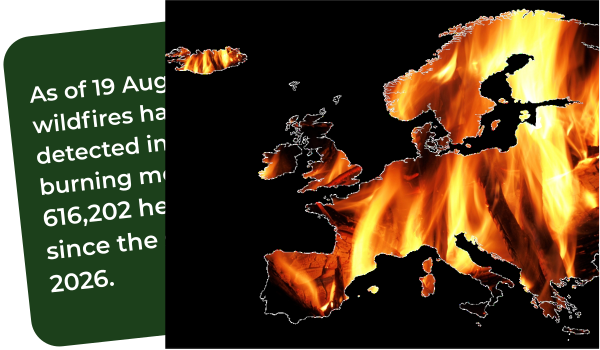
Similar pressures are present today in regions affected by recurring wildfire, flooding, hurricanes and coastal erosion.
In California, several major insurers stopped writing new homeowner’s policies or reduced their exposure because of escalating losses. As private insurers retreat, more property owners turn to the California FAIR (Fair Access to Insurance Requirements) Plan. The California FAIR Plan was established by statute (California Insurance Code sections 10090 et seq.) in August 1968 as an insurance placement facility as the state's insurer of last resort. Premiums and deductibles have risen substantially.
Along the Gulf Coast, insurers have similarly limited exposure or exited markets following repeated hurricane losses, leaving state-backed insurers of last resort with growing policy counts.
To summarize, several factors are driving demand for resilience assessments, including:
-
Insurance availability & affordability: Insurers have reduced exposure in some high-risk markets, particularly in areas vulnerable to wildfire and coastal flooding. The National Oceanic and Atmospheric Administration reports that the U.S. experienced 27 separate billion-dollar weather and climate disasters in 2024 alone.
-
Investors view climate & physical risk as financial risk. Large institutional investors, lenders and rating agencies are evaluating how companies identify, manage and disclose threats to facilities, operations and supply chains.
-
California's Climate-Related Financial Risk Act (SB 261) requires certain companies doing business in the state to publicly disclose climate-related financial risks. Meanwhile, states including Colorado, New York, Oregon and Connecticut have advanced climate resilience, adaptation, infrastructure and risk-assessment initiatives that reflect growing concern over the economic impacts of extreme weather and climate-related hazards.
-
In Europe, climate risk assessments are becoming a routine part of commercial real estate investment, insurance and lending decisions. The European Commission, OECD, and UNEP Finance Initiative all point to growing emphasis on evaluating physical climate risks and improving property resilience as financial institutions, insurers and investors seek to better understand long-term asset exposure.
 Disaster planning evolves
Early emergency planning had a focus on life safety to protect people during fires, hazardous materials releases, natural disasters and other emergencies. Later, as organizations became more dependent on technology, disaster recovery planning came to the forefront to restore data systems and communications after a disruption.
Business continuity planning broadened that approach to sustain operations during disruptions as other enterprise-wide threats such as operational, financial, regulatory, cyber and supply chain vulnerabilities were recognized.
Today, property resilience represents the next step in this evolution. Rather than addressing how quickly a business can recover or continue during a disruption, it asks how structures and infrastructure can be strengthened to better withstand disruption in the first place.
The property resilience assessment
In the disaster life cycle framework, there are four phases of disaster management:
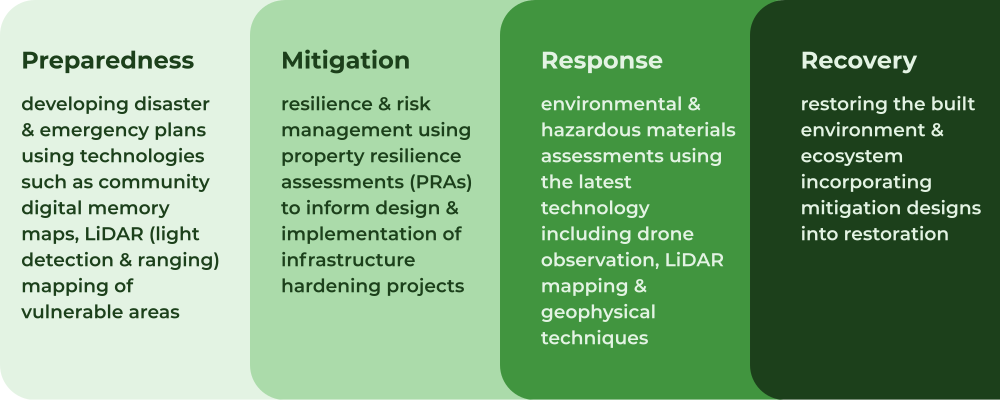
This cycle includes community planning, building code adoption, infrastructure hardening and educating populations on protective actions. This same framework is now applied to commercial and critical infrastructure resilience.
PRAs typically begin with a desktop review. Publicly available information is analyzed to identify potential hazards affecting a site. These may include flood frequency, historical and projected storm activity, wildfire exposure, drought conditions, extreme heat events, seismic hazards and projected climate trends.
The next step takes a closer look at the property itself – existing continuity plans, building systems, structural components, site conditions, utility connections, stormwater infrastructure, backup power and emergency access are evaluated, along with local building codes and regulatory requirements.
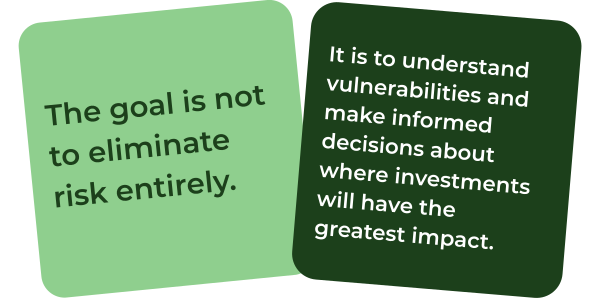
That information is used to develop a risk profile that identifies where the property is most vulnerable, estimates the potential consequences if a hazard occurs, and ranks those risks from highest to lowest priority. The result is a practical roadmap that helps owners focus their investments where they will have the greatest impact on resilience.
A final report (PRA Stage 1-3) often contains an executive summary, hazard maps, photos, site maps, vulnerabilities, a risk matrix, prioritized recommendations, estimated implementation costs and suggested timing, and expected reduction in risk all of which owners can use as a capital planning document.
 Organizations and infrastructure prepared to withstand disruptions are more likely to maintain operations, protect employees, preserve customer relationships and reduce recovery costs. Resilient properties are also likely to be better positioned during insurance renewals, financing discussions and acquisition reviews.
In addition, resilience planning can identify opportunities to improve energy performance, reduce maintenance costs and extend asset life – benefits that deliver value independent of a major weather event.
Perhaps most importantly, a PRA helps answer one of the most difficult questions owners and facility managers face: Where should limited capital dollars be invested first? Rather than treating every deficiency equally, a PRA prioritizes improvements according to the likelihood of a hazard, the consequences of failure and the cost of mitigation. This allows organizations to incorporate resilience into normal capital improvement planning instead of treating it as a separate initiative.
Turning assessment into action
A PRA gives owners and FMs a practical way to make smarter decisions about where to invest their time and capital.
Not every recommendation requires a major project. Some improvements can be made during routine maintenance or as part of planned renovations. Others may involve relocating critical equipment above flood levels, improving site drainage, adding backup power, strengthening the building envelope or creating redundancy in utility systems. The assessment helps identify which improvements will reduce the greatest amount of risk and which can wait.
Capital budgets are tight. Every facility has more needs than funding. A PRA helps prioritize projects based not only on cost, but also on the likelihood of disruption and the consequences if key building systems fail. Instead of reacting to the latest emergency, owners can make investments that improve resilience over time.
The assessment also recognizes that every facility is different. Each hospital, manufacturing plant, office building, distribution center or university campus face different risks and have different operational priorities. The goal is to develop a strategy that reflects how each property is used and what it needs to keep operating.
Few organizations can eliminate every risk. A series of thoughtful improvements made over time can significantly reduce disruption, protect occupants and improve a property's ability to recover when the unexpected happens.
A continuous process
Resilience is ongoing. Hazards evolve, regulations change, infrastructure ages and new technologies emerge. As facilities change through renovations, acquisitions, changes in occupancy or new operational demands, the risks they face change as well. Revisiting PRAs on a regular schedule will encourage noting these changes and updating a plan as needed.
The assessment provides a framework for making informed decisions year after year, helping owners and FMs prioritize improvements, guide capital planning and strengthen assets over time. As conditions change, so should the strategy.
The question is no longer whether disruption will occur. Most organizations assume it will. The challenge is determining whether their properties will be ready when they do.

Andy Hellenthal, PG (TN), National Manager, Terracon Environmental Services I Resiliency Planning, Disaster Response & Restoration, has worked on earthquake preparedness, wildfire risk, flood planning and infrastructure resiliency. His career has included municipal emergency management planning aligned with FEMA standards, helping communities develop seismic building codes, private and public sector emergency response frameworks, business continuity planning and public education programs.
References
Top image and European image via Shutterstock.
Read more on Risk Management and Finance & Business or related topics Risk Management , Business Continuity , Emergency preparedness, response and recovery and Financial Analysis
Explore All FMJ TopicsRelated articles
-

A New Approach
Improving business continuity with alarm managementBy Brad Freeman09.09.2024 -

Beware of Growing Cyberthreats
Why it’s time for stronger facility cybersecurityBy Andrew Harris & Eric Headington10.30.2024 -

Going Up?
Keeping elevators safe & compliantBy Dave Myers & Doug Taylor11.06.2024
