 Membership
 Network
 Regional Sites & Affiliates


 Events
 Participate
 Resources

 Training
 Credentials
 Government


 Content Channels
 Tools
Tools


 Business Overview





Rethinking Demand-controlled Ventilation
What FMs should know

Demand-controlled ventilation (DCV) has long been promoted as a strategy to reduce energy consumption by adjusting outdoor airflow based on occupancy. In practice, many systems rely on carbon dioxide (CO2) levels as a proxy for the number of people in a space.
However, while CO2-based DCV has been widely adopted for decades, its limitations are becoming increasingly apparent — especially as facility managers are expected to deliver energy efficiency and verified indoor air quality (IAQ), occupant comfort and compliance with evolving standards.
Where CO2-based DCV comes from
Although the use of CO2 as an indicator of ventilation dates back 170 years, it was research in the 1980s led by P. Ole Fanger that shaped the modern use of CO2 DCV. His work established relationships among ventilation rates, CO2 concentrations and perceived air quality to unadapted persons as it relates to body odor.
This research informed early versions of ventilation standards, including ASHRAE Standard 62, which associated acceptable IAQ with approximately 1,000 ppm CO2 under typical conditions. It is important to note that this was based on an outdoor air CO2 level of 350 ppm, which has risen to an average of 425 ppm today. As CO2 sensor technology became more affordable in the 1990s, it enabled broader implementation of DCV strategies in commercial buildings.
The problem: CO2 is not a direct measure of ventilation
While CO2 can indicate occupancy trends, it is not a direct measurement of outdoor airflow. Several factors make CO2-based DCV inherently uncertain:
-
Variable CO2 generation rates (varies by age, gender, diet and activity level), which are typically unknown variables at design, commissioning, and test and balance that result in incorrect setpoints for CO2 and outdoor air rates.
-
Indoor CO2 levels are influenced by outdoor CO2 concentrations, which are constantly rising and can fluctuate with season and locality.
-
Sampling error or placement of CO2 sensors can provide a lower or higher reading than actual conditions.
-
CO2 DCV is based upon achieving a steady state condition, and it is being used for a dynamic control.
-
CO2 DCV has inherent lag to actual population due to the need to fill a space volume to achieve steady state.
-
CO2 sensors have natural drift, can get dirty or degrade, and require periodic recalibration or replacement.
-
Air that reduces indoor CO2 levels does not necessarily have to come from outdoors; it only has to come from a source with less CO2 but may contain other contaminants. This makes tracking airflows and pressurization important.
-
Control logic is often incorrect, such as waiting until the room reaches a steady state condition (e.g., 1,500 ppm) resulting in under-ventilation, or setting too aggressive a setpoint (e.g., 800 ppm), which can lead to overventilation.
The lag effect & steady state: Why timing matters
One of the most significant — and often overlooked — challenges of CO2-based DCV is lag. CO2 does not instantly reflect actual population. It takes time for CO2 to accumulate and reach a measurable level within the room and even longer to reach steady state. In large-volume environments such as theaters, gyms or auditoriums, this delay can be substantial.
The effect is amplified when the actual occupancy is lower than design, which is the point of DCV to begin with.
-
Large volume spaces may take an hour or many hours to reach measurable changes in CO2 levels.
-
Ventilation systems that wait for CO2 to rise before responding are always reacting too late.
This means occupants may experience periods of inadequate ventilation before systems respond. For example, a 1,500-square-foot, 20-foot-high movie theater with 150 seats may take 90-105 minutes for the whole volume to fill with CO2 exhaled from the audience and reach equilibrium.
This is the lag. If the control logic waited for the CO2 to reach level, such as 1,000 ppm, then it is at least 20 minutes before ventilation starts and is always lagging. The problem is worse when fewer patrons attend the film. If only 50 people purchased tickets, then it would take 35 minutes to reach 1,000 ppm and five-and-a-half hours to reach a steady state.
What current standards say
ASHRAE Standard 62.1 requires DCV to be reset to the current population that shall not result in ventilation rates that are less than those required for the actual population. Because DCV is a form of dynamic reset, it also requires building exfiltration (building pressurization) to be maintained under all DCV conditions.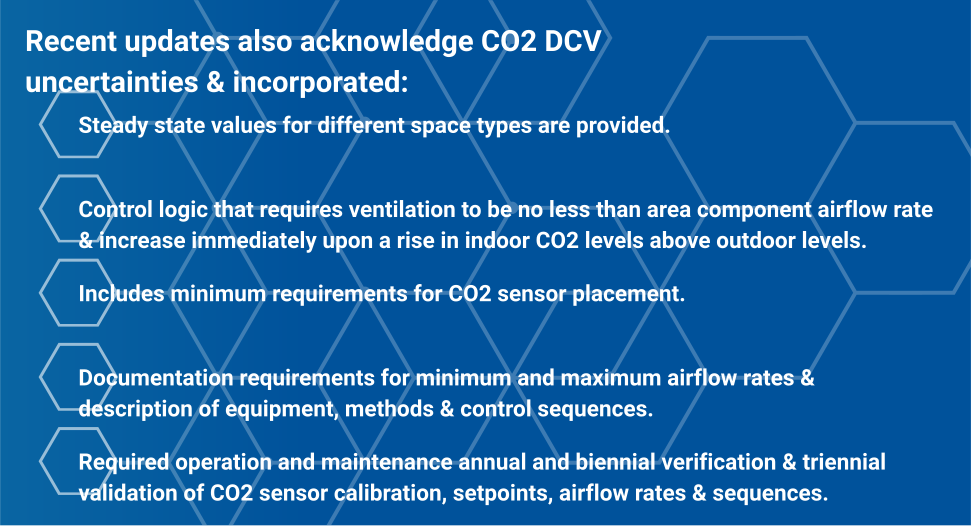
A better approach: Know the population & measure airflow rates
For facility managers, the takeaway is clear.  Emerging and practical alternatives include:
-
occupancy-based inputs (e.g., badge systems, ticketing, scheduling data, people counters)
-
direct outdoor airflow measurement systems
-
integrated building controls that respond to real-time conditions
For example, in a theater:
- ticket sales provide a direct number of occupants
- ventilation rates can be calculated based on known requirements of airflow rate per person
- minimum rates can be limited to the higher of the area airflow rate or the rate required for proper pressurization
- maximum rates can be limited to the design outdoor airflow rates so that overventilation does not occur
- airflow rates are then adjusted for the actual occupancy — without waiting for CO2 to rise
This approach eliminates inherent uncertainties, eliminates under- and overventilation, and reduces CO2 sensor maintenance related activities while allowing airflow measurement to validate rates.
Special considerations for DOAS
In dedicated outdoor air systems (DOAS), accurate airflow measurement becomes even more critical. According to ASHRAE design guidance, ventilation performance in DOAS applications requires:
-
measurement at the zone level
-
control of airflow based on actual demand
-
accommodation for pressure and system variability
Without measurement, verifying proper ventilation in these systems becomes difficult.
Next steps for FMs
As expectations around IAQ, energy performance and compliance increase, FMs should:
-
question reliance on CO2 alone as a control strategy
-
verify that ventilation aligns with actual occupancy
-
incorporate measurement where possible
-
trend and analyze data over time to validate performance
DCV remains a valuable strategy, but only when implemented with a clear understanding of its limitations.

Darryl DeAngelis has served as director of business development for EBTRON since 2018. He holds a B.S. in Marine Engineering from the Massachusetts Maritime Academy. He has more than 40 years of experience in the HVAC industry, along with four related patents and LEED AP accreditation. A longtime ASHRAE member, DeAngelis has served on numerous technical and standards committees. Currently, he serves as chair of the 62.1 Ventilation Subcommittee and as past chair of TC 7.7 Testing and Balancing. He is a voting member of ASTM and participates in several professional organizations supporting indoor air quality, building performance and facility management.
References
Top image via Getty Images.
Read more on Facility Operations , Facility Technology & Data Management and Occupancy & Human Factors or related topics Occupant Health , Operational Technology and Facility Technology
Explore All FMJ Topics