 Membership
 Network
 Regional Sites & Affiliates


 Events
 Participate
 Resources

 Training
 Credentials
 Government


 Content Channels
 Tools
Tools


 Business Overview





Safety First, Wellness Third
The hierarchy of considerations for employee wellness

Wellness in the office environment has rightfully become an important topic with employees, facility managers and designers due, in part, to reported positive ROIs, increases in productivity and improved employee workplace satisfaction. It makes sense – when workers are happy, healthy and fulfilled, they have the opportunity to be the best and most productive version of themselves. Those in pursuit of creating a workplace that supports holistic, inclusive and enduring mind-body health should be commended. However, many who have tried to implement wellness programs have been unsuccessful. Every work environment and work culture is not immediately equipped for wellness success.
Enter the Prevention Pyramid – the hierarchy of considerations for humans in the work environment. The bottom line: occupant wellness cannot be fully realized unless and until employees feel like their basic safety needs are fully met.
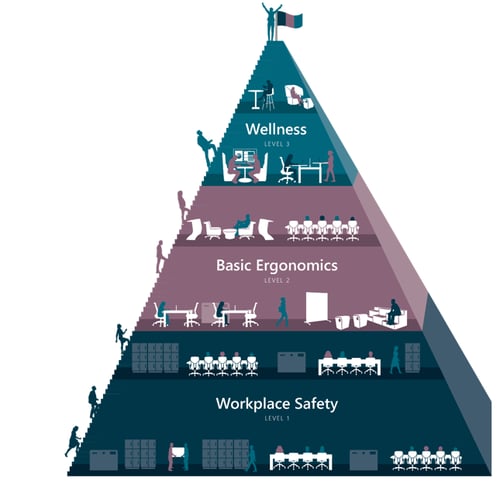 The Prevention Pyramid
The theory of the Prevention Pyramid is aligned with the thought process outlined in Maslow’s hierarchy of needs. To simplify, Maslow’s hierarchy suggests humans have an order in which needs are required to be fulfilled. For example, basic biological needs such as adequate food and shelter are mandatory before psychological factors like sense of belonging and community can be realized. The highest level of Maslow’s hierarchy (illustrated as the top of a pyramid) is self-actualization, reaching one’s fullest and ultimate potential.
When this thought process is applied to the needs of humans in the work environment, holistic wellness programs are the pinnacle of the hierarchy – something humans should strive for and representing ours fullest potential. The wellness pinnacle, however, cannot be achieved without satisfying lower levels of the pyramid first.
In this Prevention Pyramid, the first, lowest level is physical and perceived safety. It is an obligatory prerequisite that employees are provided an environment free from acute injuries or catastrophic events. Safety considerations also demand that employees feel psychological safety – that is, they have a perception and belief that they are in a non-threatening environment. The second level of the Prevention Pyramid is consideration of basic ergonomics, meaning that the environment is designed to reduce the risk of long-developing injuries and illnesses. Only when these levels are satisfied, can implementation of wellness programs have broad success.
The risk of skipping a level of the Prevention Pyramid is that wellness programs may be perceived as being insincere or hypocritical. In today’s environment, the workforce is striving to reach the top of the Prevention Pyramid; yet with pervasive issues such as harassment and active shooters, many feel unable to move past the bottom level of the pyramid. Providing considerations to reduce the risk of events while also providing employees an honest sense of safety will ultimately set the stage to allow for successful wellness initiatives.
Safety: The 1st level of the Prevention Pyramid
FMs understand that basic safety needs are not only important for employee health but are also required by law. To this point, safety programs have been typically limited to the prevention of acute injuries and basic first aid. These considerations are unquestionably important elements of a safety program. However, in the current climate, safety considerations must also encompass traumatic and catastrophic events, as well as the perceived threat of these events.
Active shooter training is becoming more common is schools, offices and hospitals. Occurrences of harassment and inequity are receiving overdue attention. Natural disasters seem to be more devastating than ever before. With these intimidations ever-present, it is not surprising that the workforce is arriving at work predisposed to stress and distraction. Pile on top of that the rigors of a stressful workday, and the idea of achieving mental and physical wellness is impossible.
In environments where workers are concerned about their basic safety because of proximity to or experience with traumatic events or the perceived threat of such an event, workers may see wellness programs as ineffective, disingenuous and unappreciated. Workers may have thoughts such as “You want me to walk more during the day, and yet, I’m concerned that areas of my building are unprotected. You don’t really understand or care what I need to be safe and healthy.” It is unlikely that considerations to improve mental health (such as biophilia, control of lighting or noise consideration) will be able to counteract the mental stress endured by an individual who feels at risk for injury, aggression or maltreatment.
According to the Occupational and Environmental Health Administration (OSHA), workplaces at a higher risk for workplace violence include environments with attributes including, but not limited to those whose purpose is to engage with the public, exchange money, have employees working outside standard business hours and/or are located in community-based environments. No environment is risk-free; however, as traumatic events can manifest in innumerable manners, and prediction of such events is impossible.
When considering the work environment, inclusion of design elements like barriers, visibility, effective lighting and arrangement of furniture to prevent entrapment may be effective. Equally important are cultural and organizational considerations. Employees may feel safer when employers ensure adequate staffing, develop a rapport with local emergency responders and provide training for a variety of events.
Two-way communication between employees and management is also highly important. Employees must feel encouraged and supported to voice concerns, suggestions and sensitivities. They must feel that their thoughts will be taken seriously and acted upon, if feasible. If their suggestions are not actionable, they need to understand alternatives and reasoning. Additionally, leadership must clearly communicate information about strategies, restrictions and opportunities. Only through two-way communication can the environment support trust and a sense of safety.
Providing employees with a working environment that reduces the risk and impact of a traumatic event and eases the fear of such events is a prerequisite to holistic wellness. These considerations are non-trivial and require monitoring and updating. As culture, atmosphere and population change, so must the consideration of workplace safety.
Ergonomics: The 2nd level of the Prevention Pyramid
The second, middle layer of the Prevention Pyramid is ergonomic considerations. Here, workplaces must attempt to reduce the risk of long-developing injuries (called musculoskeletal disorders) and provide a comfortable work environment for a diverse working population.
Minimally, workplaces need to incorporate furniture solutions that fit and are usable for the environment and work tasks. This is often achieved through adjustable furniture. Consider, for example, standard worksurface height for a seated desk, which is roughly 29.4 inches. This height coincides with the height of the 95th percentile male’s elbow height. The ergonomic logic to this approach is sound – desk height is designed for the tallest individual so that it is usable (though perhaps not ideal) for most of the population. That is, if a desk is too short, it is essentially worthless for standard working postures; however, if the desk is too high, it is usable but may require some other accommodation for smaller users. Although the design principle makes sense in this case, the result is that most of the population is working at a desk that is too high, potentially resulting in awkward postures, a risk factor for discomfort and injury.
With the increased popularity of height-adjustable tables, users can better address the discomforts they may have once experienced if other accommodations were not made (e.g., keyboard tray). Well-designed height-adjustable tables go lower than standard worksurface height, offering ergonomic benefits to users in seated postures, as well as introducing the benefit of increased opportunity to move.
Ergonomic considerations must extend beyond assigned workstations as well. Providing alternative work areas such as collaborative and lounge spaces fosters movement and diversity in working postures. Ideally, these areas also provide spaces for employees searching for places to work quietly and independently or alternatively, as a group and community.
A commitment to ergonomics means striving to accommodate all shapes and sizes of working individuals. In addition to physical differences however, employees also come to work with diversity in sensory processing. Designing spaces to be ergonomic also extends to designing inclusive and universal spaces . FMs need to be sensitive to and supportive of inclusive design that considers neurological and physical differences to create the most comfortable and productive space for all.
As with safety considerations, the risk of skipping ergonomic considerations is that any wellness program may seem superficial. Employees may feel as though companies are only focused on reducing costs rather than providing a productive, supportive and comfortable workplace. When ergonomics is fully realized, employees report higher workplace satisfaction, an indication of the significance of these considerations within the context of the Prevention Pyramid.
Wellness: The pinnacle of the Prevention Pyramid
The goal of wellness programs should be to create a work environment and culture that promotes health comprehensively and encourages employees to work in a way that aligns with their preferences. Holistic wellness programs should support total worker health and all aspects of life that affect workers’ mental and physical state including proper nutrition, adequate activity levels, community connectedness, financial stability and psychological health. Environmental opportunities to improve health should also be considered.
As with safety and ergonomics, wellness initiatives need to be supported and driven by the work culture and the design of the environment. Employees need to feel permitted, empowered and encouraged to adopt wellness endeavors.
Consider, for example, an employee who would like to improve personal fitness by walking over their lunch break. This takes a personal decision by the employee; however, the motivation is not enough to ensure their success. If this employee feels like their work culture demands they work through their lunch break, or if the employee does not have space to store shoes or clean up afterward, it is far less likely that the desired walk will happen. If the culture and the environment do not support wellness, it becomes much more difficult for an individual to reach their wellness goals.
If this example is extended further, it can be seen how the bottom levels of the Prevention Pyramid are essential to the success of a wellness program. An individual who does not feel safe in their neighborhood or in the building hallways will not be motivated to walk or move throughout the space, therefore suppressing the motivation to be healthier.
Building certifications like WELL®, fitwel® and RELI© recognize the necessity of safety and ergonomics in creating a comprehensive wellness program and include considerations of these factors in their foundational concepts. Some of these initiatives include attention to organizational transparency, universal design, emergency preparedness and visibility and proper lighting.
At the top
Supporting employees in a holistic and healthy way is more than offering smoking cessation and healthy eating programs. Space design and workplace culture need to support safety, ergonomics and comprehensive wellness. When all levels of the Prevention Pyramid are fully considered and communicated, wellness programs are well positioned to be successful, thereby fostering health, happiness and productivity.

Dr. Lauren Gant, Ph.D., CPE, WELL AP, is the human factor and ergonomics manager at Allsteel. Her background in biomedical engineering allows her to apply human factors and ergonomics principles to the design of office furniture and to research emerging trends in the office environment. Her goal ensuring products encourage healthy postures, promote productivity, and are intuitive to use correctly for a broad spectrum of worker types, sizes, and capabilities. Gant is also an adjunct associate professor at the University of Iowa, has taught engineering and ergonomics courses at the university level, has conducted extensive research in the field of ergonomics, and holds a doctoral degree in biomedical engineering from the University of Iowa. She is a is a Certified Professional Ergonomist and a WELL Accredited Professional.
References
Top image via Getty Image. Prevention Pyramid courtesy of Dr. Lauren Gant
Mattke, S., Liu, H., Caloyeras, et. Al. “Do Workplace Wellness Programs Same Employers Money?” RAND (2103). https://www.rand.org/content/dam/rand/pubs/research_briefs/RB9700/RB9744/RAND_RB9744.pdf
Song, Z and Baicker, K. “Effect of a workplace wellness program on employee health and economic outcomes” Journal of the American Medical Association (2019) 321(15):1491-1501. https://jamanetwork.com/journals/jama/fullarticle/2730614
Hopper, E. “Maslow’s Hierarchy of Needs Explained.” Thought Co. (2019, Feb. 25). https://www.thoughtco.com/maslows-hierarchy-of-needs-4582571
Occupational Safety and Health Administration (OSHA) “Workplace Violence” U.S. Department of Labor (2002, Feb 14). https://www.osha.gov/archive/oshinfo/priorities/violence.html
Solon, R. “Trauma and how it can adversely affect the workplace” Emergency Management (2016, Nov 22.) https://www.govtech.com/em/health/Trauma-and-How-It-Can-Adversely-Affect-the-Workplace.html
Paron-Wildes, AJ. “Universal Design, Inclusivity: Designing for Neurodiversity in the Workplace.” (2019) Allsteeloffice.com
Crandall, B. “HFES: Proactive office ergonomics can increase job satisfaction, employee retention.’ FMLInk (2014, Sep. 19). https://fmlink.com/articles/hfes-proactive-office-ergonomics-can-increase-job-satisfaction-employee-retention/
Read more on Occupancy & Human Factors or related topics Wellness and Well-being
Explore All FMJ Topics