
 Membership
 Network
 Regional Sites & Affiliates


 Events
 Participate
 Resources

 Training
 Credentials
 Government


 Content Channels
 Tools
Tools


 Business Overview





Slow it Down
Why sustainable leadership requires intentional decision-making

Facility management is a profession of constant motion. Leaders are expected to respond quickly, stabilize disruptions, control costs, protect safety and support the workplace experience, all while keeping operations moving forward with little margin for error.
In that environment, speed can begin to look like competence. Fast answers feel decisive. Rapid approvals feel productive. Immediate reactions appear strong. Yet many of the decisions that damage trust, exhaust teams and create avoidable operational problems are not made because leaders do not care. They are made because leaders are moving too fast to see clearly.
More work, higher expectations
That problem is becoming harder to ignore. IFMA’s first quarterly global Pulse Report found rising workload expectations across the profession, with its inaugural Facility Management Workload Index at +43, signaling that more facility professionals expect workloads to increase than decrease. The same report notes that hiring timelines for critical roles now average nearly four months, while approvals are moving more cautiously even where budgets remain relatively stable.
At the same time, JLL’s Global State of Facilities Management Report found that 84 percent of surveyed corporate real estate and FM leaders identified budget constraints and escalating operating costs as a top concern, while 81 percent named cost efficiency and budget optimization as a leading priority.
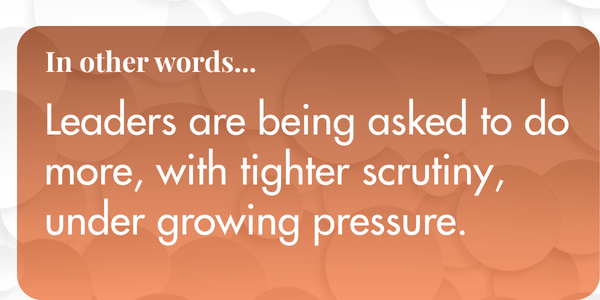 Under those conditions, urgency can quietly become a leadership culture. Everything starts to feel immediate. Every issue appears to deserve a same-day answer. Every setback is treated as if it must be solved in real time. The result is not sustainable leadership. It is reactive leadership.
Sustainable leadership is different. It does not reject action, and it does not romanticize delay. It recognizes that some decisions must be made in minutes, but many of FM’s most important decisions should not be made in emotional haste. Decisions about staffing, vendor performance, capital priorities, workplace experience, safety communication, change implementation and team accountability carry consequences that extend beyond the moment. Those choices shape culture, confidence and long-term execution.
A holistic leadership lens helps explain why. Holistic leadership centers on the full leadership environment rather than the immediate task alone. It asks leaders to consider people, purpose, values, communication, ethics and long-term development alongside performance. In that framework, leadership is not merely about producing outcomes. It is about producing outcomes in a way that preserves trust, strengthens alignment and develops others. Holistic leadership also holds that emotional intelligence and awareness of blind spots are necessary for good judgment, especially under pressure.
Leadership matters
That matters in FM because the work sits at the intersection of people and systems. A facilities leader may be addressing an equipment failure, a life-safety concern, a service-level dispute, a workplace policy change or a staffing shortfall, but the decision is rarely only technical. It affects morale, clarity, workload distribution, user confidence and organizational credibility. JLL reports that occupant well-being and workplace safety rank near the top of FM priorities globally, tied with reliability and resilience. The same report notes that 84 percent of employees’ positive workplace experience is strongly correlated with favorable views on office attendance policies. That means an organization’s facilities decisions are not peripheral. They shape how people experience the organization itself.
When leaders rush these decisions, four failures tend to follow.
The first is shallow problem definition. Teams respond to the visible symptoms rather than the underlying issue. A recurring complaint about cleaning standards may actually signal problems such as scheduling, scope, staffing or communication. A fast decision that targets the wrong cause only creates another cycle of frustration.
The second is people-blind execution. Leaders may solve the technical issue while creating a relational one. A rapid schedule change may restore coverage, but if it is imposed without context, staff may experience it as unpredictability rather than leadership. A cost-saving move may appear efficient on paper, but if it increases friction for frontline teams, the organization pays elsewhere in errors, disengagement or turnover.
The third is value drift. Under pressure, leaders can make exceptions that quietly contradict the standards they claim to uphold. They bypass consultation, communicate selectively or normalize unreasonable workloads because speed feels necessary. Over time, the team learns that the stated values matter less than the latest emergency.
The fourth is leadership fatigue. Constant high-speed decision-making depletes judgment. The World Health Organization and the International Labour Organization found that long working hours led to roughly 745,000 deaths from stroke and ischemic heart disease in 2016 and identified long working hours as the occupational risk factor with the largest work-related disease burden. Gallup’s current global indicator shows employee engagement at only 20 percent worldwide, with recent reporting also noting continuing global engagement decline.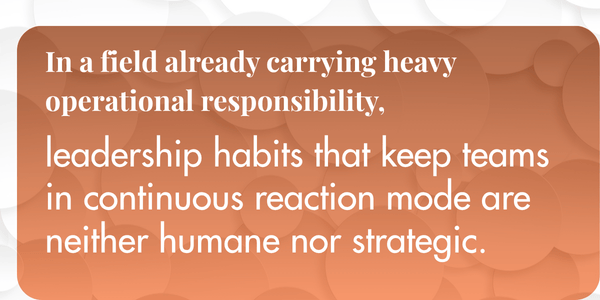
Getting ahead of time
The alternative is not slower action in every circumstance. It is slower thinking where the decision requires judgment, not merely reaction. Here are five ways to help make decisive, impactful decisions.
1. Separate decisions into three categories: urgent, important & complex.
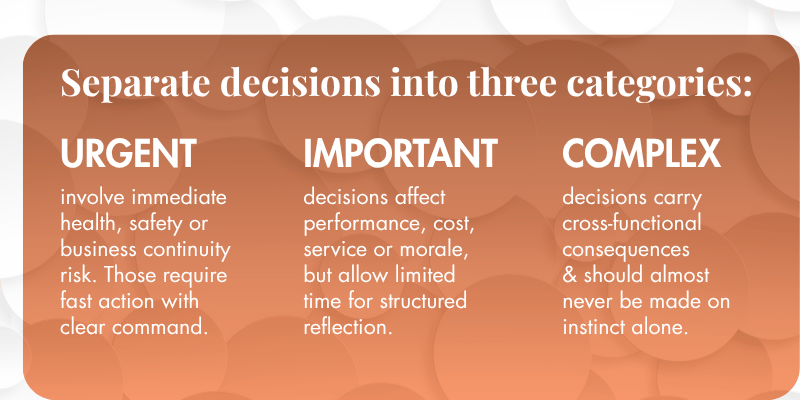
One reason many facility leaders feel trapped in urgency is that these categories collapse into one. Everything is treated as urgent, and the team loses the discipline to think proportionally.
2. Integrate the reflective pause.
This does not require a retreat or a lengthy review cycle. It may be as short as 15 minutes before a difficult personnel decision, one day before a policy rollout or a scheduled checkpoint before a contract recommendation. The purpose is to ask a better set of questions:
-
-
What problem is actually being solved?
-
What assumptions are driving the response?
-
Who will absorb the consequences of this decision?
-
What risk is being reduced, and what risk might be created?
-
Holistic leadership emphasizes that leaders must examine blind spots and manage emotions before acting. That discipline often prevents the costly mistake of solving the wrong problem too quickly.
3. Create a structured input loop.
Sustainable leaders do not invite endless debate, but they do create a repeatable way to hear from the right people before major decisions are finalized. In FM, that may include a technician, a site leader, a workplace experience representative, a procurement partner, a health and safety contact, or a vendor-facing manager. The point is not consensus. The point is clarity. The strongest decisions are often strengthened by one missing operational insight that would not have surfaced in isolation. Strategic leadership research in the user’s framework consistently ties alignment, communication and employee understanding to stronger execution.
4. Check values.
Before a major decision is implemented, the leader should be able to state in plain language how the decision aligns with the organization’s standards. Is it fair? Is it transparent? Does it protect dignity? Does it preserve trust? Is it consistent with how the organization claims to lead? In the holistic leadership model, integrity, honesty, accountability, compassion and respect are not decorative values. They are decision standards. When leaders move too fast to test their choices against those standards, short-term efficiency can quietly become long-term instability.
5. Remember communication discipline.
Fast decisions often fail not because the final answer was wrong, but because the communication around the answer was careless. Effective leadership communication requires constancy, consistency and frequency. It must be clear enough that people understand not only what is changing, but why it is changing, what it means for them and how success will be measured. In FM, poor communication can turn manageable change into unnecessary resistance. Strong communication, by contrast, reduces anxiety and converts decisions into coordinated action.
A reality check
Consider a common comparison. In one organization, an FM leader responds to rising service complaints by immediately tightening productivity targets and reassigning coverage without input from supervisors or technicians. The visible result is faster response times for a few weeks. The invisible result is lower morale, growing resentment, uneven service quality and eventual burnout in the most dependable staff. In another organization, the leader takes a brief pause, reviews work-order patterns, checks staffing gaps, consults local supervisors and communicates the rationale for targeted adjustments before launch. The response may take slightly longer to implement, but it addresses root causes rather than symptoms.
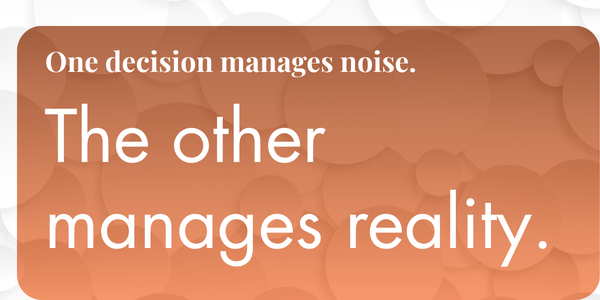 That is the deeper argument for slower decision-making. Sustainable leadership is not measured only by how quickly a leader can move. It is measured by whether movement produces stability, trust and durable performance. In a profession where rising workload, cost pressure and workplace expectations are colliding, leaders do not need less decisiveness. They need more disciplined judgment.
FM has always required responsiveness. It now requires restraint as well. The leaders who will sustain performance over time will be the ones who know when to act immediately, when to pause deliberately, and when to refuse the false choice between speed and strength.
In the built environment, the strongest leadership is often not the loudest or the fastest. It is the leadership that slows down long enough to make decisions that people can trust and organizations can live with.

Dr. Jamika Bivens is a leadership strategist, educator, and author specializing in holistic, values-based leadership and long-term impact. She holds a doctorate in strategic leadership (DSL) an MBA and professional certifications including SHRM-SCP and ATD, bringing deep expertise across leadership development, organizational strategy and human capital. Dr. Bivens is author of The Power of Legacy: Holistic Leadership for Lasting Impact, a practical and reflective guide that challenges individuals to align their values, decisions and influence in a world driven by speed, pressure, and short-term success. Her work bridges academic rigor with real-world application, equipping leaders and professionals to make principled decisions that endure beyond titles and achievements.
References
Top image via Getty Images.
Read more on Leadership & Strategy and Communication or related topics Strategic Planning and Communication Skills
Explore All FMJ TopicsRelated articles
-

Artificial Intelligence in FM
The stakeholder’s perspectiveBy Dr. Jake Smithwick & Dr. Kenneth Sullivan & Nneka Ubi05.01.2024 -

Mastering Change in Hybrid Environments
Insights from global operational leadersBy Meg Swanson09.02.2024 -

Plugged In
Solving the data disconnect in real estate and FMBy Amanda Muzzarelli & James Waddell07.01.2024