
 Membership
 Network
 Regional Sites & Affiliates


 Events
 Participate
 Resources

 Training
 Credentials
 Government


 Content Channels
 Tools
Tools


 Business Overview





Social Justice & Facility Management
JUST FM

Before the onset of COVID-19 in the U.S., Adia Marble and Kipeni (Alex) Suapaia jumped on a bus to attend a facility management program created by the IFMA Foundation and sponsored by the Denver Economic Development and Opportunity organization (DEDO). This successful FM Talent Development Pipeline Program (TDP) is a new model for a community partnership (see Figure 1), which consists of DEDO, the IFMA Denver Chapter, industry partners, Denver Community College and local community organizations. Students enrolled in this TDP represent 100 percent minority, 50 percent women and 50 percent veterans. Students earn a globally recognized certificate of completion in the IFMA Essentials of Facility Management and participate in an IgniteFM! Student Challenge, where they present a solution to a real-life industry for the opportunity to earn a monetary prize.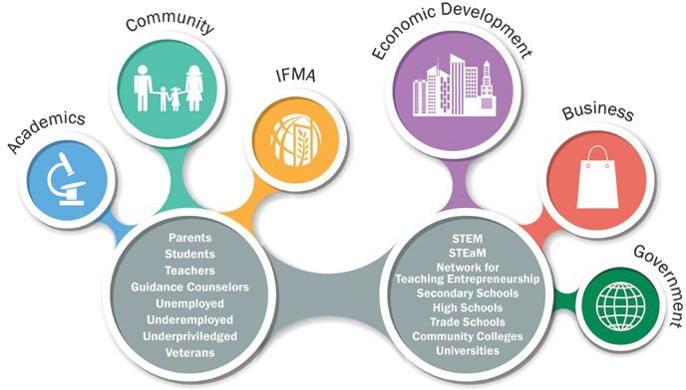
Figure 1
Also included in the TDP is a paid FM internship, along with a Career Connections event with the IFMA Denver Chapter and IFMA Foundation Global Workforce Initiative (GWI) Advisors Sodexo and ABM Industries, as well as major IFMA Foundation donor A&A Maintenance, which support the students in career advancement and opportunities.
The FM job market & opportunities today
The average FM’s age is 49, and 50 percent of the existing FM workforce will retire in the next decade. There are approximately 4,000 graduates per year from FM accredited degree programs, yet the annual demand for graduates from just a few global firms alone is greater than this number. In the last 12 months, there were more than 39,000 FM job openings in the U.S. alone. Today’s buildings are smarter and require more advanced technical knowledge than what normal training programs offer. Therefore, the need for skilled FMs is increasing, while the supply to fill the vacancies is not nearly enough.
In the U.S., the FM industry is predominantly Caucasian due to lack of marketing to the global labor market and introducing the profession later in a student’s life, if at all.
“When you compare to Generation Z,” as one researcher put it, “nearly half of Gen Z is non-Caucasian and 81 percent of Gen Zers said they have friends of a different race.” Noting this new generation’s multicultural demographic allows companies to understand that valuing diversity is not simply a cause Gen Zers advocate, but rather, multiculturalism is a criterion of who they are.”
When discussing FM with younger generations, veterans and incumbent workers, five features of the job catch their attention and encourage them to enroll in an educational program.
1. High FM salary
2. FM’s impact on sustainability and the planet
3. Impact of new technologies (IoT, robotics, AI) on the FM profession
4. FM’s impact on people’s daily lives
5. Many opportunities for advancement (Figure 2)
 Figure 2
Providing FM education & marketing to minority communities
While interest is gaining traction in growing FM education, more programs are needed in minority communities to meet the industry’s looming talent gap. With a near-100 percent job placement for accredited FM degree graduates, IFMA and the IFMA Foundation have the credentials and educational programs to train the future workforce and unleash their potential with new skills and opportunities for employment for both mid-level skills and college-educated job seekers.
National Outlook on Education ranked Chaffey College the No. 3 California community college to enroll and graduate Hispanic students. Minority enrollment is 75 percent of the student body (the majority Hispanic), which is more than the state average of 68 percent. In 2017 Chaffey, started an associate degree in business with a certificate in FM and formed an IFMA student chapter. After two years in existence, this student chapter won the prestigious 2019 IFMA Student Chapter of the Year award. Several California IFMA chapters and FM community members mentored the students, sharing their experience, providing scholarships, internships and monthly educational programs.
The GWI’s programs address the triple bottom line values of economy, equity and environment, and were created based on research that identified an annual industry gap of approximately 6,000 workers in California. Pipeline programs are offered through the California Community Colleges, where more than 50 percent of the student population qualifies for fee waivers based on their economic status. Named a California Economic Summit Top 10 Partnership in Industry and Education (PIE) award recipient in 2019, this program has specifically targeted a large, diverse student population enrolled in the business and technical programs. Chaffey College, College of San Mateo and West Los Angeles College have had success in finding their graduates FM-related employment.
Florida A&M University has a “historic mission of educating African Americans. FAMU embraces persons of all races, ethnic races and nationalities as lifelong members of the university community.” With two accredited degree programs credited through the IFMA Foundation – bachelor's of science degree in business administration with a program major in facility management and a master's degree of science of architecture: facility management – FAMU graduates the highest number of African Americans in collegiate FM. These programs are highly respected and graduate some of the finest students in the industry, many of whom are IFMA Foundation international scholarship recipients and IgniteFM! student competition winners. Students receiving scholarships are awarded a free trip to IFMA’s World Workplace Conference and Expo where they can meet potential employers, network with FM professionals from around the world, attend educational sessions and participate in student competition.
One of the first adopters of GWI, Dr. Roscoe Hightower, a FAMU professor of marketing and FM, began introducing FM to grade-school students through tennis and a sports video game. Collaborating with a local non-profit organization, the FAMU students’ "company" teaches FM practices to a grade-school tennis and nutrition program for underprivileged children. FAMU students obtain credit for this, said Hightower. The students also use the Madden Football video game to explain FM through a feature of this popular e-sports game that requires users to build a football stadium and create a facility budget to operate and maintain it.
“FAMU has its own K-12 school district within the campus. The primary, middle and high school district is part of the university making it advantageous to introduce grade-school students to facility management,” he said.
At FAMU “there are two one-credit internships required to provide students with experiential opportunities in the field to practice what they have learned in the classroom. Many of these opportunities are with external enterprises such as Leon County Facilities Management Department, Minor League Baseball, Atlanta Hartsfield-Jackson Airport, NASCAR, Jones Lang Lasalle, Sodexo and Aramark.”
Angela Johnson, P.E., PMP, MBA and NORAM (North American), an account vice president of FM service development at Sodexo and IFMA Foundation Trustee, has marketed her field and opportunities at Sodexo to K-12 students for years. During a presentation at World FM Day 2019 (Photo 3), her passionate speech on attracting students to the profession moved senior executives at marketing company ImageMedia to create an ”FM Ambassador Kit” pro bono to spread the word about FM careers to IFMA chapters. Johnson, in turn, brought in the IFMA Foundation to co-brand this kit for chapters, global communities, companies and educational institutions to use in marketing FM, a US$1 trillion industry with more than 25 million professionals worldwide.
A call to action – A JUST FM partnership
In addition to ensuring building safety in emergency and crisis situations, FMs also
contribute to Corporate Social Responsibility and Environmental and Social Justice (ESG) measures that businesses are tracking today. One measurement tool is the JUST label, which came after the creation of ESG, helping enhance the concept. The label was designed by the International Living Futures Institute (ILFI) for companies to measure and track their social justice policy’s progress. There are 22 criteria for diversity, equity, safety, worker benefit and stewardship.
The IFMA Foundation is behind a JUST FM movement to establish how FM practices contribute to the social justice policies of an organization; FM’s benefits to health and well-being, productivity, cost savings and experiential, creative environments; and positive contributions to local and global communities. JUSTFM is a newly coined term used to emphasize the social justice policies of an organization contributed by the Facility Management group which includes hiring and sustainability practices, and partnerships with community, economic development and academic organizations. JUST FM was created to bring attention to the work of the IFMA Foundation’s GWI program in its efforts to attract and promote the social justice work of this Initiative which is to grow the facility management profession for all segments of society.
It is an area in which heightened global discussion and research are needed. Through the GWI programs like the one in Denver, the IFMA Foundation — together with its partners and major donors JLL, Sodexo, ABM and A&A Maintenance — is working on JUST FM programs to attract minorities and women to the field through education, outreach and internship programs. More help is needed to expand this program.
Partnerships work and can make a difference in social justice and FM. The IFMA Foundation will continue to invite partners to participate in the shared-value investment of a better-prepared sustainable future and workforce. The key to unleashing a company’s competitive advantage and increasing corporate growth and potential lies in training today’s youth and incumbent workers for tomorrow’s business challenges. To do this, the Foundation needs to work closely with multinational corporations, national companies, and small- to medium-size businesses to identify, design and implement alliances that leverage the strengths of the corporate sector on behalf of FM for social good. Anyone can help by demonstrating leadership among their corporate peers by participating in an opportunity to shape the future.
JUST FM partnership goals
-
Fill the FM talent gap with well-qualified professionals.
-
Expose youth, incumbent workers, the unemployed and underemployed to FM careers.
-
Educate guidance counselors, parents and teachers about FM.
-
Engage local FM professionals in student outreach programs.
-
Introduce the FM profession to high schools and community colleges.
-
Grow the number of FM educational programs in minority colleges and communities.
-
Increase the number of employments, internships, apprenticeships and job-shadowing opportunities in FM.
-
Increase the number of annual scholarships offered to students.
-
Make people aware of FM’s significant role in impacting the UN2030 Sustainable Development Goals (SDGs).
-
Educate and encourage the FM and built environment industry to practice JUST FM principles.
-
Connect with STEM, STEAM and other existing outreach programs to promote FM education at an early age.
-
Educate government agencies, workforce and economic development professionals about FM careers and the importance of the profession.


Nancy Sanquist, IFMA Fellow, is a professional involved in the built environment for the last few decades. She is the Past Chair of the IFMA Foundation, with which she has worked for the last six years. She is a co-founder of the Global Workforce Initiative (GWI) and the Workplace Evolutionaries, and is the author of many articles and co-editor of books on FM/CRE, technology, architecture, urban planning and maintenance including the award-winning book series titled “Work on the Move (1&2).” She is working on a new book on “Reimagining Place in the 21st Century.”
References
Top image via Getty Images.
Sherman, Scott and Levine, Diane. Recruiting Generation Z Into the Field of Facility Management. FMJ, September/October 2019.
Pinion, Melissa (2019) Chaffey College Top Ranked for Hispanic Enrollment, Graduates. Feb 25. https://www.chaffey.edu/releases/2019/2019-feb-25-hispanic-enrollment.shtml
Hightower, Roscoe, PhD. Accredited Degree Program: Florida A&M University. Facility Management Journal May-June 2020, p.71.
Read more on Leadership & Strategy and Sustainability or related topics Environmental, Social and Governance (ESG) , IFMA Foundation and Succession Planning
Explore All FMJ TopicsRelated articles
-

Artificial Intelligence in FM
The stakeholder’s perspectiveBy Dr. Jake Smithwick & Dr. Kenneth Sullivan & Nneka Ubi05.01.2024 -

Mastering Change in Hybrid Environments
Insights from global operational leadersBy Meg Swanson09.02.2024 -

Plugged In
Solving the data disconnect in real estate and FMBy Amanda Muzzarelli & James Waddell07.01.2024