
 Membership
 Network
 Regional Sites & Affiliates


 Events
 Participate
 Resources

 Training
 Credentials
 Government


 Content Channels
 Tools
Tools


 Business Overview





Strategic Command
Applying Clausewitzian principles to FM

Facility managers, whether working within corporate, health care, educational, municipal or defense environments, occupy a strategic position at the intersection of mission continuity, safety and operational excellence. Their decisions shape not only the performance of buildings and systems but also the reliability of the missions supported by those assets. As global operations grow increasingly complex and interdependent, facility management professionals must move beyond reactive oversight and embrace strategic thinking grounded in theory, foresight and disciplined execution.
 The military philosophy of Carl von Clausewitz (1780–1831), and his seminal work “On War” (1832/1976) remains one of history’s most profound explorations of uncertainty, leadership and decision-making. Clausewitz’s insights, particularly the concept of coup d’œil, or the ability to perceive decisive truths “at a glance,” are as relevant to today’s FM professional as they were to battlefield commanders. Coup d’œil is trained intuition: the fusion of experience and situational awareness that enables leaders to identify what truly matters amid complexity.
For the facility professional, coup d’œil translates into the ability to interpret dashboards, field reports, key performance indicators (KPIs) and operational data streams to detect risks before they turn into crises. Coup d’œil allows FMs to balance tactical responsiveness with strategic vision, allocating resources where they will achieve the greatest mission impact.
Both warfare and FM demand adaptability, disciplined resource allocation and the capacity to act decisively under conditions of uncertainty. Clausewitz’s theories, including friction, the fog of war, the balance of offense and defense, and the center of gravity, offer a conceptual framework for meeting these challenges. They show how leadership, judgment and disciplined intuition can convert operational complexity into strategic advantage.
Applying Clausewitzian thought to FM reframes the discipline as the command of mission-enabling assets rather than the stewardship of the built environment. The FM, equipped with coup d’œil, becomes a professional who thinks decisively, acts deliberately and ensures that the built environment functions as an instrument of organizational success.
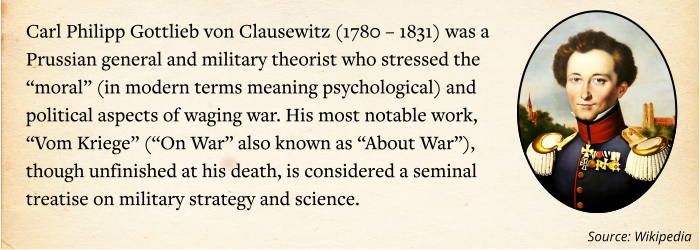 Who was Carl von Clausewitz?
Clausewitz was a Prussian general, strategist and philosopher whose posthumous masterpiece “On War” redefined the understanding of conflict, leadership and decision-making under uncertainty. His ideas transcend the battlefield, offering a universal framework for strategic thinking applicable to business, governance and organizational leadership.
Clausewitz viewed war not merely as combat but as a continuation of policy by other means — a dynamic interplay between reason, emotion and chance. He argued that success in any complex system depends less on rigid adherence to rules than on the leader’s ability to interpret unfolding conditions, adapt to uncertainty and make informed judgments with incomplete information. This concept, navigating the “fog of war,” is still as relevant to contemporary operations as it was to nineteenth-century command.
At the heart of his theory lies coup d’œil: “the stroke of the eye” — the ability to perceive decisive truths at a glance. For Clausewitz, this was not instinct in the ordinary sense, but intuition refined by experience and disciplined reasoning. It enables a leader to find the key factors in a dynamic environment and act with confidence before others can recognize the pattern.
FMs, like battlefield commanders, operate amid friction, uncertainty and competing priorities. They must protect their organization’s center of gravity, the critical assets and processes whose failure would disrupt mission continuity by allocating resources to safeguard them. Clausewitz’s observation that “no plan survives first contact with reality” applies equally to infrastructure operations, in which unforeseen events, funding constraints and cascading failures can disrupt even the most carefully designed plans.
Clausewitz’s enduring relevance lies in his recognition that leadership in complex systems is not about eliminating uncertainty but managing it. Translating his principles into FM enables professionals to evolve from technical stewards into strategic leaders capable of perceiving what really matters, anticipating the unexpected and transforming uncertainty into operational strength.
Relevance of Clausewitzian concepts to FM
Clausewitz described coup d’œil as the commander’s ability to perceive decisive truths at a glance — insights others might reach only after prolonged analysis. This ability blends sharp perception, situational awareness and sound judgment. In modern FM, coup d’œil is the ability to synthesize data from dashboards, KPIs, inspections and performance reports into an understanding of emerging risks and opportunities.
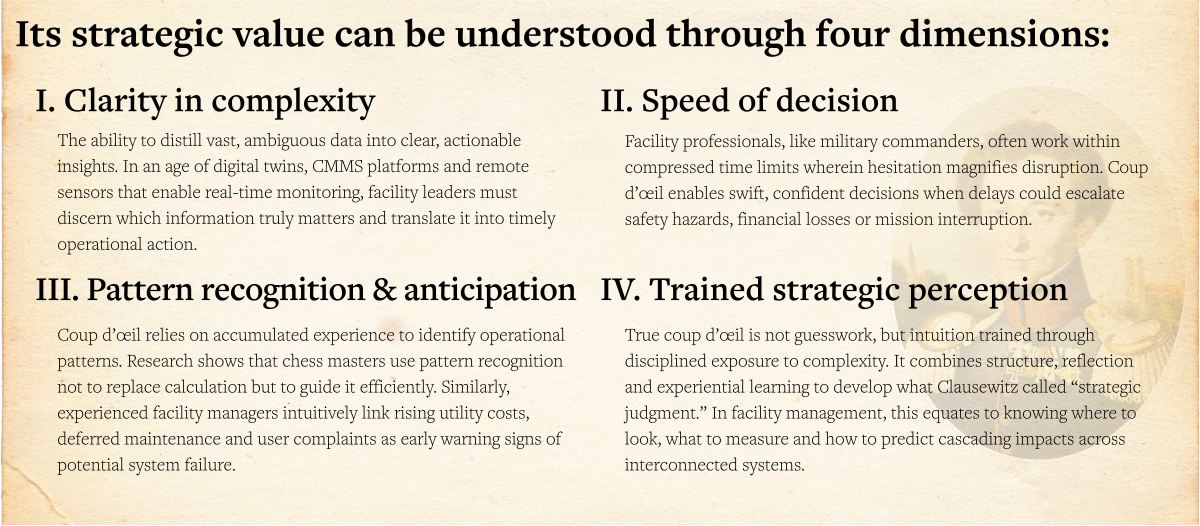
Just as skilled military commanders integrate reconnaissance, intelligence and logistics into a coherent situational picture, effective FMs integrate condition data, user feedback and KPIs into a unified operational view. Through coup d’œil, leaders shift from reacting to problems to taking proactive command, recognizing key factors others miss. Clausewitz’s broader principles, illustrated in Figure 1, reinforce this perspective.
His “Trinity of War” — passion, reason and chance — maps directly onto the facility context: passion reflects workforce morale and user satisfaction; reason represents leadership and strategy; and chance mirrors the unpredictability of operational disruptions. Together, they define human, rational and uncertain forces shaping facility outcomes.
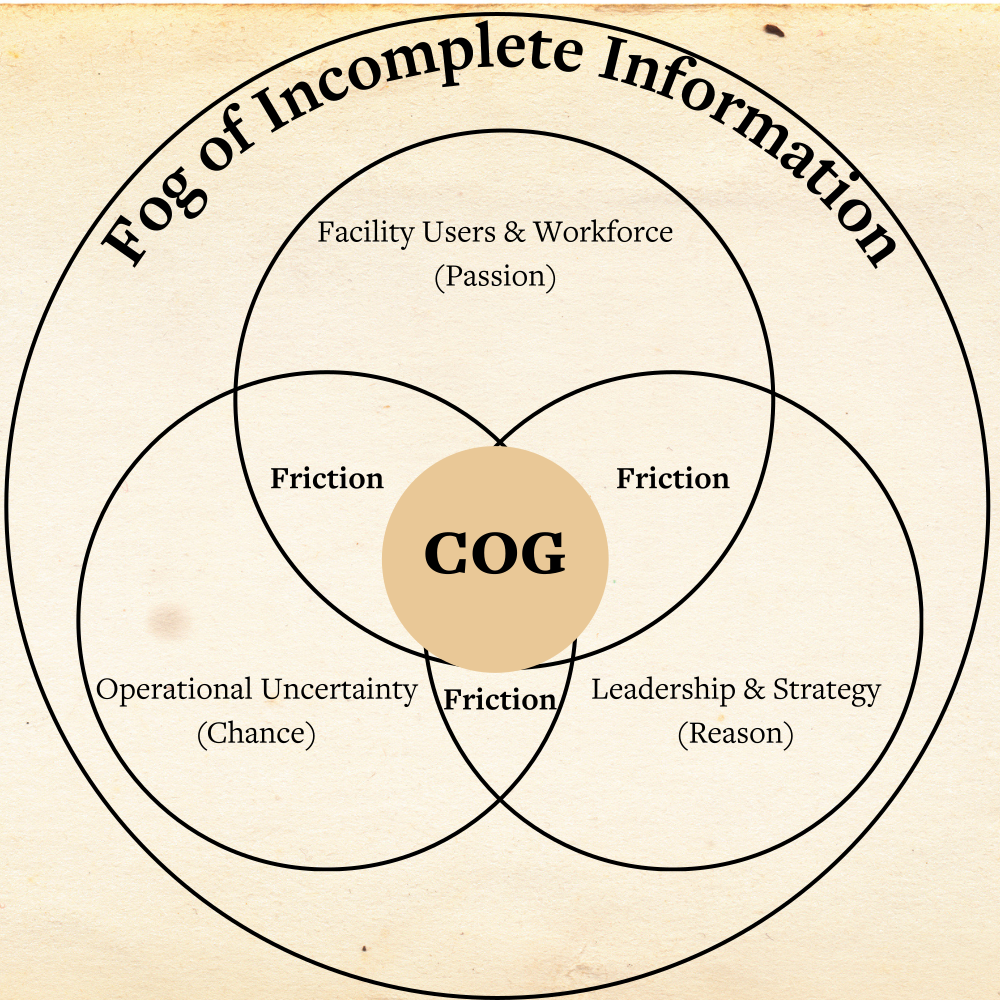 Figure 1: Applying Clausewitz’s Broader Principles to Facilities Management
The center of gravity (COG) is the source of strength that sustains any enterprise. For a military force, it may be supply lines or morale; for a facility organization, it is the critical infrastructure whose continuity sustains mission performance. Protecting critical infrastructure is equivalent to defending the COG in warfare.
Clausewitz’s concept of friction, the small obstacles that make even simple tasks difficult, captures the realities of facility management: delayed work orders, funding gaps, regulatory hurdles, change orders and coordination failures. Successful leaders mitigate friction through advanced planning, preventive maintenance and disciplined workflow.
Finally, the balance between offense and defense shapes how an organization operates. Defensive actions preserve capability through maintenance, compliance and mission assurance, while offensive actions advance capability through renewal, innovation and capital investment. Success is knowing when to conserve strength and when to seize opportunity.
Underlying all these principles is the fog of war — the uncertainty and incomplete information that cloud decision-making. Facility managers face a similar fog of information, particularly during power outages, cyber incidents or natural disasters. Acting decisively despite incomplete information demands confidence and trained intuition.
Conclusion
Clausewitz’s theories offer a lasting framework for leadership under uncertainty — one that reaches far beyond the battlefield and applies directly to modern FM practice. His insights illustrate the shift from reactive problem-solving to proactive command. When concepts such as coup d’œil, friction, center of gravity, offense and defense, and the fog of war are applied to the built environment, they provide facility leaders with a disciplined way to find clarity amid complexity, act decisively with limited information, and align infrastructure performance with mission goals.
The Clausewitzian FM views infrastructure not as a fixed asset but as an active instrument of capability — one that shapes mission readiness, continuity and resilience. The key skill in this field is disciplined intuition: the ability to spot important patterns quickly and make sound decisions under pressure. This ability allows leaders to predict cascading effects, distribute resources wisely and turn uncertainty into strategic opportunity.
Clausewitz believed that effective command depends on acting within the fog of war. Similarly, today’s facility manager must lead through changing missions, tight budgets and aging infrastructure while maintaining mission assurance. Success depends less on rigid procedures than on adaptability — the capacity to interpret shifting conditions and respond in ways that sustain organizational effectiveness.
Clausewitz teaches that success comes not from eliminating uncertainty but from managing it. From this perspective, FM is a strategic practice that combines human judgment, analysis and mission focus to gain operational advantage. Leaders who apply these principles become true commanders of the built environment, ensuring that infrastructure not only supports the mission but also strengthens it.
Developing coup d’œil, the ability to see and act decisively, is essential to FM’s future of. This skill is not innate but developed through experience, reflection and practice in complex decision settings. As missions evolve and systems become more interdependent, facility professionals must learn to detect patterns quickly, interpret signals accurately and act with confidence amid uncertainty. Cultivating this disciplined intuition fulfills Clausewitz’s ideal of effective command and defines the next generation of strategic facility leaders.

Albert Antelman is a registered architect and an IFMA member with more than 30 years of experience in federal and defense infrastructure programs. He is co-founder of the Institute of Responsible Infrastructure Stewardship and the developer of the Mission Dependency Index (MDI), a decision-support framework used by the US Defense Department and NASA to assess the operational importance of infrastructure. Antelman's work combines strategic theory, data-driven analysis and facility leadership to strengthen mission assurance and operational resilience across both public and private sectors.
References
Chase, W. G., & Simon, H. A. (1973). Perception in chess. Cognitive Psychology, 4(1), 55–81.
Clausewitz, C. von. (1976). On war (M. Howard & P. Paret, Eds. & Trans.). Princeton University Press. (Original work published 1832).
Read more on Leadership & Strategy and Quality or related topics Strategic Planning , Quality Improvement and Problem Solving
Explore All FMJ TopicsRelated articles
-

Artificial Intelligence in FM
The stakeholder’s perspectiveBy Dr. Jake Smithwick & Dr. Kenneth Sullivan & Nneka Ubi05.01.2024 -

Mastering Change in Hybrid Environments
Insights from global operational leadersBy Meg Swanson09.02.2024 -

Plugged In
Solving the data disconnect in real estate and FMBy Amanda Muzzarelli & James Waddell07.01.2024