
 Membership
 Network
 Regional Sites & Affiliates


 Events
 Participate
 Resources

 Training
 Credentials
 Government


 Content Channels
 Tools
Tools


 Business Overview





Strategic Planning
Building organizations that compete, adapt & endure

Organizations no longer compete solely with products, services or prices. They compete on their ability to anticipate change before it happens.
Markets evolve rapidly, customer expectations shift overnight, technologies disrupt established business models, and global uncertainties have become the new normal. Under these conditions, operational excellence alone cannot sustain long-term success. Strategic planning is one of the most critical leadership disciplines, transforming organizations from reactive operators into proactive innovators.
However, the effectiveness of strategic planning ultimately depends on the vision and commitment of leadership. A clear management vision provides direction during uncertainty, aligns organizational priorities and inspires employees to embrace change with confidence.
Visionary leaders do not merely respond to emerging challenges; they anticipate them, create resilient strategies and cultivate a culture of innovation, adaptability and continuous improvement. By setting a long-term direction while remaining agile in execution, management enables organizations to overcome uncertainty, capitalize on new opportunities and achieve sustainable growth in a more complex world.
 Strategic planning is often seen as something that happens once a year: making a budget and writing down some goals. That is not really what it is. Strategic planning is continuous decision-making so that organizational goals are achieved. It is the bridge that helps organizations get from where they are now to where they want to be tomorrow. Success is not always contingent on having the most money or the biggest market share. Successful organizations are the ones that truly understand what they want to do. They make good choices about how to use their resources, and they can pivot quickly in response to change.
Every good strategy starts with a purpose. Organizations must not only know what they are trying to do but also why they are trying to do it. Purpose must also factor in global and situational awareness. Leaders who keep an eye on what is happening in the economy — technology trends, consumer behavior, geopolitical shifts — can better foresee organizational opportunities and challenges.
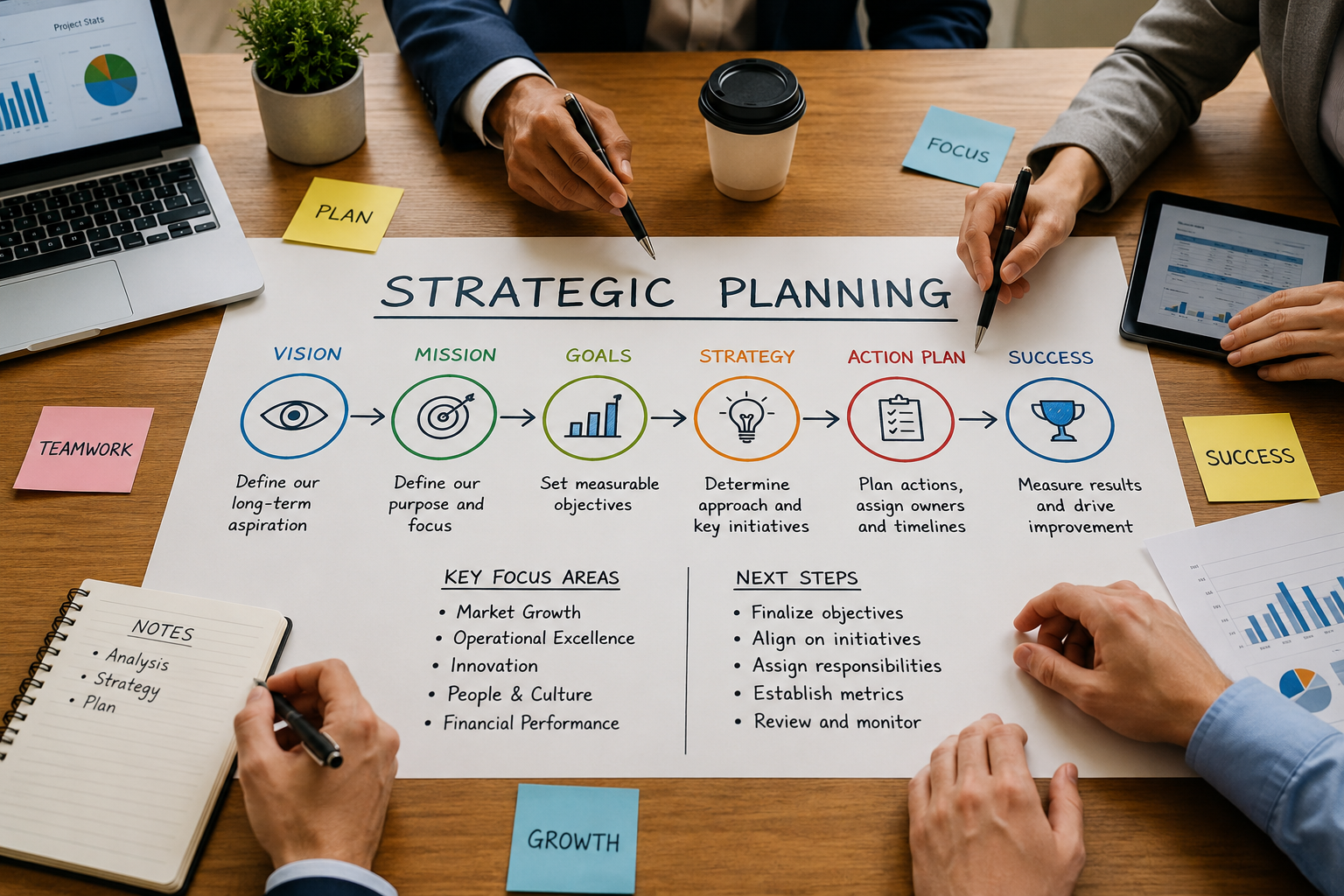 Strategic planning depends on data to inform decision-making. Organizations have a lot of information about what they are doing — that information can guide good choices. Leaders can make predictions based on the data, which helps take the guesswork out of judgment calls.
Things do not always go as planned. Organizations must be ready for disruption — climate-driven risks, cyberattacks, labor shortages, supply chain issues — and have plans in place for resilience and business continuity. They must also have the flexibility to modify those plans based on changing conditions.
Leaders must also prioritize. They must ensure that every decision they make, action they take and resource they allocate is helping achieve goals. The hardest part of planning is actually doing it. A lot of plans fail not because they are bad plans, but because they are not well executed. Organizations must ensure everyone is working together toward the same goal, measure progress and make changes if needed.
Leadership must be involved in all of this. They must understand the strategy and ensure everyone from the C-suite to the reception desk does too, while also sharing progress and next steps.
Sustainability — how organizational decisions and actions impact building occupants, the environment, the surrounding community and the business itself — is an important part of the strategic plan. Long-term success is closely linked to responsible resource utilization, environmental protection, social responsibility and sound governance practices. Strategic decisions based not only on financial returns but also ESG impacts support sustainable development while strengthening corporate reputation and stakeholder trust.
Strategic planning is not something done once. It is a living process that evolves with situations, priorities, and stakeholder needs and feedback.
 Innovation is one of the most critical pillars of strategic planning. In a competitive and technology-driven marketplace, organizations can no longer rely solely on traditional business models or past successes. Sustainable growth depends on an organization's ability to generate innovative ideas, transform them into practical solutions, and continuously improve products, services and operational processes.
Strategic planning therefore must create an environment that encourages creativity, experimentation, calculated risk-taking and continuous learning.
 Organizations that embed innovation into their strategic framework are better positioned to respond to market changes, capitalize on emerging opportunities, and create long-term competitive advantages.
Globalization has significantly increased the complexity of strategic decision-making. Organizations operate across multiple countries, cultures, regulatory environments and economic systems. Strategic planners must understand diverse customer expectations, international trade dynamics, geopolitical risks, technological advancements and cultural differences while ensuring that corporate objectives remain aligned across all regions. A strategy that succeeds in one country may require significant adaptation before it can be effectively implemented elsewhere. Consequently, global strategic planning requires cultural intelligence, cross-border collaboration and flexibility to accommodate regional differences while maintaining a unified organizational vision.
Resilience — an organization's ability to anticipate disruption, absorb unexpected shocks, recover quickly from crises and emerge stronger from adverse situations — is a defining characteristic of modern strategic planning. Recent global events including economic recessions, supply chain disruptions, pandemics, climate-related disasters, cybersecurity threats and geopolitical conflicts demonstrate that uncertainty is a permanent feature of the business environment.
Rather than viewing risk management as a reactive exercise, resilient organizations integrate contingency planning, scenario analysis, business continuity strategies and adaptive leadership into their strategic planning process. This proactive approach enables organizations to maintain operational stability while remaining agile enough to seize new opportunities during periods of change.
 Successful organizations share several common strategic characteristics that distinguish them from their competitors. They begin with a clearly defined vision, mission and long-term purpose that guide decision-making across organizational levels. They continuously monitor both the internal and external business environment through comprehensive environmental scanning, stakeholder engagement and market intelligence. Instead of relying on assumptions, they leverage high-quality data, advanced analytics and evidence-based decision-making to formulate and evaluate strategic options.
Risk preparedness is another essential component. Leading organizations identify strategic, operational, financial, technological, environmental and reputational risks before they materialize and establish mitigation plans that ensure business continuity. Equally important is commitment to continuous innovation, wherein research and development, digital transformation, process optimization and employee-driven innovation become integral elements of organizational culture rather than isolated initiatives.
Modern strategic planning incorporates sustainability and environmental stewardship.
 Efficient resource allocation is a hallmark of successful strategic organizations. Human capital, financial investments, technology, infrastructure, and both the procurement and protection of natural resources must be aligned with strategic priorities to maximize value creation and operational efficiency. Effective organizations ensure that limited resources are directed toward initiatives that generate the greatest strategic impact while eliminating waste and improving productivity.
Performance measurement is equally fundamental to strategic success: establishing clear performance monitoring systems that enable leaders to evaluate progress against strategic objectives. Regular performance reviews provide valuable insights into what is working, identify areas requiring improvement, and support evidence-based strategic adjustments. This creates a continuous feedback loop that strengthens organizational learning and enhances future decision-making.
The most successful organizations embrace a culture of continuous improvement by regularly reviewing strategies, learning from successes and failures, incorporating stakeholder feedback and adapting to changing market conditions. Strategic agility — the ability to rapidly revise priorities, reallocate resources and implement new strategies in response to emerging challenges — is one of the defining capabilities of high-performing organizations. Those that combine innovation, resilience, sustainability, data-driven decision-making and strategic agility are significantly better equipped to achieve long-term growth, maintain competitive advantage, and create lasting value for all stakeholders.
Strategic planning will be even more important as global markets, business disruptions and technologies evolve. While tools like AI and machine learning will help organizations make better decisions and operate more efficiently, they will still need people to think critically and make well-reasoned decisions.
Strategic planning is not about knowing exactly what will happen in the future. It is being prepared for anything and equipped to make decisions no matter what happens. It helps organizations compete, adapt and endure amid uncertainty and change. Organizations that plan well do better than the ones that do not. They profit, are more competitive, resilient, have happier employees and more satisfied customers.
In a world that is always changing, strategic planning is the key to success.

Izzat Ali Khan, SFP, FMP, is the general manager at EFSiM Facilities Services. A seasoned FM professional, he is passionate about creating a positive impact in business through sustainability. He focuses on integrating sustainability and innovation in businesses to build the FM industry and make the world a better place to live.
References
Top image via Getty Images.
Strategic planning image via the author.
Read more on Leadership & Strategy or related topics Strategic Planning
Explore All FMJ TopicsRelated articles
-

Artificial Intelligence in FM
The stakeholder’s perspectiveBy Dr. Jake Smithwick & Dr. Kenneth Sullivan & Nneka Ubi05.01.2024 -

Mastering Change in Hybrid Environments
Insights from global operational leadersBy Meg Swanson09.02.2024 -

Plugged In
Solving the data disconnect in real estate and FMBy Amanda Muzzarelli & James Waddell07.01.2024