
 Membership
 Network
 Regional Sites & Affiliates


 Events
 Participate
 Resources

 Training
 Credentials
 Government


 Content Channels
 Tools
Tools


 Business Overview





The Circular Economy
Rethinking & redesigning recycling
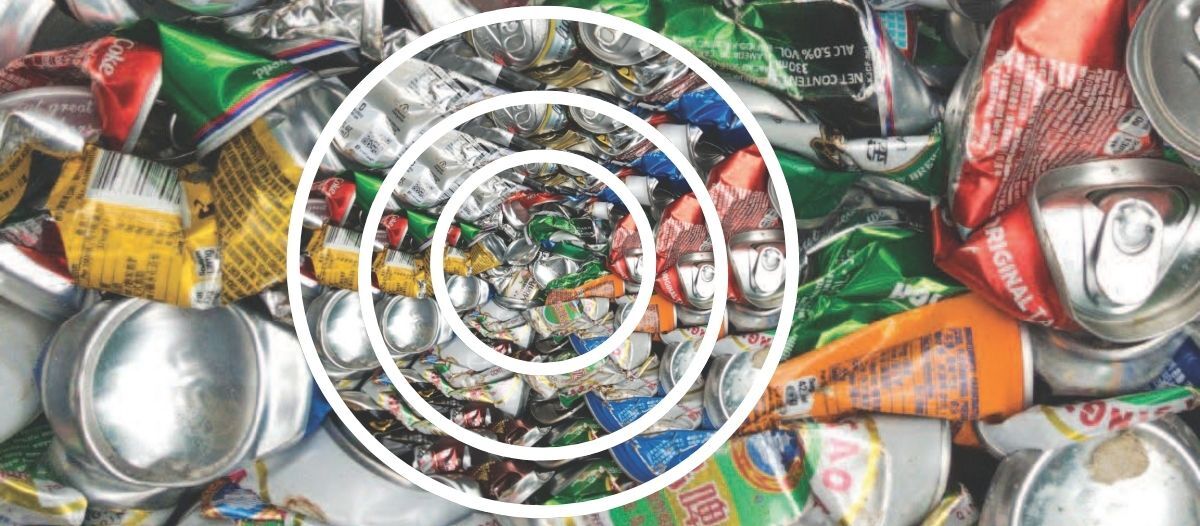
What goes around, comes around. For those people with a philosophical bent, or are fatalistic, this could mean karma, kismet or fate. They might believe people get what they deserve in the end, whether it be good or bad. It is a concept known as predeterminism.
Everything isn’t always written in the stars. In facility management there are multiple opportunities to initiate cycles to accommodate give and take. In waste management, applying the three R’s — reduce, reuse, recycle — creates a recursive loop for materials, bypassing landfills and ocean clutter. Trash avoidance policies, rethinking the use of materials or minimizing the amount of materials brought into a facility can help mitigate the amount of waste generated and contributes to a circular economy. In a circular economy, we develop a way to use materials in a secondary capacity. This takes materials past their first, intended use and extends their value in a new cycle while diverting them from the refuse pile.
Circularity
Circularity is front-of-mind for many people. Consumers increasingly choose businesses that are reducing the impact of their products on the planet. Companies are responding by taking a close look at the end of use and product life cycle of their services and optimizing resource use. It is an aggressive undertaking because circularity is not just about diverting waste at the end of a product’s life. It is also about focusing on more sustainable design at the beginning of product life, such as incorporating recycled content or using modular design principles.
The traditional linear economy has a make, use, dispose model of production. In a circular system, resource input and waste are minimized through efforts of redesign. Practices that entail preventive maintenance, repair, reuse or refurbishing of materials and, finally, recycling, all lead to less burden on the environment. A circular economy does not mean a drop in the quality of life for consumers. It can be achieved without loss of revenue or extra costs for manufacturers.
Circular business models can be as profitable as linear models. Looking beyond the current take-make-waste extractive industrial model, a circular economy aims to redefine growth by focusing on positive, society-wide benefits. It entails gradually decoupling economic activity from the consumption of finite resources. Supported by the transition to renewable energy sources, the circular model builds economic, natural and social capital. It is based on the principles that waste and pollution can be designed out of products, while keeping those products and materials in use, and it works on regenerating natural systems.
The notion of circularity has deep historical and philosophical origins. The idea of feedback, of cycles in real-world systems, is ancient and has echoes in various schools of philosophy. With current advances, digital technology has the power to support the transition to a circular economy through virtualization, analysis, transparency and intelligence driven by data and experience.
There is a world of opportunity to rethink and redesign the way materials are used. Through a change in perspective, the supply chain can be redesigned. Products can be made to be reused while using renewable energy to power the system. With creativity and innovation, a restorative economy can be built and sustained in a circular economy.
Transitioning to a circular economy is more than adjustments aimed at reducing the negative impacts of the linear economy. It represents a systemic shift that builds long-term resilience, generates business opportunities, and provides environmental and societal cycles. Consumption happens in biological cycles, where food and biologically based materials are designed to feed back into the system through processes like composting and anaerobic digestion. These cycles regenerate living systems, which provide renewable resources for the economy. Technical cycles recover and restore products, components and materials through strategies like reuse, repair, remanufacture or (in the last resort) recycling.
Waste not, want not
There is a realization emerging in the global consciousness that waste is a wholly human construct. Much like the issues that are experienced with greenhouse gas emissions, mankind is solely to blame.
Closed-loop, waste-free resource management is captured in the precepts in biomimicry and the zero-waste initiative.
In nature, there is no waste. Every molecule goes through multiple configurations. Every organism or particle provides an environmental service during and after its life. When a plant dies, a community of organisms breaks down all the chemical compounds into other compounds and individual molecules, which are then used in other organisms. Everything is used, and there is no excess. This concept can be emulated by humans to evolve into a society where there is no waste.
Biomimicry is the imitation of the systems, elements and models of nature to serve as examples to help solve complex human problems. It is the science of implementing nature-inspired activities to create a better balance with the environment — to live in harmony with the natural world and cease producing negative global impacts. It is an approach to innovation that seeks sustainable solutions to human challenges by emulating nature’s time-tested patterns and strategies. When looking at sustainability, the only real model that has worked over time is nature. It has had 3.8 billion years of research and development on which to rely.
In addition to being environmentally friendly, there are other incentives to warrant using biometric products and processes. Applying biomimicry provides the opportunity to do more with less, enabling more production and profit with less work and cost.
Zero waste is a goal that strives to encourage lifestyle change and new practices to aspire the replication of sustainable natural cycles. All discarded materials can be designed to become resources for secondary use. Zero waste means designing and managing products and processes to systematically avoid and eliminate the volume and toxicity of waste and materials, conserve and recover all resources, and not burn or bury them. Implementing zero waste will eliminate all discharges to land, water or air that are a threat to planetary, human, animal or plant health.
With the cost of waste disposal rising every year along with the green aspirations of customers, businesses large and small are looking to reduce the amount of waste they generate. In fact, achieving zero waste, or at least a component of it — zero landfill — has become a popular objective for businesses of all sizes and types. In the final analysis, achieving zero waste is a goal that encompasses much more than diverting trash to the recycling bin. However, diversion is still a perfect place from which to launch an initiative.
In either instance, whether it be biomimicry or zero waste, rethinking the very basics of activities throughout a product life cycle, from design and construction through consumption and disposal, should become a preferred business practice. Thought processes must migrate toward the question of which actions do more good, rather than simply thinking about what is less bad for the environment.
Challenges of recycling
Separating trash to be recycled has become ingrained in current society. In the United States, more than 34 percent of refuse is recycled, a gain of more than 400 percent since 1960. However, that percentage has not changed in almost two decades, and the U.S. has fallen far below other developed countries. There are other challenges on the horizon. Lower oil prices drive down profits in the recycling industry, as it becomes cheaper to create fresh plastic than it is to process, clean and recycle materials.
A crash in the recyclables global market is forcing communities to make hard choices about whether they can afford to keep recycling or should simply send all those bottles, cans and plastic containers to the landfill. Most are maintaining recycling programs but taking a financial hit as regional processors have raised rates to offset losses. Mountains of paper have piled up at sorting centers.
Cities and towns that once made money on recyclables are instead paying high fees to processing plants to take them: some are paying up to US$122 per ton for recycling, whereas last year they were paid US$16 per ton for the materials. The process is becoming financially unsound. Some financially strapped recycling processors have shut down entirely, leaving municipalities with no choice but to dump or incinerate their recyclables. There's no market. One owner of a plant that handles recyclables from about 30 communities at its sorting facility states they are paying to get rid of recyclables. He reports that 75 percent of what goes through the plant is worth from nothing to negative numbers now.
Despite the problems, recycling is here to stay. In addition to the environmental advantages and public support, many state laws mandate it. However, it must be done better, and as a last resort, after all other avenues of reuse and reconsideration have been exhausted.
Companies that produce goods are now accountable for the full life cycle of their products. The volume of waste they produce is substantial and costs have increased in parallel, particularly for waste hauling and disposal. Companies need ways to manage their product destruction in an economical and responsible manner. Achieving circularity is a critical goal for those companies that want to move from product-focused sustainability to a more comprehensive sustainable strategy.
Regeneration
Another facet of repurposing or reusing materials is called regenerative design. This is a process-oriented systems, theory-based approach to minimizing waste and can be described as the biomimicry of ecosystems. Its goal is to provide the ability for all human systems to function as a closed viable ecological and economics system for all industries.
The term regenerative describes processes that restore, renew or revitalize their own sources of energy and materials. It creates sustainable systems that integrate the needs of society with the integrity of nature. It is an arrangement that produces absolute efficiency used for sustainable development. The concept behind regeneration is one in which all waste products of one group can be used in the same or in different systems with zero loss of input and output. It becomes self-sustaining.
Rather than taking a managerial approach to nature, regeneration promotes a partnered relationship between humans and natural systems — building social and natural capital rather than diminishing them. It offers a positive framing of environmental issues that both inspire and create thinking points that could lead to transformative practices. The concept has undergone serious scrutiny when judged against issues such as the social and environmental equities that are key to sustainability and it has proven to be a viable tool.
The circle game
The circular economy initiative uses several sustainability procedures to validate certain attributes of processes and products today, including standards that validate recycled content, recyclability, bio-based content and waste minimization leading to zero waste to landfill.
The initial focus of program measurement should be on investigating characteristics or activities that evince the reinvention of materials throughout the supply chain instead of the disposal of products in a landfill.
Plans are made and then life happens, sometimes spoiling intent or forcing a shift in focus. However, plans can be made and then life helps, fueling thought and innovation based on examples provided by nature. The annual shift in seasons points to one of the many cycles in nature. How the flora and fauna react and adjust to such change teaches adaptability and sustainability. Winter signifies finality, yet spring delivers rebirth. The end of some things leads to the genesis of others. Failures in nature are fossils, and life goes on.
Adopting circularity as a common practice based on the natural cycle of things, for both materials use and conservation, should be part of future thinking. After all, a line ends somewhere — a circle just keeps going around.
Bill Conley, CFM, SFP, FMP, LEED AP, IFMA Fellow, is a facility manager at Yamaha Motor Corp. in Cypress, California, USA. He previously served as owner and chief sustainability officer of CFM2, a facility management company. Conley has more than 40 years of experience in the facility management profession and has been a proponent of sustainable operations for more than 20 years. Conley has served on the IFMA board of directors, is a recipient of IFMA’s Distinguished Member of the Year award and has received the association’s Distinguished Author award three times. He has been a regular contributor to FMJ for almost 30 years and has authored more than 100 FMJ articles.
References
Top image via Getty Images.
Read more on Sustainability and Leadership & Strategy or related topics Strategic Planning , Materials and Consumables , Sustainable Facility and Waste
Explore All FMJ TopicsRelated articles
-
Smart Building Control Systems
The foundation for a grid-interactive buildingBy Andre Marino09.25.2024 -

Smart Building Innovation
Cutting costs & carbon footprints without compromiseBy Andrew Butterworth09.12.2024 -
Chart the Path
Building sustainable cities & a sustainable futureBy Izzat Ali Khan & Aykean Forde12.16.2024
