
 Membership
 Network
 Regional Sites & Affiliates


 Events
 Participate
 Resources

 Training
 Credentials
 Government


 Content Channels
 Tools
Tools


 Business Overview




The Contract in the Filing Cabinet
The water contract nobody audits
Somewhere in most commercial buildings is a water service agreement that nobody remembers signing. A predecessor negotiated it. It renewed automatically at least once. Then it went into a file. The equipment works. The invoices get paid. Nobody asks questions.
Until something changes. A contaminant standard shifts. A tenant complains about taste. A budget review reveals that the building spends more on water delivery, and its coordination, than anyone had counted.
Water service agreements are among the least audited vendor contracts in FM, not because they lack financial weight, but because they rarely fail visibly. A failed chiller is an emergency. A lapsed security contract is a liability. Water equipment tends to run quietly, and the governing agreement stays outside the vendor review cycle for years at a time. What accumulates inside that quiet is the reason to open the file.
Why water contracts escape scrutiny
Three patterns recur across building types and regions.
Inherited terms that no longer fit the building. An agreement signed five years ago reflected the occupancy level, regulatory expectations and tenant expectations for that year. Automatic renewal preserves those terms whether or not any of the three still hold. Occupancy numbers tend to substantially fluctuate between signature and renewal, in both directions, without triggering any review of the service scoped against it.
Administrative costs that never appear as a line item. Delivered bottled water carries labor that no invoice itemizes: scheduling deliveries, monitoring stock, managing storage, fielding complaints and processing invoices. These costs are real, but they are building-specific, which makes them a poor candidate for a borrowed industry average. They are better calculated than assumed. A defensible figure comes from tracking staff hours spent on water logistics across a representative month, multiplying by the loaded hourly cost of that work, and annualizing the result. Storage is valued the same way, at the building’s own cost per square meter or foot. A number derived from the building’s own operations survives a budget review. A vendor’s generic estimate does not.
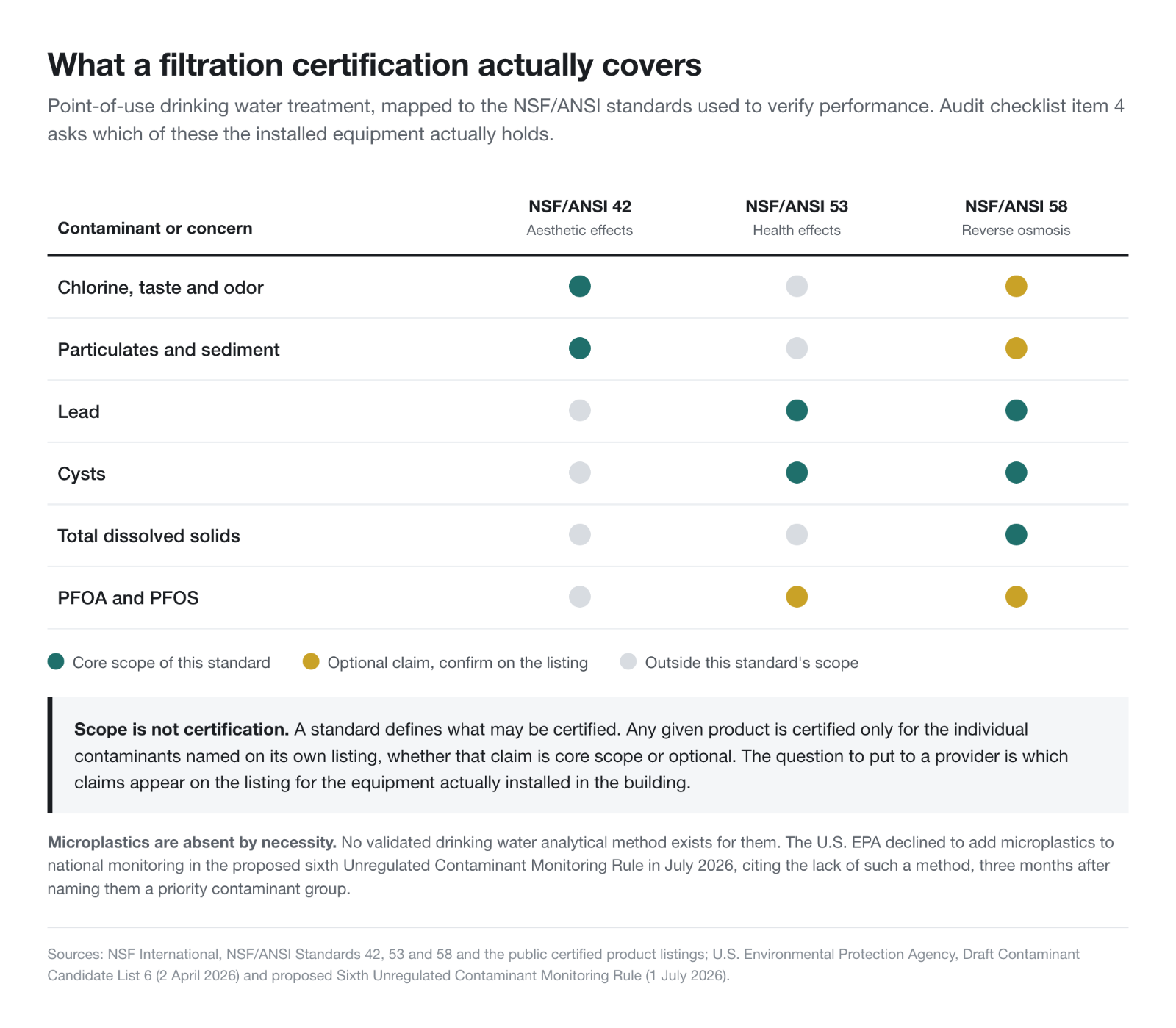
Filtration specified against an older standard. Equipment installed years ago was specified for the contaminants of concern at the time. A system specified for aesthetics addresses taste, odor and particulates, which are the actual occupant complaints, and carries no verified claim against dissolved contaminants such as lead or per- and polyfluoroalkyl substances (PFAS). Reduction of those depends on equipment certified for that specific claim, a different question from the technology installed. Nothing about the equipment will announce the gap because it is performing exactly as specified.
A regulatory picture moving in two directions
The common framing is that drinking water standards are tightening everywhere. The more accurate picture, and the more useful one for planning, is that they are diverging.
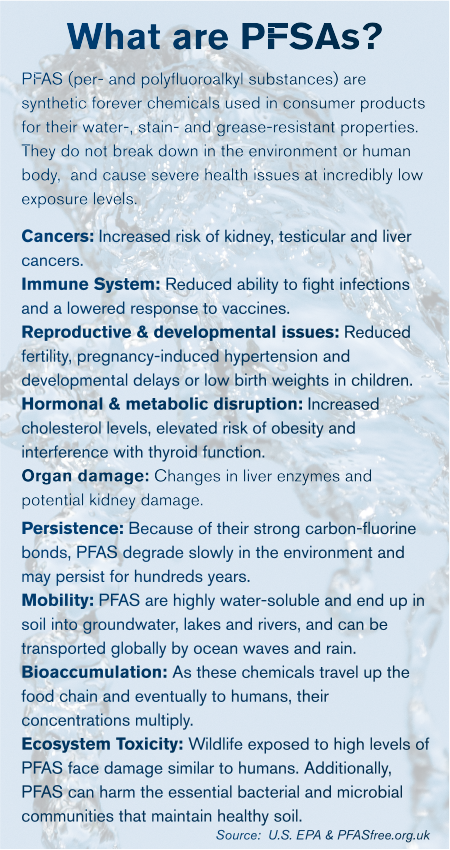 PFAS sit at the center of it: a large class of synthetic compounds widely described as “forever chemicals” because they resist environmental breakdown. The European restriction proposal alone covers more than 10,000 of them.
-
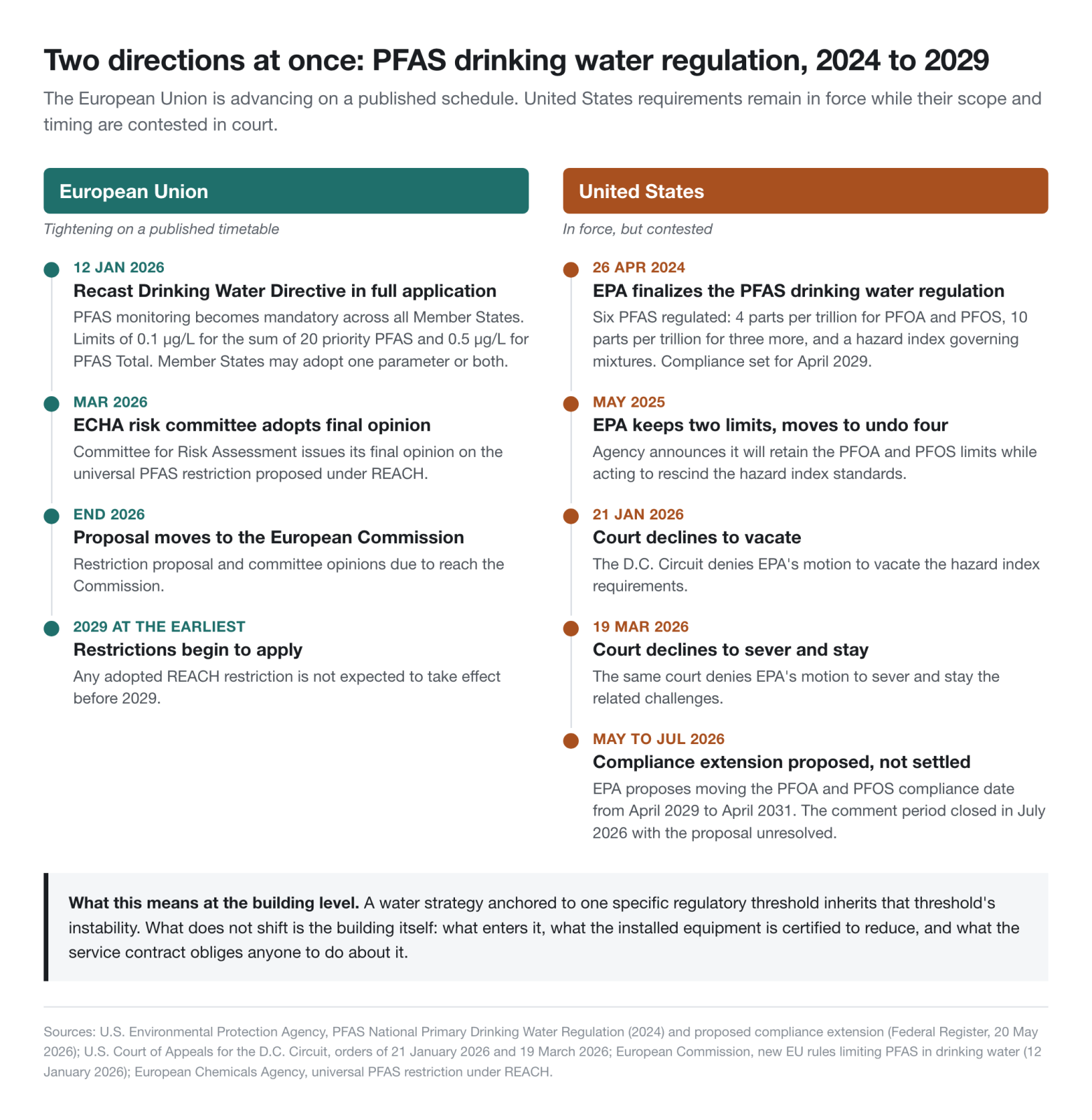
In the European Union, the direction is consistently toward tighter limits. The recast Drinking Water Directive came into full application in January 2026, making PFAS monitoring mandatory across all member states, with limits of 0.1 micrograms per liter for the sum of 20 priority PFAS compounds and 0.5 micrograms per liter for PFAS Total.
-
In the United States, the same period produced contest rather than consolidation. The EPA finalized enforceable limits for six PFAS in April 2024: 4 parts per trillion for PFOA and PFOS, 10 parts per trillion for three others, and a hazard index governing mixtures. In May 2025, the agency announced it would retain the PFOA and PFOS limits while moving to undo the standards for the other four. That effort has not succeeded: the U.S. Court of Appeals for the District of Columbia Circuit declined to vacate those requirements in January 2026 and declined to sever and stay the related challenges in March 2026, leaving the original obligations in force while the litigation continues. Separately, a proposal to extend the PFOA and PFOS compliance deadline from April 2029 to April 2031 remained a proposal through its comment period in July 2026, which means the earlier date remains in effect until a final rule says otherwise.
The next tier of contaminants shows the same split between intent and instrumentation. The EPA’s draft sixth Contaminant Candidate List, published in April 2026, named microplastics and pharmaceuticals as priority contaminant groups for the first time in the list’s 30-year history, with finalization expected in November 2026. Three months later, the proposed sixth Unregulated Contaminant Monitoring Rule declined a petition to include microplastics in national monitoring, on the grounds that no validated analytical method exists to measure them reliably in drinking water. Regulators have identified the concern well ahead of their ability to measure it.
-
Australia, Canada, South Korea and other jurisdictions have revised PFAS advisory or enforceable levels over the same period, on their own timelines and thresholds.
For a facility manager, the practical conclusion is not that one jurisdiction has it right. It is that the numbers are unsettled, in several cases actively contested in court, and that a building strategy anchored to a specific threshold inherits that instability. What does not shift is the building itself: what enters it, what the equipment installed in it can reduce, and what the contract governing that equipment obliges anyone to do about it. Those are auditable today, without waiting for a regulatory certainty that is not arriving on any published schedule.
 A 10-point water contract audit checklist
The following applies regardless of geography, building type or current provider. Every item can be answered from the building’s own vendor files or by putting the question to the incumbent provider in writing.
1. When does the agreement expire & what are the renewal terms? Many water service agreements renew automatically for 12 to 36 months unless cancellation is submitted within a defined window, commonly 60 to 90 days before expiration. If nobody can state the renewal date, the agreement has almost certainly renewed unexamined at least once.
2. What does the service cost in total, including labor & administration? The lease or delivery fee is the visible portion. The calculation described earlier, staff hours and storage valued at the building’s own rates, produces the rest. The gap between budgeted and total cost is often the most persuasive output of the audit.
3. How many filtration stages does the installed equipment use? This question is diagnostic, and it is often the one that cannot be answered from existing records. Sediment and carbon stages address aesthetic concerns. Reduction of dissolved contaminants generally requires additional stages, which may include a reverse osmosis membrane.
4. Which contaminants does the installed system address & which does it not? Request the specific certifications for the equipment in the building. Under the NSF/ANSI standards used internationally, Standard 42 covers aesthetic effects such as taste and odor, Standard 53 covers health effects including lead and cysts, and Standard 58 covers reverse osmosis performance. A provider unable to produce certification documentation has answered the question.
5. When was water quality last tested at the point of delivery? Not at the municipal source, where compliance is the utility’s obligation, but at the tap or dispenser where occupants actually drink. Testing belongs on a recurring schedule, not only at commissioning.
6. What service level does the agreement actually commit to? Response times vary from 24 hours to several weeks. An agreement with no defined service level for filter changes, equipment failures or water quality complaints leaves the FM without leverage when it is needed.
7. Are filter change intervals documented & enforced? Filter media has a finite service life, and a carbon stage performing to specification in its first month may be exhausted well before its scheduled replacement. Without a verifiable replacement record, the building cannot demonstrate that its filtration performs as specified.
8. Does the arrangement align with the organization’s sustainability commitments? Point-of-use dispensing displaces single-use plastic containers at volumes that become material across a portfolio. Where an organization has ESG commitments or tenant-facing sustainability targets, the water service arrangement is measurable against them and is often overlooked in that reporting.
9. Does the service model still match occupancy? Delivered water that suited 50 occupants introduces different logistics at 200. A dispenser sized for a small floor may be undersized after a fit-out. Occupancy change is the most reliable trigger for a service model review and is the most commonly missed.
10. Was the agreement competitively bid or inherited? An agreement carried forward without evaluation against alternatives is, by definition, unaudited. Testing the market does not oblige anyone to change providers. It establishes whether the current arrangement remains defensible, a more useful thing to know.
 Moving from checklist to action
A water contract audit is not a capital project. Most of the required inputs already exist: the agreement, 12 months of invoices, equipment documentation and occupancy records. The questions above can be worked through in an afternoon; and the two that usually cannot be answered immediately, filtration stages and certification coverage, are answerable by written request to the incumbent provider.
In many buildings the audit will conclude that the service is sound and the terms are fair. That conclusion has value, because it is documented rather than assumed, and it gives the next FM something the current one did not inherit. In others it will surface a gap: filtration specified against superseded expectations, administrative cost that was never quantified, or terms that stopped matching the building several renewals ago.
Leaving the file closed is the only option that produces no information at all. An agreement that renews without review, equipment whose performance is unverified, and water quality resting on decisions made by someone who left years ago is not a neutral position but an unexamined one.
The water contract in the filing cabinet is a vendor agreement, an infrastructure decision and a statement about how the building treats the people inside it. It merits the same scrutiny as every other system the facility manager is accountable for.

Joseph Savino leads brand and marketing strategy at HYDR8, a workplace water and break room services company serving the New York and New Jersey metropolitan region. His work sits where building operations meet vendor contracts, much of it spent helping facility and operations teams understand what their existing water service agreements actually commit them to. He follows drinking water regulation closely, particularly how shifting contaminant standards in the United States and Europe translate into decisions at the building level.
References
U.S. Environmental Protection Agency, “Draft Contaminant Candidate List 6,” 2 April 2026.
European Commission, “New EU rules limit PFAS in drinking water,” 12 January 2026.
NSF International, NSF/ANSI Standards 42, 53, and 58 for point-of-use drinking water treatment.
Top image via Getty Images.
Charts courtesy of the author.
Read more on Finance & Business and Facility Operations or related topics Operational and Capital Budgeting , Supplier or Vendor Management and Contract Administration
Explore All FMJ Topics