Membership
 Network
 Regional Sites & Affiliates


 Events
 Participate
 Resources

 Training
 Credentials
 Government


 Content Channels
 Tools
Tools


 Business Overview





The Cornerstones
How a woman’s perspective shapes & sustains organizational transformation

Many transformations are built on a technology fallacy: the belief that data and AI alone drive success. In reality, transformation depends on something far less visible. It relies on employees, many of them women in back-office and support functions who hold deep operational and institutional knowledge essential for execution. Yet these contributions are not always adequately supported through workplace design and employee experience, limiting organizations’ ability to sustain long-term transformation success.
The hidden reality behind transformation success
A successful transformation is not always what it appears to be. On the surface, transformation may be perceived as successful if its strategic targets are achieved, whether through outcomes such as efficiency gains or cost reduction. However, beneath these outcomes lies a critical question: whether transformation is aligned with the realities of day-to-day work and how it affects the people on the ground responsible for sustaining it.
The statistics are sobering. A recent survey by McKinsey shows that roughly 70 percent of transformation efforts fail. A Gartner study found that only 48 percent meet or exceed their targets. In many of these cases, failure has little to do with strategy and everything to do with how organizations engage and enable their people.
 In many cases, employees struggle to connect with transformation strategies. Leaders may focus heavily on technology, processes and efficiency, while underestimating how change is experienced on the ground, misreading silence as alignment and overlooking early signs of resistance. More critically, there are cases in which employee well-being and workplace conditions are not adequately considered, particularly for women balancing professional responsibilities alongside caregiving and workplace expectations.
The implications are significant. Globally, failed transformation efforts cost organizations an estimated US$2.3 trillion per year. This is particularly relevant in markets such as Singapore and Saudi Arabia, where transformation is not only an organizational priority but part of a broader national agenda. In such contexts, organizations — especially banks — are viewed as strategic national instruments with state-adjacent responsibility in ensuring women’s participation is not merely an organizational priority, but a critical requirement for long-term transformation success.
Lessons from Singapore & Saudi Arabia: Women in transformation
Traditionally, across periods of revolution and transformation, women have often operated behind the scenes. Yet their contributions have been so profound that they can determine whether institutions and transformation efforts ultimately succeed or fail. Despite this, much of their role remains overlooked or unaccounted for within the transformation story itself.
A closer look at transformation efforts in both Singapore and Saudi Arabia reveals a common pattern: women are not merely participants in transformation; they are among the people shaping and sustaining it.
In Singapore’s banking sector, women are not simply recipients of transformation initiatives, but active contributors to their execution and success. Female employees are heavily represented in operational and support functions such as operations, call centers, branches, middle office and sales support. These roles are deeply embedded within the operational core of organizations and are often considered the engine that keeps day-to-day operations moving forward. Through years of operational experience, many employees develop deep institutional knowledge of legacy systems, operational processes, customer behavior and business cycles. In transformation programs involving automation, process re-engineering or technology modernization, this knowledge becomes foundational, as successful implementation often depends on employees who understand how work is performed on the ground.
A similar shift can be observed in Saudi Arabia, where national transformation efforts under Vision 2030 have accelerated women’s participation in the workforce and broader economy. Women have become an increasingly important part of the Kingdom’s transformation agenda, representing a significant and previously underutilized talent pool. Female labor force participation reached 35.4 percent by the third quarter 2024, surpassing the original target of 30 percent. Women now constitute 43.8 percent of small and midsize enterprises, and hold more than 43 percent of senior leadership positions across various sectors.
From the examples in Singapore and Saudi Arabia, the role of women in transformation is therefore not merely supplementary; it is a strategic necessity.
Workplace & well-being: The missing layer in transformation
If women are central to transformation, then what is holding them back from staying in the workplace or progressing into leadership roles compared with their male counterparts? Have organizations provided enough training programs, mentorship and clear career pathways to support women in their professional careers?
The reality, however, is far more nuanced.
According to McKinsey’s 2025 Women in the Workplace study, there is, for the first time, a notable ambition gap: women are less interested in being promoted than men. Other workplace and well-being surveys, including Gallup, have also shown that mental health, well-being and work-life balance frequently rank as important priorities for women alongside career promotion.
This does not mean women lack ambition. For many women, career progression cannot be separated from the workplace environment, personal health, safety and caregiving responsibilities.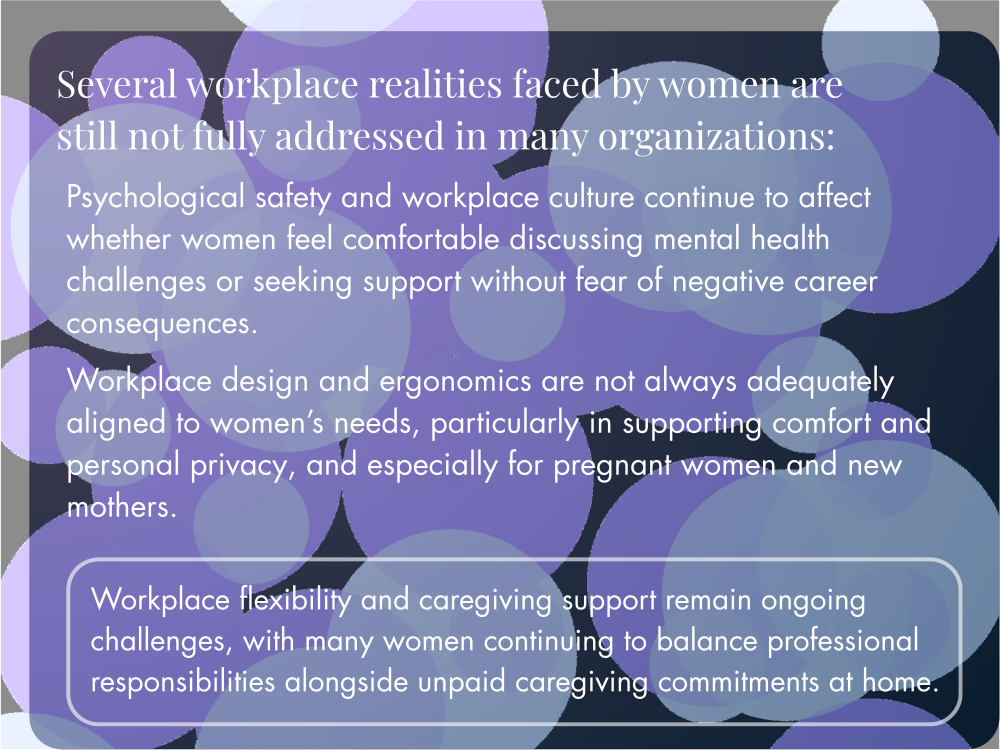
Women often face career penalties due to caregiving expectations and workplace structures designed around uninterrupted, traditional career paths. These challenges cannot be solved through mentorship, training or career pathways alone. They require organizations to treat workplace strategy and employee well-being as part of the core business strategy for sustaining transformation success.
Embedding workplace strategy into transformation
First and foremost, before developing a workplace strategy, leaders must understand the broader strategic objectives of their organization.
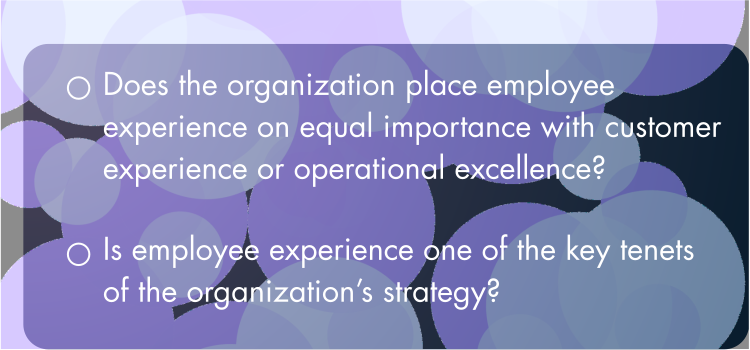
These questions are critical because they shape the culture of the organization and how leaders view employees either as operational resources or as the cornerstone of organizational success.
Secondly, organizations need to clearly define what workplace experience means. Workplace experience is a critical component of the broader employee experience, shaped by the physical, digital and psychosocial work environment, and by how effectively it enables people to perform, collaborate, feel included and thrive at work. Creating inclusive workplace experiences is not only an employee issue, but also a business and transformation imperative. While workplace priorities may vary across organizations, this alignment is essential for effective workplace strategy execution.
Thirdly, organizations need to assess the maturity of their workplace environment. Workplace surveys are a useful starting point, providing direct employee insights into workplace satisfaction, work patterns and areas requiring improvement. These insights also help organizations shape future workplace strategies.
Fourth, organizations should establish a workplace employee journey similar to a customer journey framework. This involves mapping the workplace touchpoints employees experience throughout the working day, from health, safety and security to workplace support services such as facility maintenance. The objective is not only to improve operational efficiency, but also intentionally design workplace experiences that better support employees. Organizations should also establish clear workplace design guidelines to maintain consistent workplace experience across different offices and operational locations.
Lastly, leaders should foster inclusion by encouraging women to contribute to workplace strategy and workplace surveys. Incorporating women’s perspectives helps ensure workplace initiatives address real day-to-day workplace needs and better support long-term transformation success.
Transformation: Bridging workplace strategy & execution
This is where transformation plays a critical role in bridging the gap between workplace strategy and the execution of workplace initiatives. Together with HR, corporate real estate (CRE) and IT, transformation functions can help translate workplace insights into practical initiatives structured around several core themes that directly support women in the workplace.
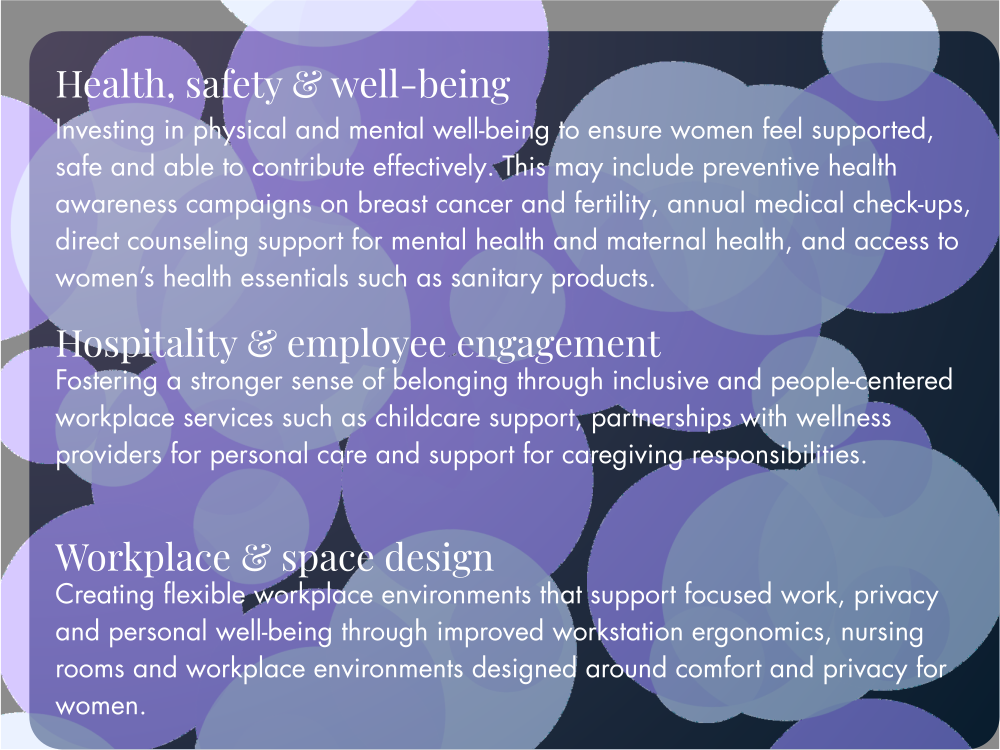
Organizations do not always need significant investment to improve workplace experience. In many cases, small but intentional workplace initiatives can make a meaningful difference in supporting women’s well-being, workplace participation and long-term contribution to transformation success.
Conclusion
Deeper consideration is needed to address the workplace realities faced by women, particularly those in back-office and support functions whose contributions are often less visible, yet critical to transformation success.
While transformation scope is frequently centered on technology implementation, automation or financial outcomes, organizations must also recognize the broader challenges women face in balancing professional responsibilities, workplace expectations and caregiving commitments. Workplace strategy, employee well-being and inclusive workplace design are not peripheral considerations, but important enablers of sustainable transformation success.

Nadhir Hassan is a transformation leader with over 10 years of experience driving large-scale business, operational, and digital transformation initiatives for leading banks in Singapore and Saudi Arabia. He currently serves as Shared Services Transformation Lead at Saudi Awwal Bank (SAB), where he leads strategic transformation programmes focused on operating model redesign and workplace transformation. He holds an MBA from Manchester Business School.

Kati Barklund is a global workplace strategist and transformation leader with more than 25 years of experience advising organizations on workplace and FM strategy. She serves as Global Chair of IFMA's Workplace Evolutionaries (WE) Community and is a recognized advocate for human-centered, sustainable and business-aligned workplace strategies that enable people and organizations to thrive.
References
Top image via Getty Images.
Read more on Workplace , Emerging Topics and Leadership & Strategy or related topics Occupant Health , Wellness and Well-being and Team Management
Explore All FMJ Topics