
 Membership
 Network
 Regional Sites & Affiliates


 Events
 Participate
 Resources

 Training
 Credentials
 Government


 Content Channels
 Tools
Tools


 Business Overview





The Data Blindspot
Uncovering hidden workplace costs

It is impossible to ignore the rising costs of facilities and maintenance regarding commercial offices. JLL reports 84 percent of commercial real estate (CRE) and facility management leaders cite escalating operation costs and budget constraints as a top concern.
Several factors impact facilities and maintenance costs. Those overseeing offices are quick to point to hybrid workforce schedules, erratic foot traffic and skewed building occupancy as the primary drivers.
Yet what is it about these workforce shifts that is sneakily undermining facilities management? This question prompted a recent Wakefield Research survey of more than 400 FM decision-makers. Here are some of the key data findings.
-
24 percent of office space that is under or unoccupied is regularly cooled and heated.
-
47 percent of decision-makers have recently postponed or canceled investments aimed at improving energy management.
-
66 percent of maintenance teams clean all areas of the building with the same frequency regardless of actual use.
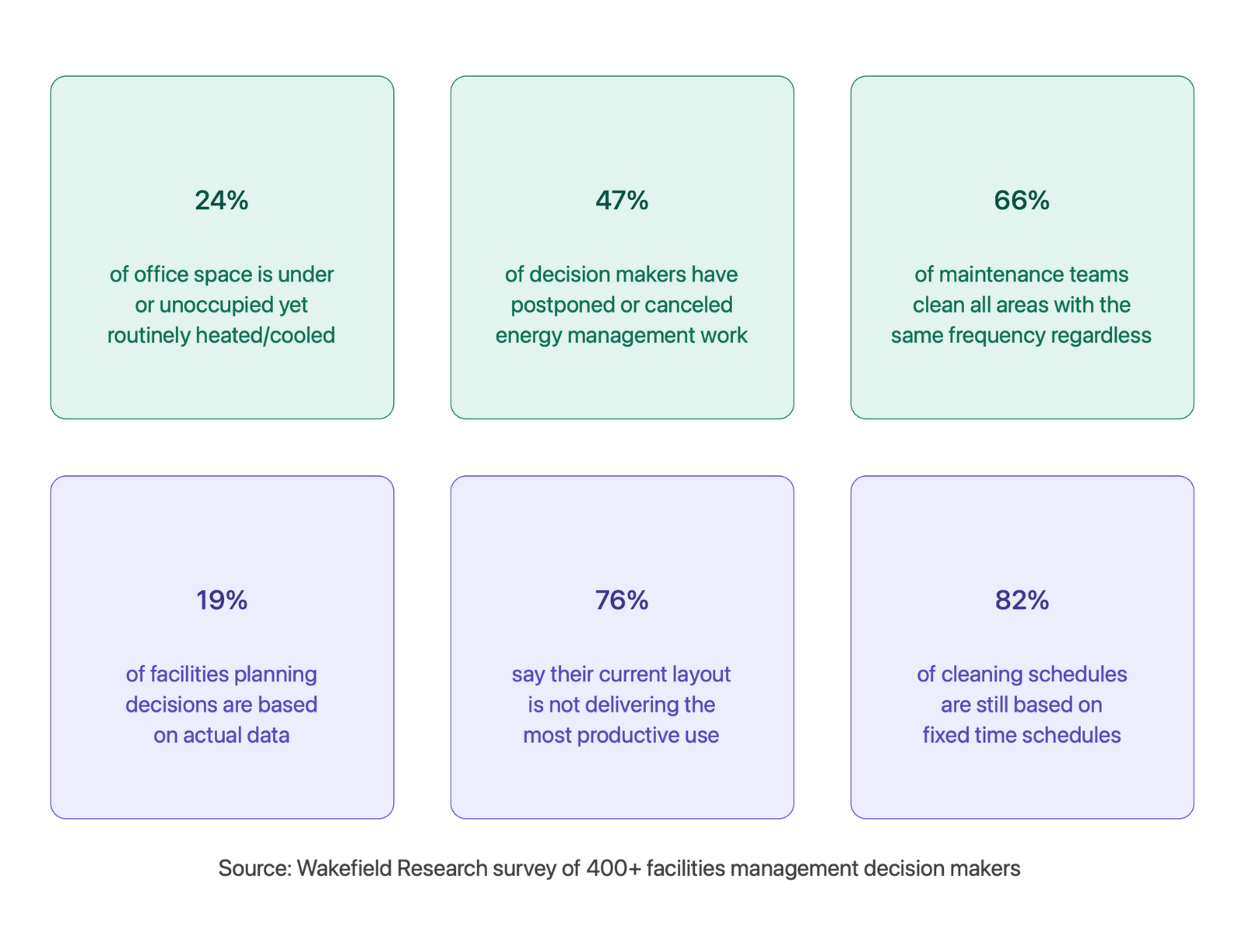 The survey results reveal how a lack of data on office usage has a significant ripple effect on facilities management, maintenance and planning. It also indicates that traditional office cleaning processes based on fixed schedules have not kept pace with shifts in the workforce.
The knowledge blind spot explains why only 19 percent of facility planning decisions are based on data, according to the survey. The rest of the decisions are based on gut instinct or simply following how things have always been done. It is time to rethink old patterns.
The impact of not understanding office usage
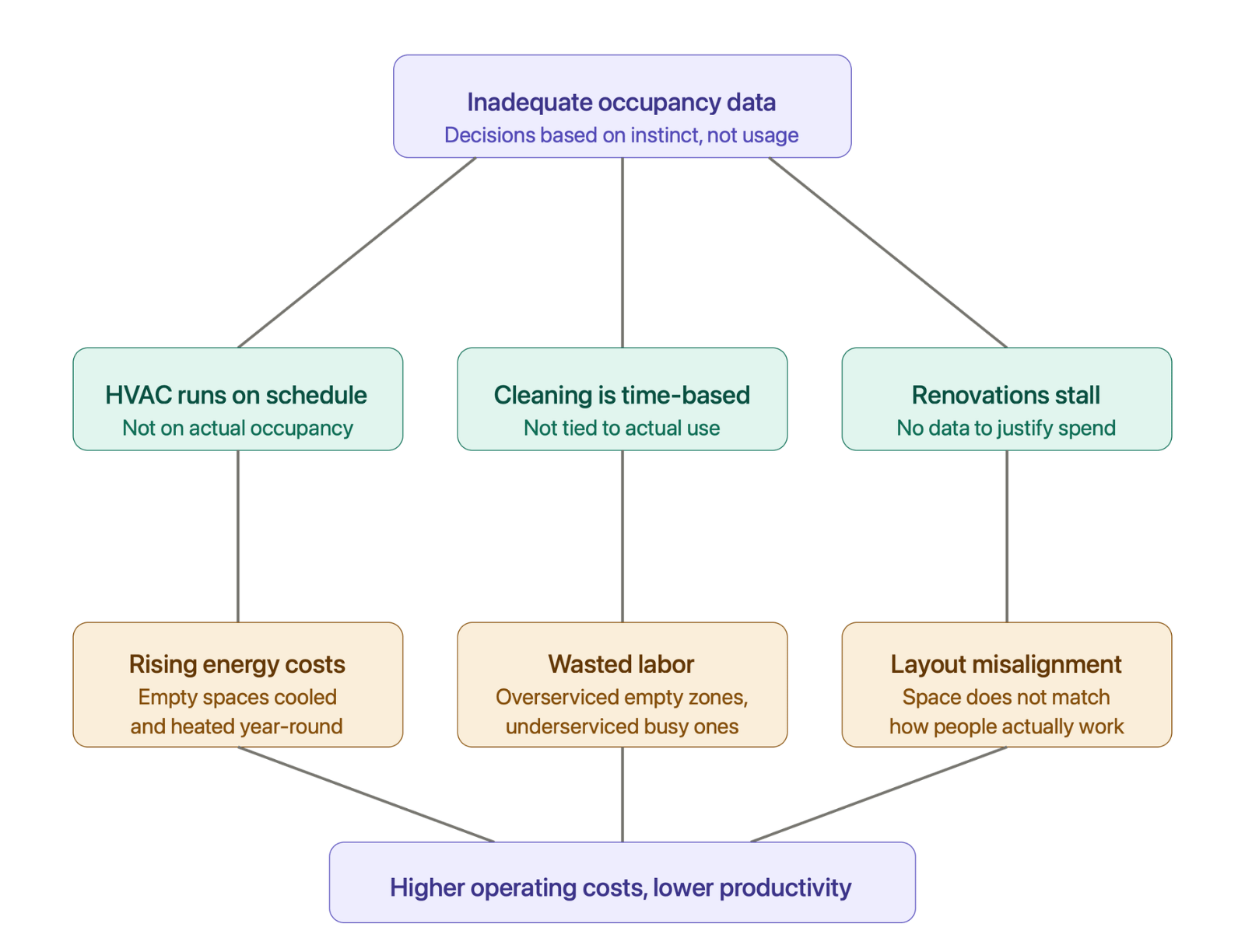
When facility managers do not have accurate insight into how the office is used, it increases costs in several ways. For example, the consistent cooling of under- or unoccupied spaces puts unnecessary strain on the HVAC systems at a time when electricity prices continue to rise.
Of note, a March report from JLL found electricity prices for commercial properties increased 33 percent from 2020 to 2025, and demand is expected to increase an additional 25 percent by 2030. Depending on the age of the building and its infrastructure, these numbers could go even higher.
 When a commercial property is leased to a variety of tenants, at best, it is difficult for FM teams to anticipate the influx of workers throughout the week. Even when office occupancy is full or nearly full, there is potential to inadvertently elevate energy and maintenance costs. This happens when employees use spaces for purposes beyond their original intent.
It is common for a team that cannot find an open conference room to take over a section of the cafeteria. Because 82 percent of cleaning spaces are still based on fixed schedules, according to the Wakefield Research survey, this impromptu employee huddle creates additional, unexpected work for the cleaning crew. Just as high office occupancy days can lead to underserviced areas, empty areas waste labor and supplies.
Another example is the individual on deadline that books a conference room for focused work. While the intention is rooted in productivity, the action inadvertently drives up building costs. The diligent employee in the conference room is not always aware the space is set to heat/cool a dozen people, not an individual. Over time, this unnecessarily strains systems while elevating the building’s carbon emissions.
When office space is not optimized, the workforce cannot be fully productive. This takes the form of erratic office attendance, more ad hoc meetings and less collaboration. It often leads to refined human resources policies and management mandates for full-time office attendance. Those rules may bring bodies back to the office, but they undermine productivity. What often gets overlooked is how the office is used and if the space, layout and design are aligned with the needs of the workforce and culture of the company.
Consider the more common gripes of RTO mandates are usually around an insufficient number of conference rooms, private work areas and dedicated brainstorming spaces. This feedback should not be dismissed. Buildings are like finely tuned instruments, and the FM needs real-time data on occupancy, foot traffic and overall usage by zone, down to a granular level. It requires understanding human movement in the office to get ahead of potential issues and spot trends over time.
This leads to more realistic maintenance and cleaning schedules based on usage, not time of day. It also allows for better insight into spikes in attendance based on time of day, week and year, as well as which area of the building the workforce is most active. This intel can be used to inform decisions about office layout and design.
It also reflects the Wakefield findings that nearly half of decision-makers report delaying or canceling construction and/or renovation projects due to the lack of data on how the space is being used.
Indecision is decision
Delaying or halting office redesign is understandable when considering the average global fit-out costs. JLL’s 2026 numbers estimate them to be US$205 per square foot. Yet one of the biggest gating factors in getting accurate data on office usage is the way it is captured. Cameras are easy to install but cannot go everywhere, create friction with employees and generate massive amounts of files that are costly to manage. They are overkill when the goal is to simply understand how a space is being used. Additionally, badge swipes and room reservation systems have obvious workarounds, impacting the veracity of the data.
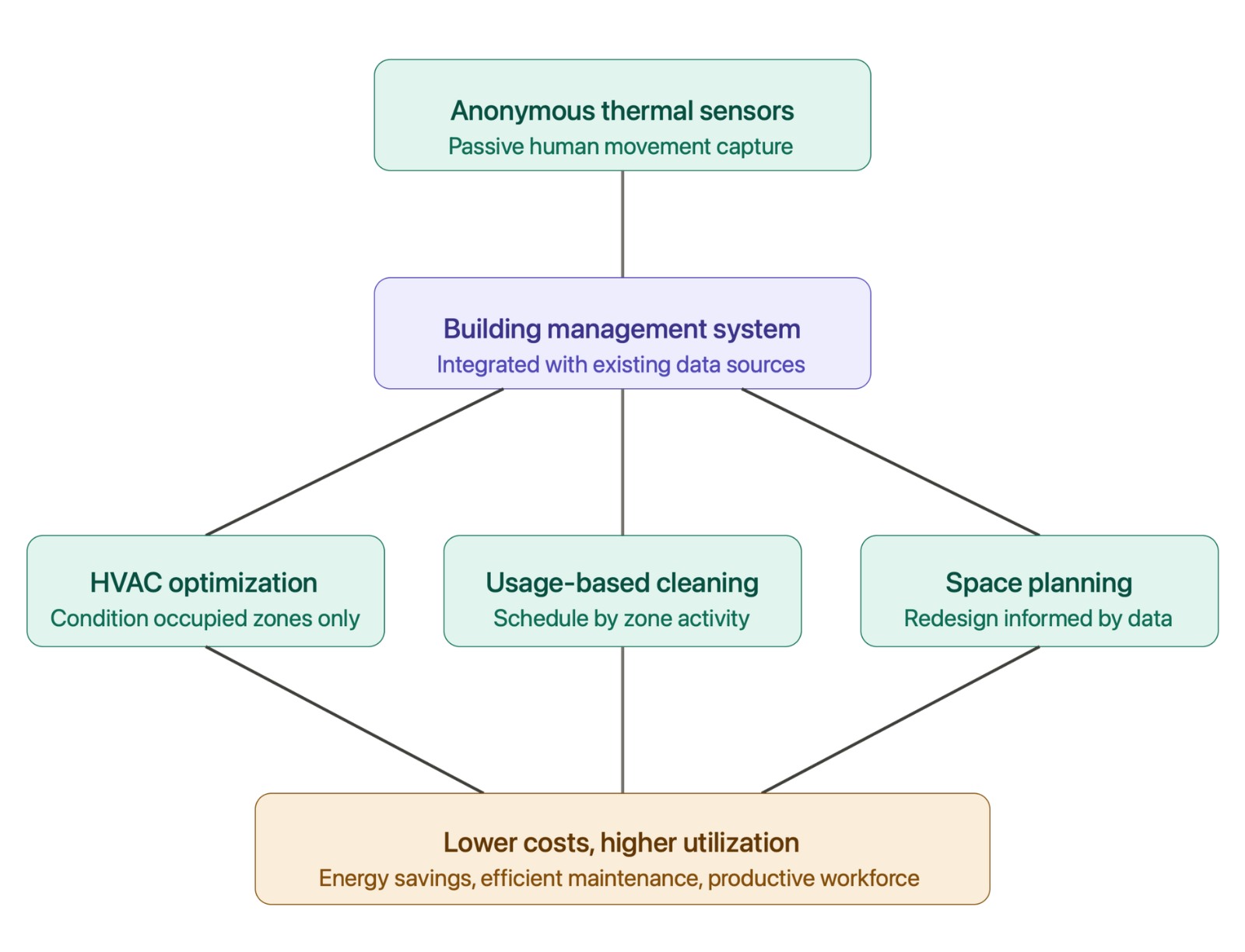
However, recent innovations in thermal design from MIT enable the capture of human movement in the office without the use of cameras or other identifiable information. This level of insight, when integrated with other building data sources, can make a big impact.
 Going beyond occupancy data to infer action
A large Silicon Valley software company was struggling with low office attendance, hovering around 15 percent, on average. When they enacted a return-to-office mandate, attendance was high until employees had one-on-one conversations with their managers explaining how they could not accomplish real work in the office. Within a few months, occupancy did not budge beyond 45 percent.
The company experimented with thermal sensors and within a few months, uncovered workforce habits that were not obvious yet explained why they were stuck at a low building utilization rate.
Aside from the usual behaviors of coffee badging, the company faced common issues of underutilized desks, overused conference rooms and not enough collaborative workspaces. This led to an office redesign and restructured maintenance schedules. Within a few weeks, attendance hit more than 90 percent. From a maintenance perspective, the company reports cost savings of approximately US$1,400 per restroom per year. When factoring in higher productivity and maintenance savings, the office fit-out costs were justified.
While the RTO push-pull between employees and managers has subsided, these rightsizing issues are becoming more apparent. It prompts employees to be less than fully committed, has a negative impact on the building, and creates discord that could be solved by adjustments to schedules and office layouts. This cannot be surprising to decision-makers when 76 percent report their current layout is not delivering the most productive use of office space based on the Wakefield Research findings.
 Optimizing building management & operations
Capturing passive data on office usage without disrupting the workforce helps FMs improve efficiency in their crews, the building and the tenant experience. Acquiring this data is easier when the FMs are employees of the building owner. For outsourced teams that support a multitenant office building, working with CRE stakeholders is critical for building optimization.
Yet this data cannot be the only source to support decision-making. When connected with existing building management tools, it presents a more comprehensive view of what is happening now and what is likely to happen.

Honghao Deng is CEO and co-founder of Butlr. He is a formally trained architect with a master’s degree in computational design from Harvard University.
References
Top image via Getty Images. Article graphics courtesy of Butlr.
Read more on Sustainability , Facility Operations and Finance & Business or related topics Financial Analysis , Sustainable Facility and Operations
Explore All FMJ TopicsRelated articles
-

Smart Building Control Systems
The foundation for a grid-interactive buildingBy Andre Marino09.25.2024 -

Smart Building Innovation
Cutting costs & carbon footprints without compromiseBy Andrew Butterworth09.12.2024 -

Chart the Path
Building sustainable cities & a sustainable futureBy Izzat Ali Khan & Aykean Forde12.16.2024
