Membership
 Network
 Regional Sites & Affiliates


 Events
 Participate
 Resources

 Training
 Credentials
 Government


 Content Channels
 Tools
Tools


 Business Overview





The Future of Workplace Experience
Tying it to business outcomes

For almost a decade, we have used sensors and software to understand how offices, conference rooms and entire workplaces are used. But the best sensors can offer is a snapshot of what was happening at a point or points in time in one a given place or set of places.
We’ve used surveys and focus groups as a way of capturing employee attitudes, likes, dislikes, wants, and needs. While these tools can offer great insights, low participation rates and survey overload can limit their value.
Recently, we’ve embarked on a mission to optimize the workplace experience. However, we struggle to measure our progress or tie it to business outcomes.
Using these traditional methods to prescribe workplace design and work practices is like trying to coach a football team when all you have to go on is a few game photos, interviews with a few of the players, and the ending score at their most-recent game. All that is about to change.
Sensors have become so small they're almost invisible, so cheap they're practically free, and so unobtrusive they're easy to forget. They’re increasingly embedded in the things we use and wear, and even in environments in where we live and work. These sensors talk not just to us, but with one another. When combined with other hardware and software, they can learn from experience, predict outcomes, prescribe solutions and even take corrective action.
If you think about this network of sensors as a kind of peripheral nervous system with the information they collect being stored in and analyzed by a virtual brain, you can begin to imagine where all this is going. Everywhere we go will all be connected. They will learn from us and we from them. They will respond in real-time, more accurately predict and prevent problems, and allow us to collect feedback from occupants without the risk of survey bias.
Software hardware and software solutions have taught us a great deal about where people work, what they do, and how they work best. We've learned that almost any type of workplace can be effective, if the occupants have a variety of spaces from which to choose. We can predict what size conference rooms are needed most, we can reduce maintenance costs by only cleaning the rooms that were used, and much more.
We’ve also made good progress in applying neuroscience to workplace design. We know individuals and teams need places for both contemplation and interaction if creativity and innovation are to flourish. We know that lighting can be used to alter our natural body rhythms. We know that playing a quick game can quickly build trust between strangers. And we know that exposure to nature can soothe the soul.
Wearables and other technologies already allow us to track location, sense movement, and detect whether the wearer is sitting or standing, working on a computer, or talking on the telephone. Sensor technologies are already able to provide information about who talks to whom, how often, how energetically they're speaking, whether they’re stressed, and even their gender and ethnicity. These and similar advances are helping us answer questions such as:
-
Are people collaborating more after a workplace change initiative?
-
Does the succulent wall improve air quality?
-
Is everyone in the meeting being heard, of just those with the biggest voices?
The critical question is whether the changes we make to our workplaces and work practices help attract and retain talent, increase productivity, foster creativity and innovation, reduce costs, boost revenue, or help achieve other business goals. This is where the real opportunity lies. If we expect to create workplace experiences that optimize outcomes, we need to correlate what the sensors and analytics tell us about how people perform in various environments with business results.
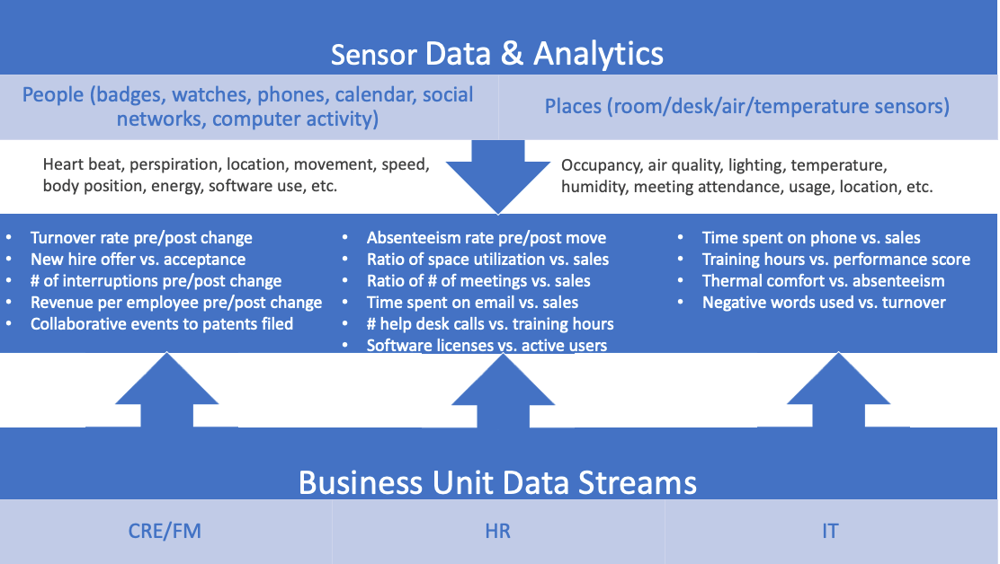
Creating the workplace experience: Today vs. tomorrow
The “Workplace Experience” is an amalgamation of every interaction a person has with the work they do, the people they work for and with, the places they work, the company’s brand, and more. It begins even before someone is hired based on all they have experienced with the organization as a customer, shareholder or observer. It never ends in some cases. Even after someone leaves, they will talk to other people, potential customers, vendors, and even perhaps reporters about their experience. Some may even return as contractors or employees.
FM/CRE, HR, IT and other organizational units are scrambling to enhance the employee experience, but they are primarily about removing barriers to success. They are reactive, rather than proactive. They address extrinsic, rather than intrinsic motivators—the ones that that have the biggest impact on employee engagement.
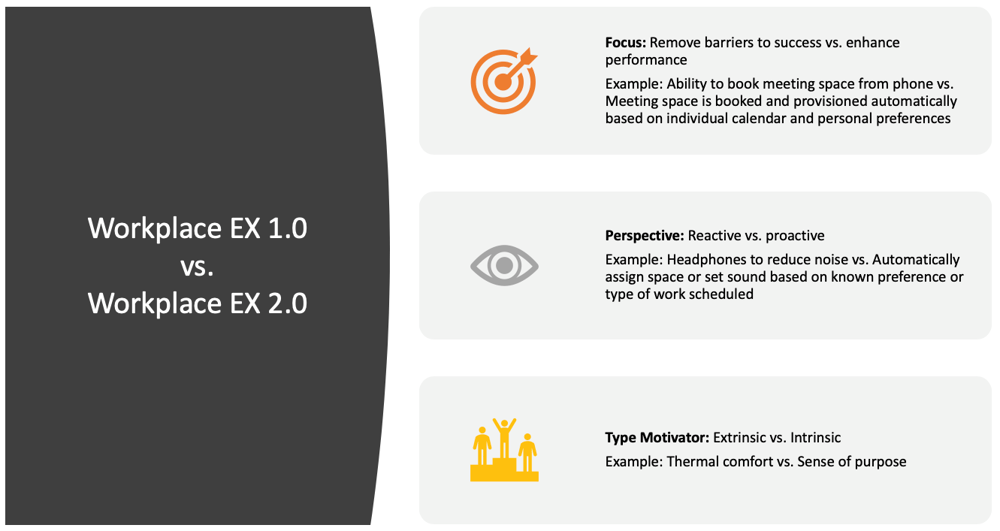 As new data sources emerge, existing ones are unlocked, and data streams are combined, we will finally be able to easily measure the impact of workplace change on business, and privacy notwithstanding, even personal outcomes. The primary focus for change initiatives will be to enhance performance. They will be proactive, rather than reactive and will foster intrinsic vs. extrinsic motivation.
The nervous system and virtual brain will grow in complexity as in more connections between sensors and data streams and knowledge from data analyzed over time and under different conditions. As it does, we will increasingly be able to develop insights not just about broad populations, but also by industry, job category, geography and much more.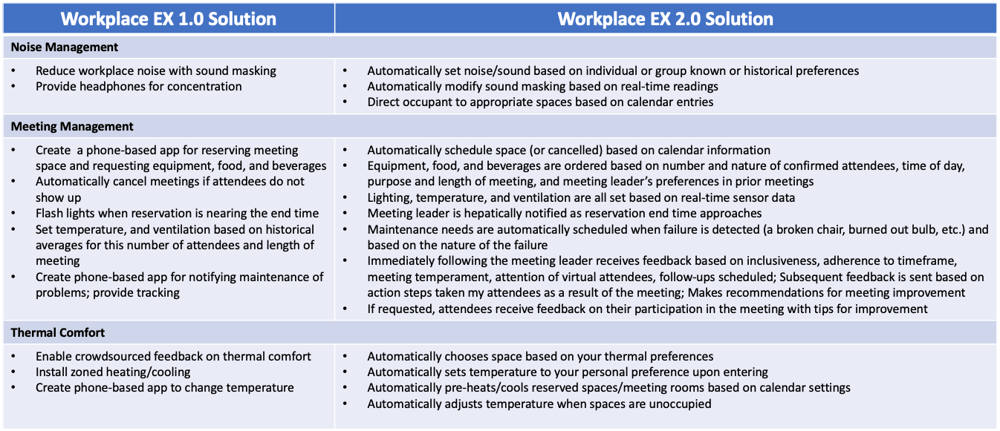
Let’s talk privacy
We live in an age where lights can hear, watches can record sleep patterns, and conference software can gauge attention levels. Employees blithely give up the right to privacy with a stroke of a pen their first day on the job. That means their online activity, phone conversations, location, and even keystrokes are fair game for employers to use as they like. Some countries have passed regulations to protect employee privacy, but in the U.S. and elsewhere, these protections do not exist or are easily waived, often unknowingly.
Interestingly, research shows employees are willing to share private data provided there’s something in it for them; it makes their job easier, provides a learning opportunity, or offers some other benefit. But any organization that cares about its reputation must be completely open and transparent about how the data will be used and protected, and include only those employees who have explicitly opted in.
A new game for a new decade
We still have much to learn about human behavior and motivation, about how people perform in various environments, and measuring outcomes in an age where brains, not brawn, create organizational value.
As employee privacy issues are resolved, new datasets will become available. They will include information about how people work, what frustrates/delights them, what work they should be doing more of or less of, where training is needed, and more. They will inform leadership of flight risks, manager effectiveness, and unwanted behavior. They will identify opportunities for outsourcing and in-sourcing. They will identify high-potential employees, reveal under-performers, uncover reskilling and upskilling opportunities and allow us to measure the impact of the workplace environment on an organization’s most important asset, its people.
Imagine a football coach who has every play ever played in his head, knows what his players will do almost as quickly as they do, and continually adjusts his strategy to keep every player performing at his peak. Welcome to Workplace EX 2.0—coming to a workplace near you.

Kate Lister is a recognized thought leader on trends that are changing the who, what, when, where and how of work. She is president of Global Workplace Analytics (GWA), a research-based consulting firm that has been helping public and private sector employers optimize the triple bottom line outcomes of remote and other workplace strategies for more than a decade. Lister is a member of Workplace Evolutionaires’ (WE) Leadership team and the curator of the WE:Brief.

Debra Moritz is the head of strategic consulting for Cushman & Wakefield, Inc. where she oversees an integrated delivery platform designed to improve client business performance by reducing cost, increasing revenue and mitigating risk. With more than 25 years of experience and a successful track record of advising business clients on the strategic management of their assets and portfolios, Moritz has developed an in-depth understanding of the complex and unique challenges businesses face in ensuring that major real estate decisions are aligned with and support core business objectives.
References
Top image via Getty Images.
Article charts courtesy of IFMA's Workplace Evolutionaries.
Read more on Workplace and Facility Technology & Data Management or related topics Workplace Utilization and Facility Technology
Explore All FMJ Topics